
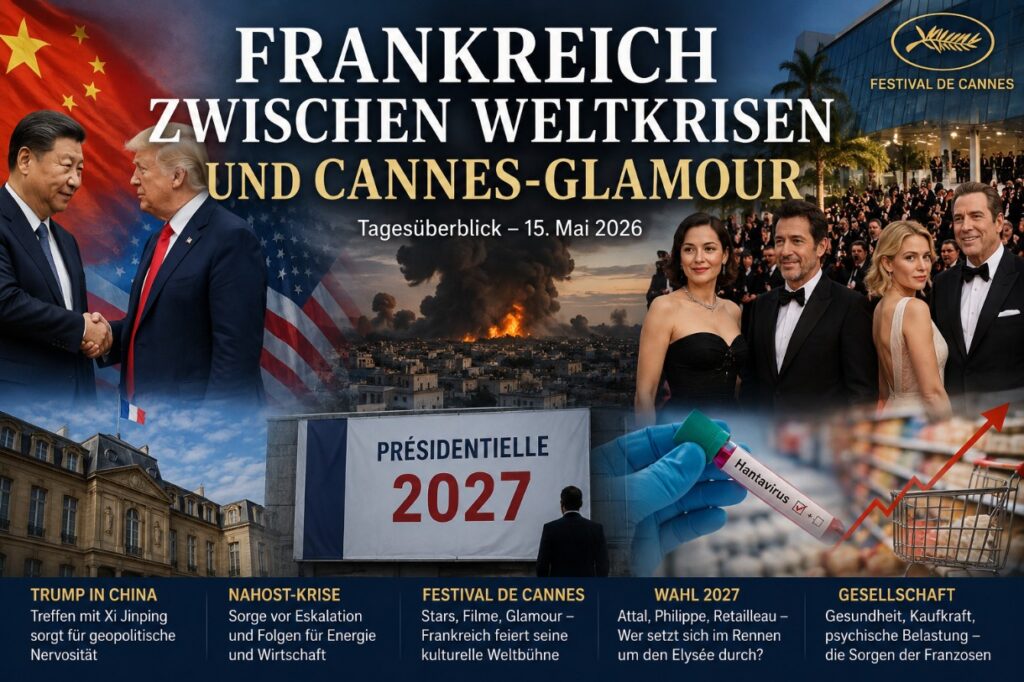
The French press experiences on 15 May 2026 a news day that is emblematic of the country’s current mood: international uncertainty, geopolitical nervousness and, at the same time, an attempt to maintain cultural normality. While foreign policy is above all dominated by the meeting between Donald Trump and Xi Jinping in the headlines, attention at home is increasingly turning to the 2027 presidential election. At the same time, the Cannes Film Festival produces those images of elegance and lightness that are traditionally perceived in France as a counterworld to crises and conflicts.
Trump and Xi: Fear of a New World Order
At the center of international reporting is the meeting between Donald Trump and Xi Jinping in Beijing. French leading newspapers analyze the encounter far less as diplomatic routine than as a display of power between two rival world orders.
The Taiwan question is being followed particularly closely. Xi Jinping has warned unusually openly of a possible military escalation, further exacerbating an already tense geopolitical situation. French commentators see this as an indication that China could increasingly be willing to assert its strategic interests more offensively.
In Paris concern is growing that Europe could lose influence in a bipolar world between Washington and Beijing. Several French analyses recall the debates of recent years about Europe’s “strategic autonomy” — a concept President Emmanuel Macron has been advocating since his Sorbonne speech in 2017.
The nervousness also has economic reasons. France’s industry remains heavily dependent on global supply chains. A deterioration of tensions in the Asia-Pacific region would not only destabilize world markets but could also have direct consequences for energy prices, inflation and trade flows in Europe.
The Middle East Remains the Major Source of Uncertainty
At the same time, the crisis in the Middle East continues to occupy nearly all news channels and foreign policy desks. French media report intensively on diplomatic contacts between Israel, Iran, Lebanon and the United States.
Notable is the growing concern about a regional expansion of the conflict. While attention long focused almost exclusively on Gaza, the Strait of Hormuz and Iran’s role are now moving more into the foreground.
This development has considerable strategic significance for France. Around one fifth of the world’s traded oil passes through the Strait of Hormuz. Even minor military incidents could have significant effects on European energy markets.
French business media therefore warn of a new wave of inflation. After the economic strains caused by the war in Ukraine and the energy crisis of 2022 and 2023, French society is considered particularly sensitive to rising living costs.
Cannes as a Counterworld to Political Reality
While the news channels report on geopolitical risks, a completely different reality unfolds on the Côte d’Azur. The Cannes Film Festival remains in 2026 a major national event with enormous symbolic impact.
The French press reports extensively on premieres, stars and social appearances. Marion Cotillard, Léa Seydoux, Guillaume Canet, John Travolta and Éric Cantona are shaping today’s headlines in the culture sections.
It is far from being only about cinema. Cannes traditionally fulfills a cultural and psychological function in France. The festival symbolizes continuity, international prestige and France’s ability to preserve cultural radiance despite global crises.
Many commentators point out that Cannes has an almost therapeutic effect, especially in times of geopolitical uncertainty. Between images of war, fears of inflation and political conflicts, the Croisette provides those images of glamour and stability that consciously attract part of the French public.
At the same time the festival remains an important economic factor. The luxury industry, tourism, the film industry and the media benefit massively from worldwide attention. Especially in a strained economic environment, this symbolic economy has considerable weight.
The Quiet Start of the 2027 Presidential Campaign
Domestically attention is increasingly turning to the 2027 presidential election. Although no official campaign has yet begun, French media are already analyzing movements within the political center and the conservative right intensively.
The names Gabriel Attal, Édouard Philippe and Bruno Retailleau are being mentioned particularly often at the moment. Each of them is trying to position themselves as a credible alternative between Macronism and the political extremes.
For many observers Gabriel Attal remains the natural heir of the Macron camp. At the same time Édouard Philippe continues to enjoy high popularity, especially among moderate conservative voters. Bruno Retailleau, for his part, embodies the attempt of the traditional right to profile itself more strongly on security and migration policy.
However, the political situation remains fragile. The dissolution of the National Assembly in 2024 has left deep institutional tensions. France still appears politically polarized and at the same time lacking direction.
Many commentators now speak of a transitional moment for the Fifth Republic. The traditional party system remains weakened while populist forces on both the left and the right continue to gain influence.
Society Between Exhaustion and Crisis Fatigue
Alongside geopolitics and domestic politics, social issues continue to occupy the French public. The most recent hantavirus case now causes less alarm but is still closely followed by news channels.
This particular sensitivity can be explained by the experiences of the Covid-19 pandemic. Health issues have since received significantly higher political and media attention in France than before.
At the same time numerous reports about psychological stress, exhaustion at work and purchasing power problems appear. Many French media describe a society that has been in permanent crisis mode for years: pandemic, inflation, the Ukraine war, geopolitical tensions and domestic political conflicts have created a climate of lasting uncertainty.
The debate on mental health in particular has gained significantly in importance in France. Topics such as burnout, social isolation and anxiety about the future now regularly appear in major daily newspapers and television discussions.
On this news day France shows a remarkable duality. On the one hand, geopolitical risks, economic worries and political uncertainty dominate the public discourse. On the other hand, the country demonstratively clings to its cultural rituals — above all the Cannes Film Festival.
It is precisely this simultaneity that seems typical for France at the moment: the fear of an unstable world order on the one hand and a strong determination not to let lifestyle, culture and social normality be entirely determined by the crises of the present.