
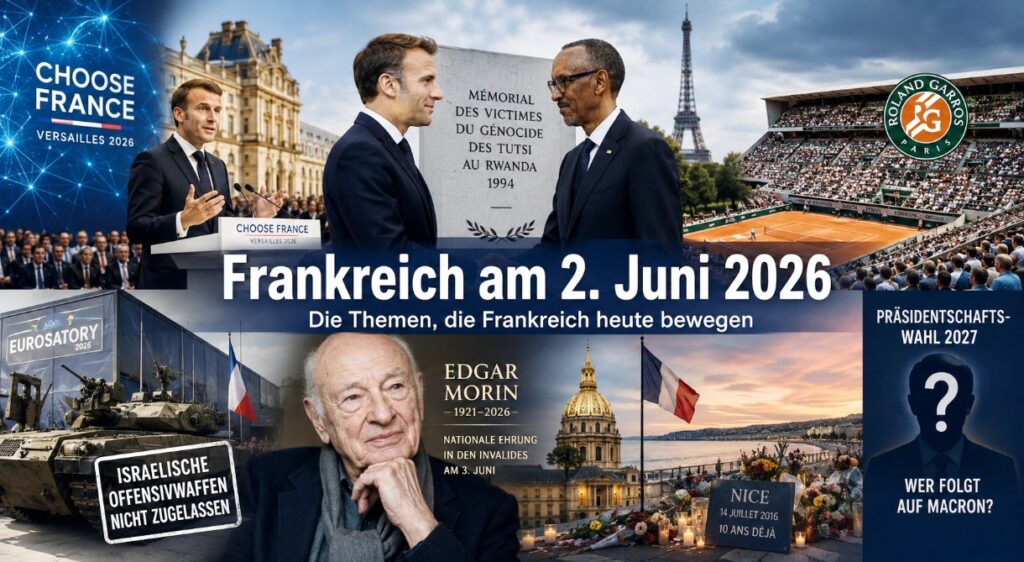
On June 2, 2026, France experiences a news cycle that uniquely reflects the country’s tensions and ambitions. While President Emmanuel Macron emphasizes the nation’s economic future with multi-billion investment commitments, questions of historical responsibility, national memory, and political succession also shape public debate. The French media portray a country navigating between technological advancement and confronting its past.
Record Investments as a Signal for France’s Business Location
The economic coverage continues to focus on the “Choose France” summit, which once again attracted international investors to Versailles. The announced investments reach a record level, intended particularly to promote the expansion of data centers, artificial intelligence, digital infrastructures, and future technologies.
For the government, these commitments represent a significant success. Macron has long pursued the goal of positioning France as a leading European hub for high technology and innovation. Establishing major technology projects is considered not only an economic policy victory but also a strategic response to growing competition from the United States and China.
At the same time, observers point out that the actual impact of such investment announcements will only become measurable in the coming years. It will be crucial whether the billion-euro promises translate into permanent jobs, research capacities, and industrial value creation.
The Difficult Memory of Rwanda
A highly symbolic highlight is the joint inauguration of a monument in Paris commemorating the victims of the genocide against the Tutsi in Rwanda by Emmanuel Macron and Rwandan President Paul Kagame.
The 1994 genocide is among the darkest chapters of recent African history. France’s role during these events continues to occupy politicians, historians, and the public. For several years, Paris has sought to reassess its policies at the time and to move closer to Kigali.
The joint commemorative event is widely seen by commentators as a step toward reconciliation. At the same time, it serves as a reminder of how strongly historical questions continue to influence French foreign policy. The debate over responsibility, memory, and historical reckoning remains a central part of the Republic’s political identity.
Farewell to Edgar Morin
The culture pages are dominated by the upcoming national honor for the late philosopher and sociologist Edgar Morin. The ceremony at the Invalides underscores the extraordinary position Morin held in French intellectual life.
Morin was regarded as one of the most important thinkers of the 20th and early 21st centuries. His work on the complexity of modern societies, democracy, and humanism influenced generations of scholars and intellectuals. In a time of increasing social polarization, many commentators highlight his reflections on the interconnectedness of political, social, and ecological challenges as especially relevant.
For many observers, his death marks the end of an era of French intellectualism with an international influence far beyond the country’s borders.
The Controversy Over the Eurosatory Arms Fair
The decision by France to exclude certain offensive Israeli weapons systems from the Eurosatory arms fair continues to spark political debate.
This measure is interpreted differently. Critics see it as a political distancing from Israel at a time when the security situation in the Middle East is deteriorating further. Supporters view the decision as a diplomatic signal in light of the ongoing Gaza conflict.
The debate highlights France’s difficult position in the Middle East conflict. Traditionally, Paris tries to maintain both close relations with Israel and dialogue with Arab states. This balancing act is becoming increasingly challenging amid regional tensions.
Ten Years After the Nice Attack
The remembrance of the Nice terrorist attack also gains significance. The tenth anniversary of the attack in July is approaching, and preparations for national commemorations are already in full swing.
The July 14, 2016 attack is among the most severe terrorist acts in modern French history. The upcoming memorials not only remember the victims but also the profound changes the wave of terrorism over the past decade has brought for France. Issues of internal security, radicalization prevention, and social cohesion remain central political topics.
The Pre-Election Campaign for 2027 Begins
Although the next presidential election will not take place until 2027, many political analyses already focus on the period after Macron. Since the constitution prohibits the incumbent president from running again, the search for a new leader of the political center begins.
The media are particularly attentive to the activities of former Prime Minister Gabriel Attal. At the same time, other politicians from the liberal and conservative camps position themselves for the forthcoming power struggle.
The central question is not only who might succeed Macron, but also whether the president’s political alliance will endure without his personality. The coming months are therefore expected to be increasingly dominated by strategic power struggles within the center.
Roland Garros Headlines Sporting News
While politics and the economy dominate the news pages, Roland Garros remains the country’s major sporting event. The tournament is in its decisive phase, and public attention grows with each match day.
The French Open is one of France’s most important sporting events and provides a common point of reference for a broad audience amid political and economic debates. Television stations, radio, and online media cover developments on the Paris clay courts almost around the clock.
International Crises as Background Noise
The international situation remains a constant backdrop to French reporting. Especially the tensions in the Middle East, relations between Israel and Iran, and the economic consequences of geopolitical uncertainties occupy politics and the economy alike.
For France, not only foreign policy issues are central. Rising energy prices, market uncertainties, and potential impacts on the European economy make international crises a domestically relevant topic. With upcoming G7 meetings, security and economic questions are expected to gain even more weight in the coming weeks.
On this June 2, 2026, France presents itself as a country in transition. The government bets on economic progress and technological modernization, while at the same time historical memories and questions of national identity shape public debate. The topics of Rwanda, Edgar Morin, and Nice illustrate how strongly the engagement with the past continues to influence the Republic’s political self-conception. In parallel, the 2027 presidential elections cast their shadow forward, opening the discussion about the country’s political future after the Macron era.