
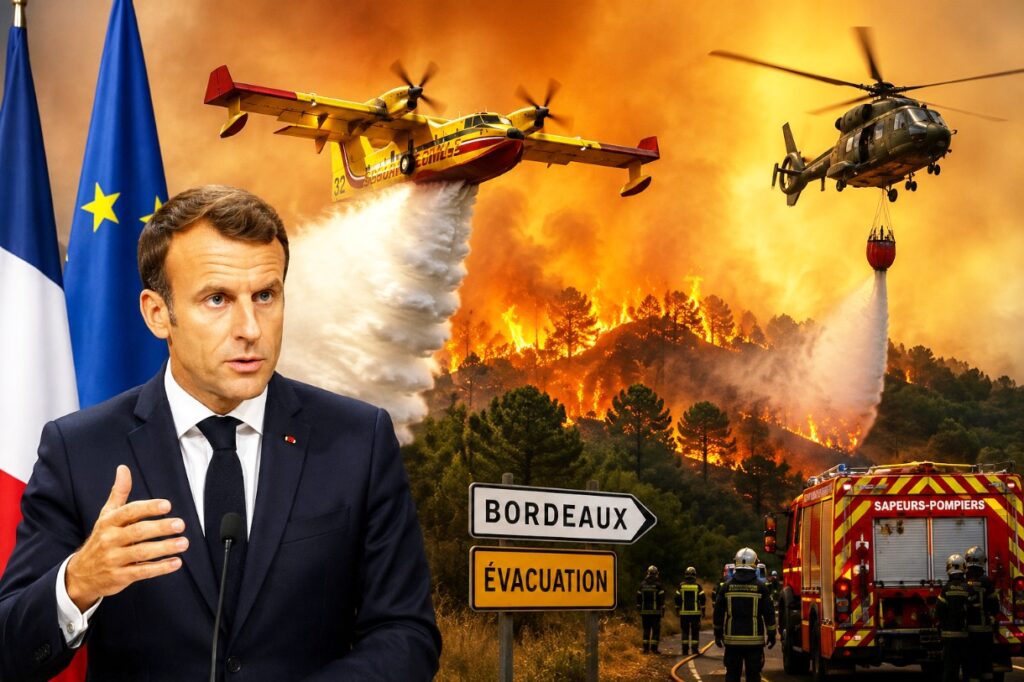
The devastating wildfires in southwestern France have reached a new level of escalation. In view of the rapid spread of the flames, President Emmanuel Macron has activated the European civil protection mechanism and officially requested support from the European Union. Additional firefighting aircraft and heavy helicopters from several EU member states are expected to arrive in France within the next few hours. The move underscores the severity of the situation – while also illustrating how much the fight against large-scale wildfires has now become a shared European task.
Major Fire in Gironde Forces Thousands to Flee
The situation is particularly dramatic in Gironde, west of Bordeaux. There, a major fire has spread to at least 2,400 hectares within a short period of time. High temperatures, extreme drought and shifting winds are making firefighting operations considerably more difficult. The fire front is developing dynamically, repeatedly forcing emergency crews to make tactical adjustments.
More than 10,000 people alone had to leave their homes, holiday accommodation and campsites overnight. Numerous roads have been closed and several municipalities evacuated as a precaution. Authorities are closely monitoring weather developments, as every change in the wind can create new fire hotspots or further fuel existing fires.
On Friday morning, President Macron described the situation as still ‘extremely tense.’ The priority, he said, was protecting the public and supporting firefighting crews, which have been working continuously under difficult conditions for days.
Reinforcements From Four European Countries
France will receive short-notice support from several European partner countries. Based on commitments made so far, Croatia is sending two Canadair firefighting aircraft, while Portugal is providing two Air Tractor firefighting planes. They will be supplemented by two heavy Black Hawk helicopters from the Czech Republic and Slovakia.
The different aircraft will perform different tasks. Canadair aircraft can collect large quantities of water from lakes or the sea and release it over fire zones within minutes. Air Tractor aircraft are particularly suitable for precise firefighting attacks on smaller fire hotspots or difficult-to-access sections of terrain. Black Hawk helicopters, in turn, offer the advantage of high flexibility and can be deployed specifically where ground crews urgently require support.
International assistance does not necessarily mean that France’s own emergency services have reached their limit. Rather, it indicates that the government expects a prolonged operation and is requesting additional capacity as a precaution. Since other regions of Europe are also affected by wildfires at the same time, firefighting aircraft are considered a particularly scarce resource during the summer months.
European Civil Protection as a Safety Net
The European Civil Protection Mechanism was created to provide member states with rapid and coordinated support during exceptional natural disasters or other crises. Once a country determines that its national resources are insufficient or could become overwhelmed at short notice, it can request assistance from the European Union.
Coordination is handled through the Emergency Response Coordination Centre (ERCC) in Brussels, which is staffed around the clock. There, offers of assistance from participating countries are pooled and the deployment of personnel, vehicles, aircraft and specialized equipment is coordinated.
A central role is played by the RescEU program, which was established as a strategic European reserve. It includes firefighting aircraft, helicopters and other response assets operated by individual member states but kept available for cross-border operations within the European Union. In light of the growing wildfire risk, this reserve has been continuously expanded in recent years and was reinforced again for the 2026 fire season.
Repeated Call for Help Within Just a Few Weeks
France had already activated the European mechanism at the beginning of July after several major wildfires broke out simultaneously. At that time, Sweden, Cyprus and the Czech Republic, among others, supported French emergency crews with aircraft and helicopters.
The fact that Paris is once again relying on European assistance within a few weeks illustrates the mounting pressure on national civil protection systems. Response resources now have to be deployed more frequently and for longer periods at several fire sites simultaneously. At the same time, the number of extreme weather situations is increasing across many parts of Europe, further intensifying competition for specialized firefighting capacity.
For France, this means that international cooperation is increasingly becoming part of national crisis preparedness rather than merely an exception for extraordinary events.
The renewed activation of European civil protection demonstrates how the threat situation in Europe is changing. Wildfires are no longer isolated natural events; they are developing into cross-border challenges that require a coordinated European response. With every exceptional heatwave, the importance of shared response reserves, rapid logistical support and coordinated crisis responses grows. The solidarity of member states is thus becoming a decisive factor in protecting people, infrastructure and nature – and a permanent component of Europe’s security architecture.