
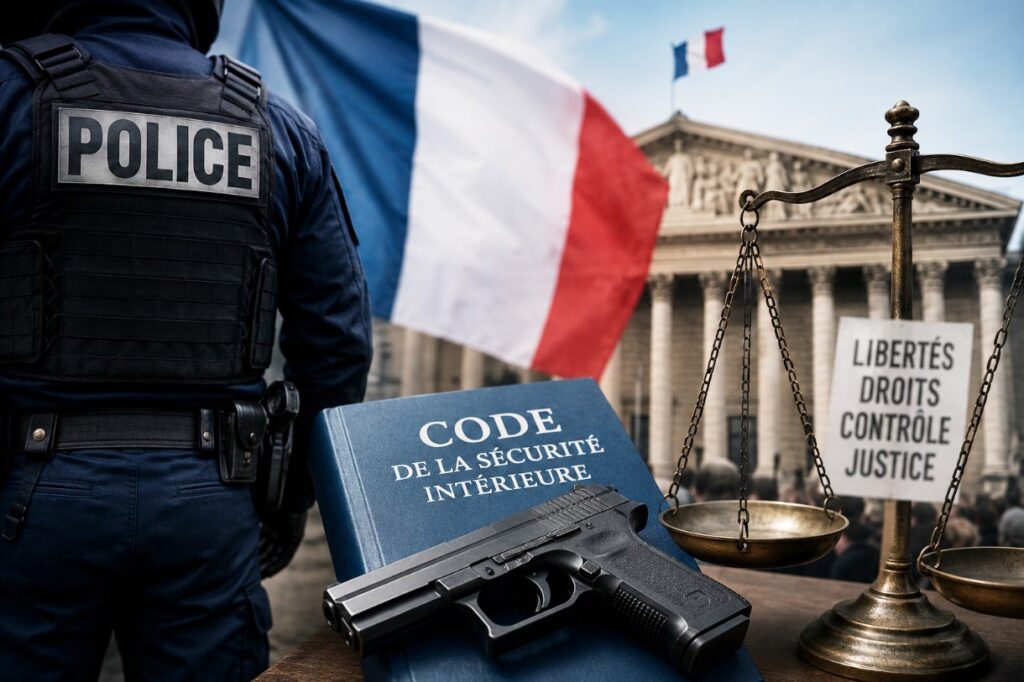
The French National Assembly has passed in first reading a controversial bill that would grant police officers and gendarmes expanded legal protection when using their firearms. The government-backed reform introduces a rebuttable presumption that a use of a firearm is initially lawful if it falls within one of the statutory exceptions. Supporters see this as a necessary safeguard for security forces, while critics warn of a weakening of rule-of-law oversight mechanisms and a problematic signal.
However, the legislative process is not finished with the vote in the National Assembly. The draft must now pass the Senate and then continue through the further parliamentary procedures. Amendments to the text are therefore possible.
From the self-defence presumption to a presumption of lawful conduct
During parliamentary deliberations the bill was softened on a central point. While the original version had included a “presumption of self-defence”, which raised significant constitutional and European law concerns, the government dropped that wording.
The version now adopted instead provides for a rebuttable presumption that police officers or gendarmes acted within one of the statutorily defined exceptional cases when they used their firearms. At the same time, the already applicable principles of absolute necessity and strict proportionality expressly remain in force.
Legally, this does not amount to an automatic justification of the use of firearms. Investigative authorities and courts still retain the ability to rebut the presumption based on the evidence and to determine unlawful conduct. According to the government, the reform therefore mainly changes the starting point of criminal investigations, not the material prerequisites for the use of lethal force.
Government points to changed security situation
The government justifies the reform by the increased demands on the police and gendarmerie. France has repeatedly been shaken by terrorist attacks in recent years, and violence against security forces has also increased. Officers often have to make decisions within a few seconds in highly dynamic operational situations, decisions that can determine life and death.
In the government’s view, operational personnel therefore deserve stronger legal protection. Those who act under extraordinary time pressure and meet the statutory conditions should not be presumed to have committed an offence from the outset. The rebuttable presumption creates more legal certainty and takes into account the particular burdens of police service.
The proposal received support mainly from conservative and right-wing parties, which for years have been calling for better legal protection for security forces. They argue that officers’ trust in the rule of law must be strengthened so that they can perform their duties without constant fear of lengthy criminal proceedings.
Left opposition warns of a shift in the balance
The left opposition, by contrast, rejects the reform outright. Deputies from the Greens, the Socialists and other left-wing factions warned during the debate that even the introduction of a legal presumption could lower the threshold for the use of firearms.
In their view, there is a risk of a gradual shift in the balance between state force and rule-of-law oversight. Critics also fear that relatives of victims may in future have greater difficulty proving unlawful police operations in court, because the burden of proof could effectively shift to the detriment of those affected.
Several opposition politicians pointed out that France already has comparatively extensive statutory powers for the use of firearms. Rather than further expanding police latitude, investments in training, de-escalation and independent oversight mechanisms would be the more appropriate path.
Amnesty International criticises a “vote de la honte”
The reaction from Amnesty International France was particularly strong. The human rights organization described the vote as “vote de la honte” — a ‘shameful vote’.
According to the organization, the proposed regulation undermines fundamental rule-of-law principles. Especially in cases of lethal force, the state must be subject to particularly strict requirements. A statutory presumption in favour of the acting officers could complicate investigations and undermine confidence in the independence of the judiciary.
Other human rights organizations also expressed doubts about the compatibility of the reform with the requirements of the European Convention on Human Rights. They therefore call for a thorough constitutional and European law review during the further legislative process.
Legal consequences remain open
<p(Legal scholars assess the practical significance of the reform differently. Some see primarily a symbolic change, since the statutory conditions for the use of firearms remain unchanged and judicial oversight remains fully possible.Others point out that a changed legal starting point can already have effects on investigative proceedings. Prosecutors would initially have to assume that the conduct was lawful as long as no contrary evidence is presented. Whether this actually leads to a changed prosecution practice will, however, only become apparent after the law comes into force and the first court rulings.
The reform is part of an ongoing debate over the relationship between internal security and civil liberties. After the Islamist terrorist attacks since 2015, recurring riots in French cities and an increasing number of attacks on police officers, the protection of security forces enjoys high political priority in large parts of the population. At the same time, cases of lethal police shootings — particularly during traffic stops — have repeatedly sparked protests and reinforced calls for stronger independent oversight of state force.
Against this background, the reform now adopted has considerable political symbolic force far beyond its legal effect. Debates in the Senate will show whether the bill survives in its current form or will be fundamentally altered. Regardless of the outcome of the parliamentary process, the debate highlights how difficult it remains to reconcile the protection of security forces with the preservation of rule-of-law guarantees in a democratic society.
Author: P. Tiko