
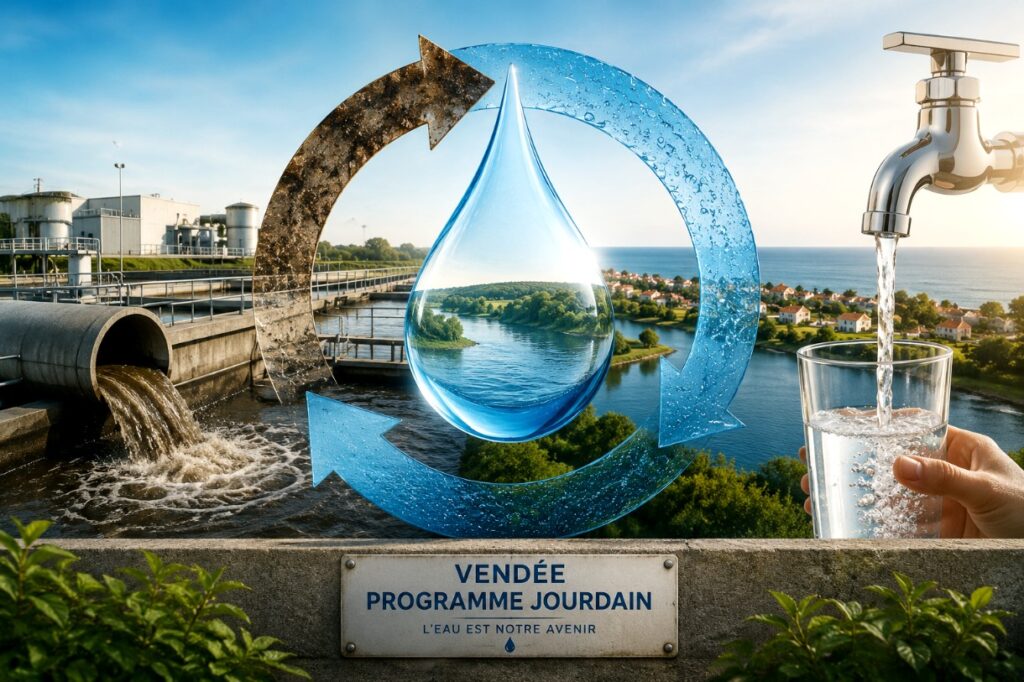
In the French region of Vendée, a project is underway that a few years ago would have sounded like science fiction. Treated wastewater will no longer simply be discharged into the Atlantic, but will return to the water cycle as a potential source of new drinking water. The “Programme Jourdain” is already counted among the most ambitious water projects in Europe.
The idea seems strange at first. Should water from treatment plants really one day return to the drinking water system? Many people react to this idea with almost instinctive skepticism. It is understandable. Water holds an almost sacred emotional character. No one wants to think about where the water has already been.
This is precisely where this project focuses.
Because the water from Vendée does not return directly to the tap. Between wastewater and drinking water there are several technical barriers that resemble a high-tech laboratory more than a regular treatment plant. After the classic purification, an additional treatment with ultrafiltration, UV disinfection, and reverse osmosis follows. Even tiny residues of medicines, pesticides, or the so-called PFAS chemicals are removed from the water.
In the end, what remains is almost pure H₂O.
The treated water first passes into natural reservoirs, rivers, and lakes. Only afterwards does it go back into the production of drinking water. This indirect cycle is designed to provide additional safety, both technically and psychologically.
Vendée has an almost symbolic character for such an experiment. The region on the Atlantic coast of France depends heavily on tourism, but has been experiencing increasingly dry summers for years. Lakes and rivers carry less water, while millions of tourists use showers, pools, and campsites. Even today, nearly 90 percent of drinking water comes from surface sources. If it rains little, the system quickly becomes strained.
And this is something that happens more and more frequently.
Climatologists have been painting the same picture for years: longer drought periods, hotter summers, and increasing competition for water. What once seemed like a problem for distant desert countries now affects Europe. Spain is struggling with dry reservoirs, Italy with drops in groundwater levels, and even France already knows summers when municipalities must ration drinking water. The phrase “Water always comes from the tap” is slowly losing its naturalness.
The scale of the project shows how seriously the situation is taken. A pipeline of about 25 kilometers connects the treatment plant near Les Sables-d’Olonne with the region’s water reserves. It is expected that this will provide millions of additional cubic meters each year. For those responsible, it is no longer just about environmental policy, but about supply security.
Politically, the issue remains sensitive.
The term “from toilet to drinking water” spreads quickly on social media and often provokes mocking comments. For this reason, operators respond with utmost transparency. Groups of visitors can tour the facilities, scientists continuously monitor water quality, and health authorities supervise all processes. No one wants to take risks here. The loss of trust would be too great.
Internationally, France is not alone in this idea. Singapore has recycled part of its water for years, and Namibia and California already successfully use highly treated wastewater. What is new is that now Europe is also increasingly betting on these technologies. France was for a long time hesitant on this topic, almost cautious, like a driver on ice. Now the country suddenly steps on the accelerator.
That is why this sign has a significance far beyond Vendée.
Europe is beginning to understand that water will no longer be an inexhaustible resource. Regions that smartly close their cycles will probably be much more resilient in the coming decades. Others might one day discover that the old resource management no longer fits in a warming world.
Perhaps the real revolution of this project lies there: it is not technology that changes our view of water, but the recognition that wasting it will simply be too expensive in the future.
By C. Hatty