
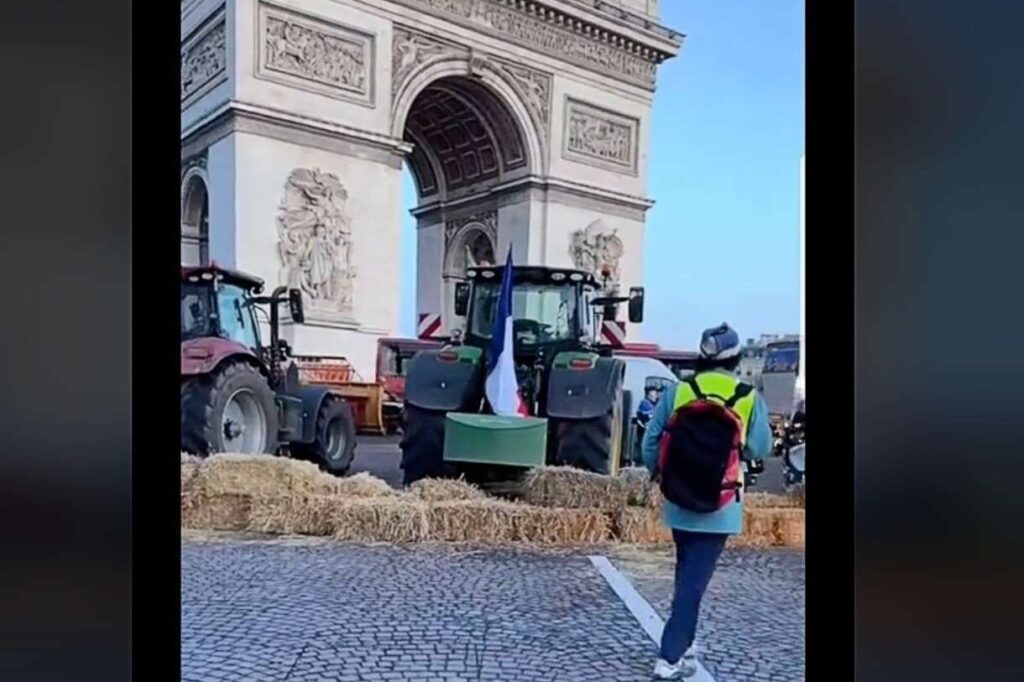
France is experiencing a new escalation of protests by farmers today – with noticeable consequences for millions of commuters, businesses, and domestic freight traffic. In the capital region Île-de-France, the important A13 motorway was completely closed on Thursday morning. A traffic jam kilometers long – according to Transport Minister Philippe Tabarot about 150 kilometers – largely brought the western access traffic to Paris to a standstill. This is the provisional peak of a wave of protests directed, among other things, against the planned free trade agreement between the EU and the South American Mercosur alliance.
The government is meanwhile striving to limit the damage – both politically and logistically. The approach towards the protesters fluctuates between diplomatic consideration and police restraint. But with the anger on the streets growing, so does the pressure on President Emmanuel Macron.
An Alliance Under Scrutiny: The Resistance Against Mercosur
The central trigger of the nationwide blockades is the discontent of many French farmers about the free trade agreement between the European Union and the Mercosur countries (Brazil, Argentina, Uruguay, Paraguay). Although the agreement has not yet been ratified, the mere prospect of its implementation is causing turmoil. The farmers fear that cheap imports from South America – especially beef – will further put the already economically strained French agricultural sector under pressure.
France’s farmers are not alone with their criticism: environmental organizations and consumer advocates also express concerns. They point to low production standards in the Mercosur countries, especially regarding the use of pesticides or animal welfare issues. Added to this is the environmental problem – such as the ongoing deforestation of the Amazon region for the export of agricultural products.
The French government has so far expressed ambivalence about the Mercosur agreement. President Macron had already threatened a veto against the agreement in 2019 due to the environmental policies of Brazil’s then-President Jair Bolsonaro. Meanwhile, additional declarations are being negotiated in Brussels to guarantee environmental and social standards. But many farmers find this insufficient.
Traffic Collapse in Île-de-France
The closure of the A13 – one of the main routes from the west to the capital – shows how effectively the protests are currently influencing daily life in France. Among those affected on Thursday were the Ambroise Paré Tunnel and the Saint-Cloud Tunnel. Both access routes to Paris were blocked by protesting farmers with tractors.
Philippe Tabarot, who has been Minister of Transport for six months, spoke in the morning on the channel France 2 about the situation. Although attempts were made to prevent the influx of tractors into Paris, “some got through.” The security authorities wanted to avoid confrontation. “The farmers are not the enemies of the country,” emphasized Tabarot, underlining the government’s willingness to engage in dialogue.
The strategy: de-escalation through tolerance. But this comes at a price. For days, commuter traffic has suffered, especially in the capital region already burdened by snow and ice. In connection with the approaching storm front “Goretti,” a logistical disaster threatens. Already, the railway company (SNCF) has announced restrictions on parts of train traffic in Normandy and Brittany.
Between Security and Symbolic Politics
Tabarot repeatedly referred to the balance between security and mobility. Just the night before, the government had taken restrictive measures in view of the weather situation – such as speed limits, driving bans for trucks, and recommendations for home office. The farmers’ blockades further worsened the situation. Nevertheless, they have so far refrained from a police clearance.
The reasons for this are political in nature. The memory of earlier waves of protests – such as the Gilets Jaunes (Yellow Vests) in 2018 or the farmers’ protests in 2024 – is still fresh. At that time, there were sometimes violent clashes, nighttime traffic jams, and a massive loss of trust in state institutions. The government wants to avoid exactly that at all costs.
But the balancing act is difficult: while Tabarot expresses understanding for the farmers’ concerns in the interview and shows them respect, many commuters and businesses criticize the lack of enforcement of state authority. Long-distance truck drivers are also particularly affected, complaining about insufficient support. The minister pointed out that “most regions” had organized visits to blocked truck drivers – a weak consolation for those affected by the continuous traffic jams.
Political Terrain in Motion
The protests come at a delicate time for President Macron. After a difficult year 2025 – with protests against pension reform, geopolitical tensions in Africa, and ongoing budget problems – the Élysée is striving for stability. The agricultural sector is traditionally seen as particularly sensitive in France, not least because of its symbolic significance for national identity and self-sufficiency.
Furthermore, the regional election in March 2026 is approaching. The topic of agriculture is strategically relevant for the election – not only in rural areas but also in urban milieus, where organic consumption and regionality are highly valued. An escalation of the farmers’ protests could play into the hands of populist parties, foremost the Rassemblement National, which has already publicly shown solidarity with the demonstrators.
Currently, the government is trying to buy time through dialogue offers and targeted concessions. Agriculture Minister Annie Genevard is in contact with interest groups, and the Prime Minister has announced an “agricultural crisis summit.” However, whether this will be enough to reduce the pressure from the streets is uncertain.
At the end of this eventful day, a conclusion will likely remain that Philippe Tabarot inadvertently provided in the interview: It was at least achieved that “all people were able to sleep at home this time” – a remarkably modest standard for assessing state crisis management in 2026.
Author: P. Tiko