
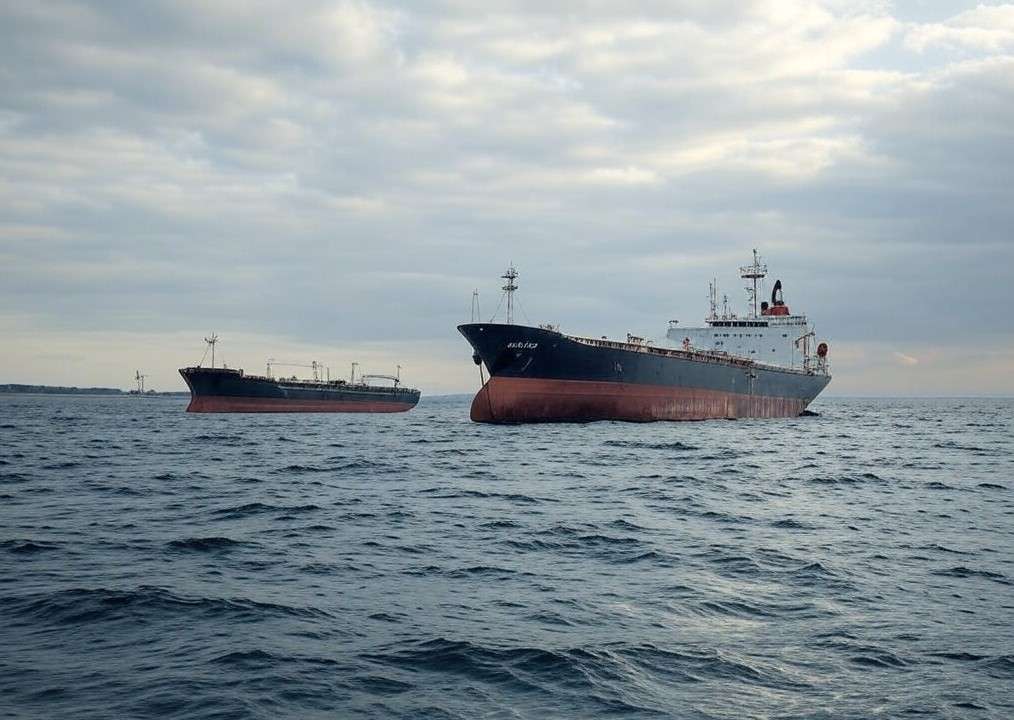
With the seizure of the tanker Tagor in the Atlantic, France has sent another signal in the maritime sanctions war against Russia. The operation, carried out more than 740 kilometers west of the Breton coast, marks another step in an increasingly offensive European strategy against the so-called Russian shadow fleet. What initially appears to be a technical inspection of a suspicious ship actually touches on central issues of international security, energy policy, and the enforcement of Western sanctions against Moscow.
A tanker under suspicion
According to French authorities, the tanker had departed from Murmansk in northern Russia. The navy suspected that the ship was sailing under a possibly illegal flag. Such cases are now considered a classic feature of those ship networks that are supposed to enable Russian oil transports despite international sanctions.
An inspection team boarded the tanker and checked the ship’s documents. The initial findings are said to have confirmed the original doubts. Subsequently, the judiciary was involved and the ship was redirected to a controlled sea area where further investigations will take place.
The French government emphasizes that the measure was carried out in accordance with international maritime law. Nevertheless, the incident shows how sensitive the control of commercial vessels on the high seas has become. Every intervention moves in the tension between state sovereignty, international law, and geopolitical deterrence.
The Shadow Fleet as a Strategic Instrument of Moscow
Since the introduction of Western sanctions against Russian energy exports, the so-called shadow fleet has developed into one of the most important instruments to circumvent restrictions. Estimates by Western security and financial institutions now speak of several hundred ships being used directly or indirectly for Russian oil shipments.
The basic principle is simple: tankers regularly change owners, operating companies, or flag states. Often, shell companies in third countries are involved. This obscures the actual origin of the cargo or the economic responsibility.
Particularly problematic is the use of so-called “flags of convenience.” States with weak control mechanisms often allow shipping companies to register vessels under their flag without consistently enforcing international safety standards. This makes it more difficult for authorities to trace who is ultimately responsible for a ship.
According to Western assessments, this network significantly contributes to Russia continuing to generate substantial revenues from the oil business despite the sanctions. Energy exports remain one of the most important sources of financing for the Russian state and thus indirectly also for the war effort in Ukraine.
France’s New Maritime Resolve
The seizure of the Tagor is not an isolated case. In recent months, France has already inspected several tankers linked to the Russian shadow fleet. The cases of Boracay, Grinch, and Deyna had already made it clear that Paris has significantly expanded its maritime surveillance.
It is noticeable that the French measures no longer focus solely on the Mediterranean. The current operation in the Atlantic shows that the French Navy has now extended its attention to significantly larger maritime areas.
This development corresponds to a general shift in European security strategy. While the European Union has long concentrated on economic sanctions, the practical enforcement of these measures is increasingly coming to the fore. Sanctions only exert their effect if loopholes are consistently closed.
This is particularly difficult in the maritime sector. Global shipping is based on complex ownership structures, international insurance models, and different national legal systems. States therefore require extensive intelligence information and international cooperation in order to identify suspicious ships at all.
Cooperation with Great Britain
The close cooperation with Great Britain is remarkable. Although London has left the European Union, security policy cooperation on Russia sanctions remains close.
Since the beginning of the war in Ukraine, Great Britain has been one of the most active countries in imposing sanctions against Russian oil transports. The British authorities maintain extensive lists of suspicious ships and regularly participate in surveillance measures at sea.
The cooperation between Paris and London illustrates that European security policy is increasingly organized outside traditional EU structures. Especially in maritime matters, both countries have significant military capabilities and global deployment options.
For France, the cooperation also offers the opportunity to underline its claim as the leading European military power. After Great Britain left the EU, Paris is the only member nation with nuclear deterrence, a permanent seat on the UN Security Council, and comprehensive high seas capabilities.
Environmental Hazards on the High Seas
In addition to the political and economic aspects, another factor is increasingly coming into focus: the environment.
Many ships of the shadow fleet are considered technically outdated. Experts point out that numerous tankers are significantly older than is usual in international oil transport. At the same time, there are repeated reports of inadequate maintenance and insufficient insurance.
A serious accident could have significant ecological consequences. Especially the European coastal states view the situation with growing concern. A major oil spill in the Atlantic, North Sea, or Mediterranean would not only have economic consequences but could also cause long-term damage to marine ecosystems.
From the perspective of the European governments, the enforcement of sanctions is therefore increasingly connected with the argument of environmental safety. The control of suspicious tankers is presented not only as a geopolitical measure but also as a contribution to the protection of international waters.
A political signal to Moscow
The public communication of the operation by President Emmanuel Macron is hardly accidental. The fact that the French head of state personally announced the detention emphasizes the political significance of the event.
France has been trying for months to redefine its role within Europe. In view of the ongoing uncertainty about the long-term development of the Ukraine war and the geopolitical tensions with Russia, Paris increasingly presents itself as a guarantor of European security.
The detention of the Tagor fits into this strategy. It demonstrates domestic capability for action and sends a message abroad to Russia and to the operators of the shadow fleet: European states are ready not only to defend their sanctions policy on paper but also to enforce it operationally.
Whether the investigations will ultimately lead to criminal consequences remains open. What is already decisive is the political impact. Every controlled tanker increases the risks for those networks that benefit from the evasion strategies. At the same time, France makes it clear that the enforcement of international sanctions is increasingly being decided on the high seas – and that the Atlantic has now become as much a part of this geopolitical theater as the Baltic Sea or the Mediterranean.
Author: P. Tiko