
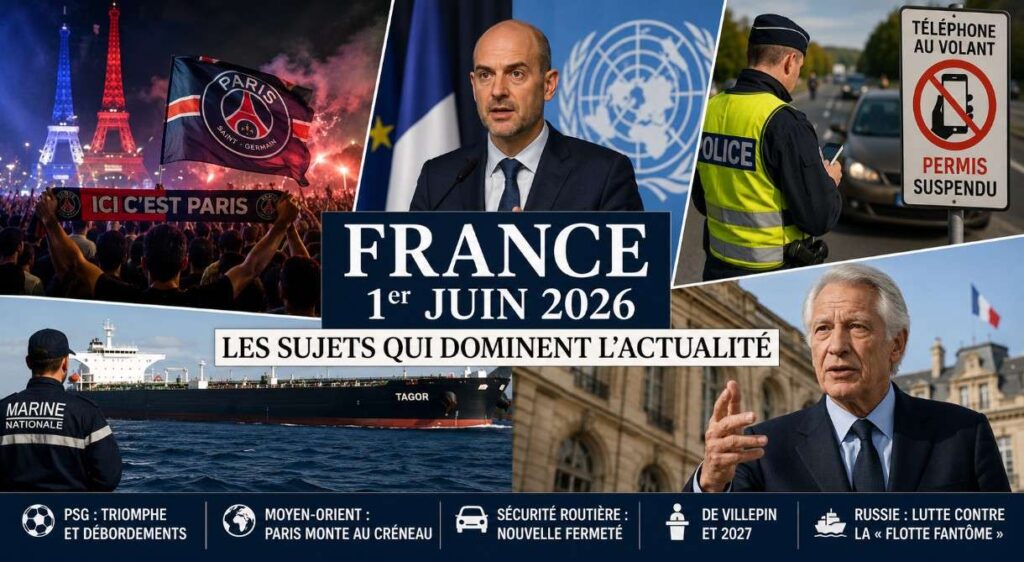
Today’s news cycle in France is marked by an unusual mix of sporting enthusiasm, foreign policy tensions, domestic political debates, and societal challenges. While the celebrations surrounding Paris Saint-Germain’s renewed Champions League triumph continue to dominate headlines, topics such as Middle East policy, traffic safety, and preparations for the 2027 presidential election are increasingly moving to the forefront.
PSG Between Triumph and Security Debate
Paris Saint-Germain’s second consecutive Champions League victory remains the dominant topic in the French media. After the win in the final against Arsenal, the Champ-de-Mars and later the Parc des Princes transformed into massive celebration zones. Images of tens of thousands of cheering fans are featured on numerous front pages today.
At the same time, the riots on the fringes of the celebrations occupy politics and security authorities. Hundreds of arrests and numerous injuries have once again raised the question of how France can organize large events without relying on massive police presence. The discussion about violence in public spaces is thus gaining new momentum.
Paris Increases Pressure in the Middle East Conflict
Foreign Minister Jean-Noël Barrot draws attention with his call for an urgent United Nations Security Council meeting. The background is the recent Israeli military actions in Lebanon, which are increasingly being critically assessed in Paris.
In diplomatic circles, this move is interpreted as an attempt to reposition France more strongly as an independent diplomatic force in the Middle East. After years of limited influence, Paris could be trying to reconnect with its traditional mediator role in the region. At the same time, there is discussion about how far the French government is willing to escalate its criticism of the Israeli leadership.
Tougher Approach Against Distraction While Driving
The decision by the prefect of Ardèche to take a significantly tougher stance on the use of mobile phones while driving is receiving extensive media coverage. Drivers could temporarily lose their licenses immediately upon such violations.
The trigger for this is the rising number of accidents and continuing concerns over distractions in road traffic. Many observers view this measure as a potential precedent for other departments. Traffic safety remains a sensitive topic as France, despite long-term progress, still faces a high number of serious traffic accidents.
Dominique de Villepin Positions Himself
The political press is increasingly looking towards the period after Emmanuel Macron. Particular attention is on recent statements by former Prime Minister Dominique de Villepin, who publicly declared he is “on the way to the Élysée.”
Whether this will indeed become a candidacy for the 2027 presidential election remains open. Nevertheless, many observers see Villepin as a potential candidate who could appeal to voters beyond traditional party lines. His foreign policy experience and distance from established political camps give him a special position.
The debate also shows how early French politics is already entering the post-Macron phase. Parties and potential candidates are increasingly beginning to outline their strategic positions for the coming years.
Russia Sanctions and the “Shadow Fleet”
European sanctions policy towards Russia also occupies the French media. The focus is on the Russian tanker “Tagor,” which was controlled and temporarily detained by the French Navy in the Atlantic.
The action is seen as part of Western efforts to combat the so-called Russian shadow fleet. This fleet includes ships that often operate under changing flags and are intended to circumvent existing sanctions in the oil trade. The tanker’s control is therefore interpreted as a signal that France wants to strengthen its role in enforcing international sanctions.
Other Topics of the Day
Besides the major headlines, other developments are occupying the French public:
- The cautious rapprochement between France and Algeria after several years of diplomatic tensions.
- The intensive search for the missing eleven-year-old Lyhanna in the Gers department.
- The discussion about the worldwide deterioration of workers’ rights and its consequences for social standards.
- Early warnings of a possible heatwave in June and questions about France’s adaptation to increasing climate extremes.
- The ongoing French Open tournaments, which are gaining more and more attention with the start of the second week.
France is thus starting June with a remarkable simultaneity of different topics. The euphoria over PSG’s success may overshadow many other news items, but in the background, the major political and societal debates of the summer are already taking shape: France’s role in international crises, internal security, preparation for the 2027 presidential election, and adaptation to new geopolitical and climatic challenges.