
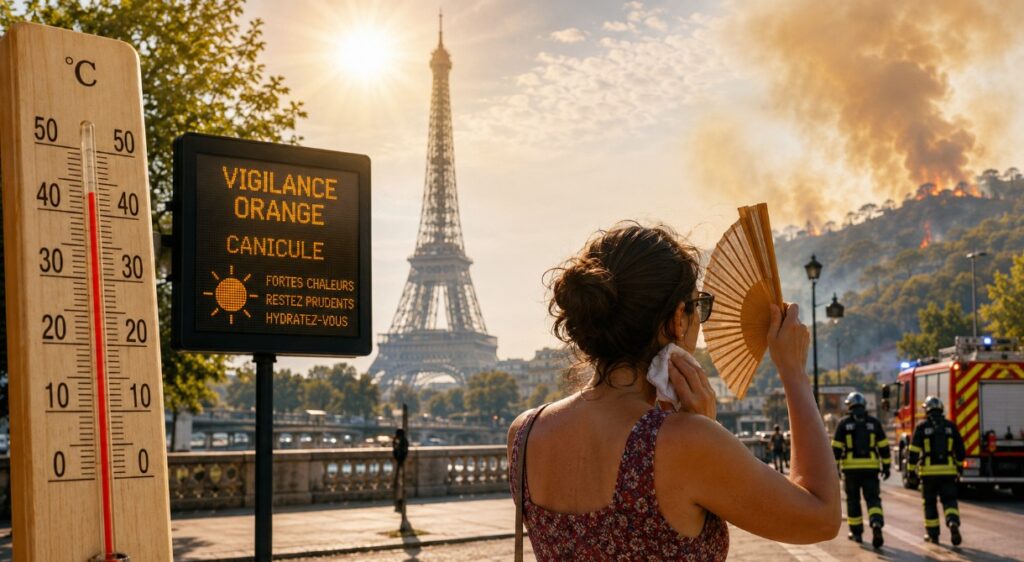
France is currently experiencing a moment when multiple crises are simultaneously shaping public debate. This heatwave, exceptional in most parts of the country, not only dominates weather coverage but has also raised numerous questions about health, infrastructure, climate adaptation, and the state’s political capacity to respond. At the same time, environmental issues, the risk of forest fires, and the first strategic maneuvers ahead of the 2027 presidential election have become focal points of public attention.
Heatwave drives news agenda
The most prominent topic remains the rare, early and intense period of high temperatures. Heat warnings have been issued for Paris and many other areas. Reaching 38 to 39 degrees Celsius at the end of May is also unusual for France.
The discussion is no longer limited to breaking meteorological records. The core question is whether France is adequately prepared for more frequent extreme weather events. The government has convened cross-departmental crisis meetings to coordinate measures for the coming summer, focusing on water reserves, fire-prevention measures, health protection and the resilience of critical infrastructure.
The opposition has also used the situation to accuse the government of lacking preventive measures. The heatwave has thus gradually become a political issue.
Schools become symbol of inadequate adaptation
Schools are currently under particular scrutiny. Media outlets across many areas report overheated classrooms and insufficient cooling facilities. There is a nationwide debate about how educational institutions should respond to climate change.
An elementary school in the Landes department has become a symbol of this discussion; temperatures measured under its glass roof exceeded 50 degrees Celsius, and parts of the building were temporarily closed as a result.
Many commentators believe this is not an isolated incident but reflects that a large number of public buildings are still designed according to last century’s climate conditions. Schools, hospitals and administrative buildings are increasingly becoming the focus of widespread discussion about France’s national resilience.
Air pollution exacerbates health risks
Meanwhile, rising ozone concentrations in the Paris region have raised concerns. Authorities have already taken several measures, including traffic restrictions and lower speed limits.
The combination of high temperatures and worsening air quality places a particular burden on the elderly, children and patients with respiratory conditions. Health experts warn that this mutually reinforcing climate and health risk situation is worrying.
The media increasingly emphasize that future heat waves are not merely meteorological events but complex crises involving health, mobility and public safety.
Forest fire season starts earlier
Another major topic is concern over forest and vegetation fires. Especially in southern regions, authorities are highly concerned about the risks brought by drought, high temperatures and local wind patterns; these factors have clearly increased the likelihood of fires, and well before the traditional summer period.
Experts point out that the forest fire season has noticeably lengthened in recent years. Fires that used to occur mainly in July or August now often appear as early as May, presenting new challenges for firefighting and disaster prevention.
This discussion highlights that the impacts of climate change have penetrated the daily operations of national institutions.
First contest ahead of the 2027 presidential election
Beyond climate and social challenges, the political outlook has also become a focus. Discussion about the 2027 presidential election is heating up.
Former Prime Minister Gabriel Attal has announced a campaign to succeed incumbent President Emmanuel Macron, attracting significant attention. The move is seen as an important step in contesting leadership of the political center.
Editorials on all sides also focus on fundamental questions about the future: How will France achieve economic modernization? How to secure energy supplies? How to respond to social tensions and the challenges of climate change?
The current heatwave acts like a magnifying glass, making many long-standing structural issues even more apparent under extreme weather conditions.
At the end of May 2026, France finds itself in a state where weather events, environmental problems and political debate are increasingly intertwined. The unusually high temperatures are no longer merely a meteorological phenomenon but a test for infrastructure, the healthcare system and the nation’s crisis response. They not only affect weather reporting but also profoundly shape public opinion, foreshadowing the upcoming summer agenda.