
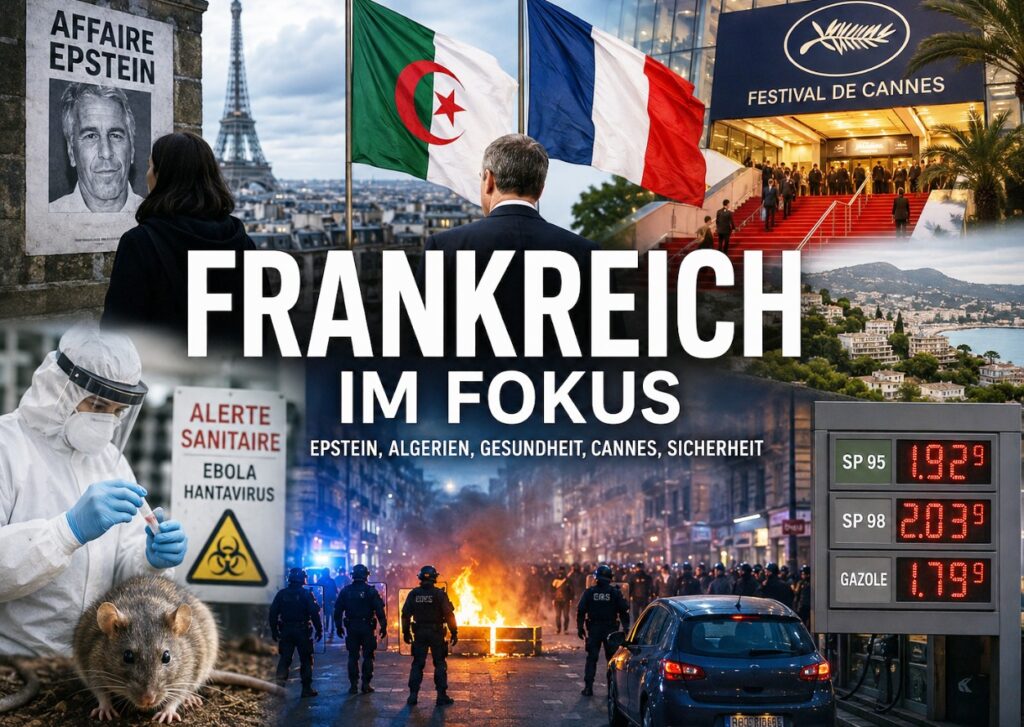
France begins the new week with an unusually dense flow of news. Domestic affairs, international tensions, health issues, and cultural debates intertwine, creating a general atmosphere of tension. Notably, it is not a single major event, but the simultaneous occurrence of multiple crisis themes that mobilize different social layers: the Epstein case returns to the French public eye, a diplomatic crisis with Algeria, concerns about the outbreak of a new virus, the political charge of the Cannes Film Festival, and discussions about violence and loss of security control in French cities.
The Epstein Case Becomes a Political Topic in France Again
The Paris prosecutor’s office reported that more suspected victims related to the Jeffrey Epstein case have emerged, causing a huge reaction in France. The focus is once again on the model agent Jean-Luc Brunel, who died in 2022 and was long considered a central figure in France’s connection to Epstein’s network.
The case touches on multiple sensitive areas in France: the fashion industry, elite networks in Paris, the role of international intermediaries, and possible negligence by judicial authorities. Tabloid media mainly emphasize sexual exploitation aspects, while political publications increasingly discuss why France took almost no action for many years.
Particularly sensitive is its symbolic significance. Paris has been regarded for decades as the European capital of luxury goods and the fashion industry. It is this environment once again connected to the Epstein investigation, severely impacting the French cultural sector’s self-image.
The case touches on multiple sensitive areas in France: the fashion industry, elite networks in Paris, the role of international intermediaries, and possible negligence by judicial authorities. Tabloid media mainly emphasize sexual exploitation aspects, while political publications increasingly discuss why France took almost no action for many years.
Particularly sensitive is its symbolic significance. Paris has been regarded for decades as the European capital of luxury goods and the fashion industry. It is this environment once again connected to the Epstein investigation, severely impacting the French cultural sector’s self-image.
This discussion also recalls previous scandals in France, such as those involving Gabriel Matzneff or Dominique Strauss-Kahn, where power, prestige, and institutional tolerance were intertwined. Many commentators now believe these are no longer isolated incidents but structural problems of elite protection mechanisms.
Darmanin Visits Algeria: Migration Becomes a Geopolitical Conflict
Before Interior Minister Gérald Darmanin’s visit to Algeria, the political tone on internal affairs in France noticeably hardened. Relations between Paris and Algiers have been tense for months. The controversies involve visa issues, the deportation of rejected asylum seekers, and policies surrounding the historical memory of the Algerian War.
In particular, the right-wing political camp accuses President Emmanuel Macron of being too lenient towards Algeria. Members of the National Rally openly describe his approach as “diplomatic submission.” Such statements reflect that the Algerian issue has deeply entered France’s debates on identity and migration.
In reality, the relationship between the two countries is dominated by interdependence. France requires Algeria’s cooperation on deportations and security matters; Algeria is closely linked to France economically and socially. In addition, the large community of Algerian-descended French expatriates politically connects the two countries.
Therefore, Darmanin faces a dilemma: on one hand, to show toughness domestically, and on the other, to keep diplomatic communication channels open. Conservative media particularly view this visit as a test of Macron’s North Africa strategy.
Health Concerns from Ebola to Hantavirus
Meanwhile, public concern about potential health risks is also intensifying. French infectious disease experts have specifically warned that Mayotte, a French overseas territory, is vulnerable as the Ebola virus spreads in certain parts of Africa.
Mayotte has long been regarded as a sensitive area for health crises due to limited medical resources, high population density, and strong migration flows. Structural problems in the region had already become apparent during the COVID-19 pandemic.
In addition, the media have also focused on a series of hantavirus cases in the Jura region as well as disease cases occurring on the expedition ship MV Hondius. Many media outlets strive to clarify details and distinctions, placing greater emphasis on accuracy after contradictory information circulated on social networks.
This tension also stems from Europe’s recent experience. Since the COVID-19 pandemic, the public and media have become more sensitive to infectious disease information, with even localized cases capable of attracting nationwide attention.
At the same time, this has exposed a familiar pattern in the modern information society: scientific uncertainty is often interpreted by the media as an imminent threat. Health authorities are therefore actively working to reassure the public and provide contextual explanations.
2026 Cannes Film Festival: Cultural Event Overshadowed by Political Conflict
The Cannes Film Festival remains France’s most important cultural event, but this year its aura of glamour is clearly giving way to political tension. Attention is focused not only on competition films but increasingly on power issues within the French media and film industry.
Especially heated discussions revolve around the influence of the Bolloré Group and Canal+ on production structures, financing, and public debate in the cultural sector. The background is accusations that supporters opposing Bolloré’s initiatives are facing pressure.
Thus, Cannes once again reflects broader social conflicts. Over the years, media power in France has increasingly concentrated in the hands of a few entrepreneurs, with Vincent Bolloré seen by many critics as a symbolic figure of the American-style conservative media restructuring.
Therefore, the film festival is not only a platform for cultural display but also a battleground for ideological struggle. This discussion is reminiscent of similar conflicts in Italy and the United States, where ownership structures of major media groups are becoming increasingly politicized.
Meanwhile, many films in this year’s competition focus on themes of social crisis: immigration, identity, social violence, and the erosion of democratic institutions. Cannes has nearly become a cultural echo of the European political situation.
Nantes: A Symbol of a Deeper Security Crisis
Following a new wave of riots around the football match between Nantes and Toulouse, discussions about violence and the loss of control in French cities have intensified again. Notably, Nantes is now often referred to as a symbolic city, no longer just certain suburbs of Marseille or Paris.
This greatly changes political perceptions. For a long time, Nantes was regarded as a relatively stable, prosperous, and high-quality living large city. Frequent reports about drug crime, shootings, and urban violence there now amplify the perception of a nationwide problem.
Discussions on security issues are closely linked to social problems. For years, France has struggled with high youth unemployment rates in poor communities, the underground economy of drug trafficking, and growing distrust towards state institutions.
In terms of internal affairs, this trend has particularly strengthened parties that put security and order at the core. At the same time, pressure on the government to deliver visible results is increasing. Security issues may thus become one of the central political topics in the coming months.
Economic concerns have also intensified the atmosphere. The rise in fuel prices caused by tensions in the Middle East has made consumers sensitive, further reinforcing a general sense of insecurity. Combined with the immigration debate, reports of violence, and geopolitical crises, this has created a social climate that many French commentators describe as potential fatigue.
This Monday in France feels like a country simultaneously dealing with multiple political and social tensions — with no obvious signs of relief yet.
Author: Andreas M. Brook