
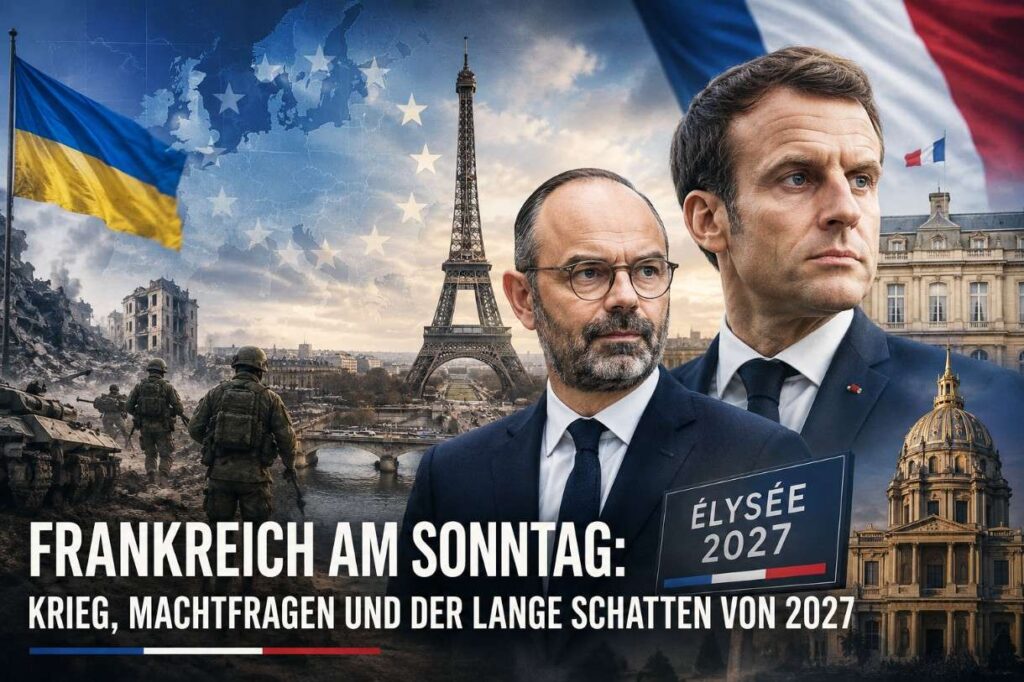
France is experiencing a political mix this Sunday in which international crises, strategic uncertainty, and preparations for the 2027 presidential election are increasingly overlapping. The war in Ukraine remains the dominant foreign policy issue. At the same time, the political class is visibly beginning to prepare for the time after Emmanuel Macron. Édouard Philippe in particular is increasingly emerging as a possible successor to the president.
Ukraine war is changing France’s strategic thinking
The war in Ukraine now shapes almost all security policy debates in Paris. The Russian celebrations on May 9, discussions about ceasefires and new tensions between Moscow and the West are being closely watched in France. Behind the diplomatic statements a fundamental worry is growing: Europe could permanently enter a phase of geopolitical instability.
The French government is already speaking openly about rearmament, European defense capability, and military autonomy. The Ukraine war has triggered a rethink in France’s security policy. Terms like “strategic autonomy,” “wartime economy,” or “Europe’s sovereignty” have long since become part of everyday political vocabulary.
Even within the French armed forces the mindset is changing. The massive use of drones, electronic warfare and hybrid attacks in Ukraine is seen as a warning sign for French military planning. Paris now analyzes the conflict not only as a regional crisis but as a possible model for future European wars.
President Macron is using this development to position France as a central power in Europe. His message remains consistent: Europe must learn to become more security-politically independent from the United States. Especially against the backdrop of possible political changes in Washington, this argument is gaining weight in Paris.
Édouard Philippe positions himself for 2027
While foreign policy dominates, the background already shows the beginnings of the 2027 presidential campaign. The former Prime Minister Édouard Philippe is currently acting particularly conspicuously.
Officially, Philippe has not yet declared his candidacy. Politically, however, he has long behaved like a candidate for the Élysée Palace. Nationwide appearances, programmatic interviews and the careful staging of statesmanlike calm are now part of his strategy.
Philippe is trying to present himself as a counter-model to Macron — less impulsive, less confrontational and more focused on stability. In a politically exhausted France, this very profile could become attractive. Many voters long for predictability and institutional calm after years of social tensions, protest movements and international crises.
At the same time, the political center remains fragmented. Several conservative and liberal politicians are positioning themselves for 2027. Interior Minister Gérald Darmanin, Laurent Wauquiez and Xavier Bertrand each pursue their own power strategies. the French right is organizationally splintered, while Macron’s camp does not yet have a clear succession order.
That makes Philippe particularly interesting at the moment: he appears to many observers as a candidate who could appeal to both parts of the liberal Macron camp and moderate conservatives.
The creeping “fin de règne” of Macron
In the background of these developments is a psychological shift within French politics: the country is beginning to come to terms with the end of the Macron era.
Formally Macron remains president until 2027. Politically, however, many observers already speak of a “fin de règne” — the gradual end of an era of rule. His domestic authority appears weaker than at the start of his second term. The pension reform, societal polarization and the difficult majority situation in parliament have eroded his power base.
At the same time, Macron is trying to stabilize his political role on the international stage. Foreign policy issues continue to offer him the opportunity to demonstrate a claim to leadership: Ukraine, European security, the Middle East or energy policy.
Yet herein lies a remarkable contradiction of current French politics. While Macron remains active and visible internationally, the domestic political focus is increasingly turning to the time after him.
Concern about new escalation in the Middle East
Alongside Ukraine, nervousness in Paris is also growing about the situation in the Middle East. French government officials openly discuss the consequences of a regional escalation — especially with regard to energy prices, trade routes and the Strait of Hormuz.
France has traditionally been among the European countries with particularly intensive political and economic relations in the region. Accordingly, Paris follows any escalation between Iran, Israel and the Gulf states very closely.
The concern is less a single crisis and more the possibility of multiple simultaneous shocks: a protracted war in Ukraine, tensions in the Middle East, economic weakness in Europe and, at the same time, increasing domestic political polarization.
This concurrence of different crises is changing the country’s basic political mood. France is no longer discussing only individual conflicts, but increasingly the question of how resilient the state and society can remain in a permanently unstable world order.
France between claims to power and insecurity
Behind the current debates lies, ultimately, a larger strategic question: What role does France want to play in a geopolitically uncertain Europe in the future?
France has traditionally seen itself as the military and diplomatic core of Europe — as a nuclear power, a permanent member of the UN Security Council and the only major military power in the EU with global ambitions. The war in Ukraine further reinforces this self-image.
At the same time, however, the sense is growing that Europe as a whole is entering a much tougher era. Decades of relative stability seem, from the French point of view, to be coming to an end. Security policy, economic resilience and strategic independence are therefore moving to the center of almost all political debates.
Precisely for this reason, discussions about Macron, Édouard Philippe, Ukraine or the Middle East are closely connected. They ultimately revolve around the same fundamental question:
How do you govern France in a time when Europe has lost its geopolitical innocence?
Author: P. Tiko