
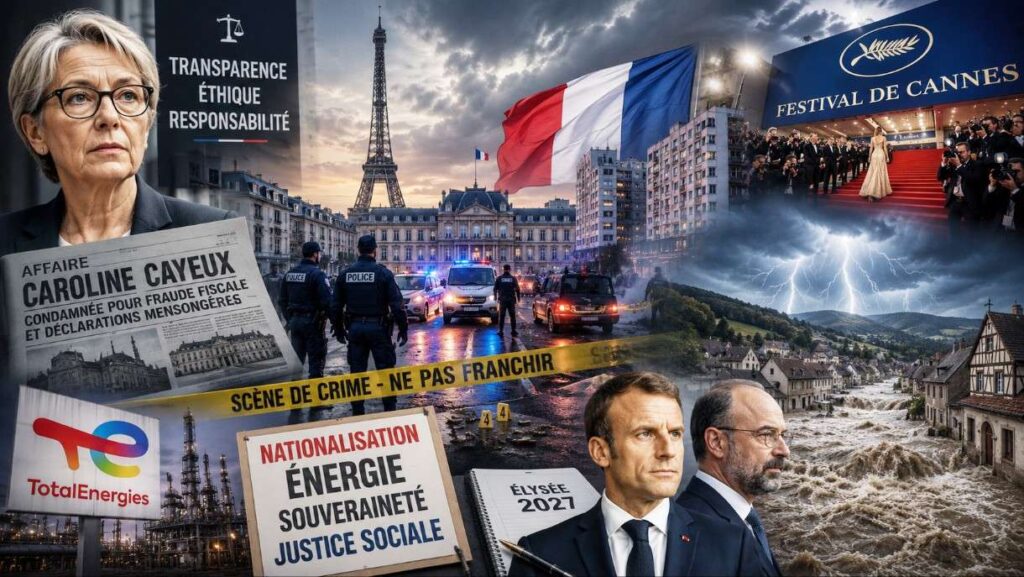
France is currently experiencing a news cycle that almost exemplifies the country’s nervousness. Domestic political scandals, escalating security debates, extreme weather conditions, and the first open preliminary battles for the 2027 presidential election overlap into an overall picture of constant tension. The public debate increasingly appears exhausted, but at the same time highly politicized.
The Caroline Cayeux Affair and Distrust of the Elite
The former minister Caroline Cayeux remains at the center of political discussion. Her conviction for tax fraud and false asset declarations strikes a sensitive nerve in the French public. The affair is part of a long series of political scandals that have been undermining trust in the political class for years.
Many commentators recall Jérôme Cahuzac, former budget minister under François Hollande, who ironically hid a secret foreign bank account while fighting tax evasion. The long-time local politician Patrick Balkany also remains for many French people a symbol of a political culture in which personal enrichment and public power appear closely intertwined.
The case of Cayeux is particularly problematic because France has significantly tightened its transparency rules in the past ten years. After several corruption scandals, control mechanisms were expanded, asset declarations made mandatory, and the Haute Autorité pour la transparence de la vie publique strengthened. Nevertheless, new scandals keep emerging — which many French people now interpret less as individual misconduct and more as a structural problem.
The political consequence is a further loss of trust in established parties and institutions. This climate has favored both the success of the Rassemblement National and the growing polarization between left- and right-wing populist forces for years.
The Security Debate After the Nice Shooting
At the same time, the issue of internal security dominates the headlines once again. After the deadly shooting in the Les Moulins neighborhood in Nice, France is engaged in an intense debate about drug crime, arms trafficking, and the diminishing influence of state authority in certain districts.
The images of automatic weapons in broad daylight are particularly shocking. French media now openly speak of a “Mexicanization” of certain gang conflicts — a term that would have been considered exaggerated just a few years ago. This refers to the increasing militarization of criminal networks, territorial control of individual neighborhoods, as well as the visible weakening of state presence.
Interior Minister Bruno Retailleau is already under considerable pressure early on. The conservative right demands tougher police measures and a drastic tightening of criminal law. Left-wing parties, on the other hand, point to social neglect, unemployment, and the decay of public infrastructure in many banlieues.
In fact, a deeper problem of France is revealed here: the drug economy has long since become a parallel economic model in some suburbs. Security authorities have been warning for years about professionally organized networks with international connections, especially through Mediterranean ports such as Marseille.
The security issue is once again developing into one of the central topics of the upcoming presidential election.
Extreme Weather and the Vulnerability of the Regions
The weather is also occupying the country massively. Severe thunderstorms have caused significant damage in several regions. Especially the mudflows in Alsatian Aschbach as well as the storm damage in the Gers department dominate the regional news broadcasts.
France is thus experiencing a renewed debate about the consequences of climate change — but with one particularity: the discussion is increasingly focusing on the concrete vulnerability of rural regions. Floods, hailstorms, and heavy rain often affect communities with limited financial resources and weak infrastructure.
While the large cities often seem better protected, in rural areas the feeling is growing of being almost defenselessly exposed to climatic changes. Insurances have been warning for years about rising costs due to natural disasters. At the same time, preventive measures and municipal protection systems are increasingly reaching their limits.
The political dimension is significant. Climate policy in France is no longer discussed merely as an ecological issue, but increasingly as a problem of state resilience and territorial equality.
Cannes as a Symbol of French Soft Power
Today officially marks the start of the Festival de Cannes — an event that holds political and economic significance far beyond the cultural sector.
While international stars and film delegations arrive, the French focus is also on the gigantic security and logistics organization behind the glamour. Thousands of security personnel, complex traffic control, and international media presence make Cannes a major state operation every year.
The festival remains a central component of cultural soft power for France. In times of geopolitical tensions, Paris continues to see itself as a global cultural power that exerts international influence not only militarily or economically, but also culturally.
At the same time, Cannes has enormous economic significance for the Provence-Alpes-Côte d’Azur region as well as for the French film industry as a whole. Despite competition from streaming, the festival remains one of the most important international showcases for European cinema.
The Debate about TotalEnergies
Today, a statement by Manuel Bompard, the coordinator of La France Insoumise, is also causing political discussions. He demands the nationalization of TotalEnergies and describes it as “extremely profitable” for the state.
Behind this demand lies a broader French fundamental debate: What role should the state play in strategic economic sectors? France traditionally has a significantly stronger state-driven economic culture than many other European countries. Companies like EDF or the SNCF are still regarded by many French people as part of national sovereignty.
The energy crisis since the Ukraine war has further intensified this discussion. High prices, geopolitical uncertainties, and the fear of losing control over critical infrastructure strengthen interventionist positions — both on the left and sometimes on the right.
Critics, however, warn of enormous costs and possible conflicts with European competition rules. Nevertheless, the debate shows how strongly questions of economic sovereignty have recently moved back into the center of French politics.
The Early Shadow of the 2027 Presidential Election
Although the election will not take place until 2027, the political scene is already visibly starting to align itself for the post-Macron era. Emmanuel Macron is effectively in his final term, which is leading to an open succession battle within the political system.
Édouard Philippe is currently being watched especially closely. The former prime minister is increasingly positioning himself as a pragmatic stability candidate for the civic center. His strategic restraint appears calculated: Philippe has so far avoided open confrontations with Macron but is simultaneously systematically building his own profile.
Macron’s late appointments and personnel shifts are therefore increasingly interpreted from an electoral strategic perspective. Many observers already see initial power shifts within Macron’s camp.
At the same time, both the Rassemblement National and the radical left are trying to politically capitalize on the current climate of social insecurity. Security, purchasing power, migration, and institutional trust are likely to dominate the upcoming election campaign.
On this Tuesday, France therefore seems like a country in permanent transition: economically burdened, socially tense, and politically already focused on the time after Macron. Between fears for security, climate concerns, mistrust of elites, and growing social polarization, the feeling intensifies of a state that must appear capable of action while constantly managing crises.