
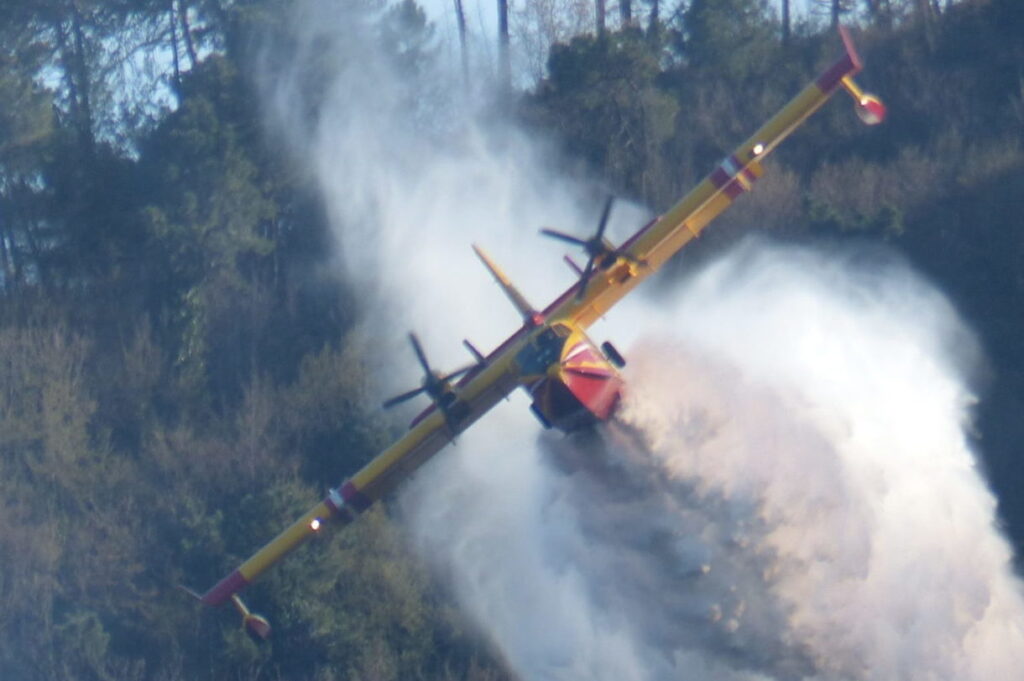
France is upgrading its fight against forest fires. On June 4, 2026, Interior Minister Laurent Nuñez signed the order for two new DHC-515 firefighting aircraft in Nîmes. These are the latest generation of the world-renowned Canadair planes, which have been indispensable tools in combating large forest and vegetation fires for decades.
The investment amounts to around 200 million euros. However, behind the announcement lies a sobering reality: the two planes are expected to be delivered only in 2032 or even 2033. At a time when forest fires are increasingly becoming a permanent threat, such a timeline seems almost paradoxical.
The new aircraft complement two DHC-515s already ordered in 2024, scheduled for delivery in 2028. In the long term, the French civil protection authority plans a fleet of a total of 16 amphibious firefighting aircraft. These planes can scoop water directly from lakes, rivers, or the sea and drop it over fire zones again within seconds — a crucial advantage in rapidly escalating large fires.
The expansion of the air fleet is not without reason. The 2025 wildfire season showed how drastically the situation has changed. Nearly 15,000 fire outbreaks were recorded last year. Around 1,800 of these developed into true forest fires, destroying almost 20,000 hectares of natural area. What used to primarily affect the Mediterranean region is now spreading far beyond the south of France. About fifty départements are now considered particularly threatened.
This development reflects a new reality. Higher temperatures, longer dry spells, and more frequent heatwaves create conditions under which fires can spread rapidly. Many regions that had little experience with large forest fires must now prepare for scenarios that were long considered exceptional.
Why does the delivery of the new planes take so long?
The reason lies in the unique market situation. The Canadian manufacturer De Havilland Canada is currently the only producer of this special aircraft class. After production of the classic Canadair planes was discontinued in 2015, manufacturing had to be practically rebuilt due to sharply increasing demand in Europe. Numerous countries are now investing heavily in their firefighting aircraft fleets, filling order books for years to come.
These long wait times cause frustration among fire departments and regional politicians. They point out that the effects of climate change are already visible today, while important equipment is often only available many years from now. A growing gap exists between increasing danger and industrial reality.
Therefore, attention is increasingly turning to European alternatives. The French government supports several national projects, including developments by the companies Kepplair and Hynaero. The goal is to bring domestic firefighting aircraft to market in the medium term and reduce strong dependence on a single foreign manufacturer.
The order for the two DHC-515s is thus more than just a procurement process. It highlights how long-term states must now think to be prepared for the challenges of the coming decades. While the wildfire season approaches every year, France is already planning resources today that will only be operational in the early 2030s. The fight against the megafires of the future has long since begun — even if many of its most important tools are still on the drawing board or at the end of a long production chain.
Author: Andreas M. Brucker