
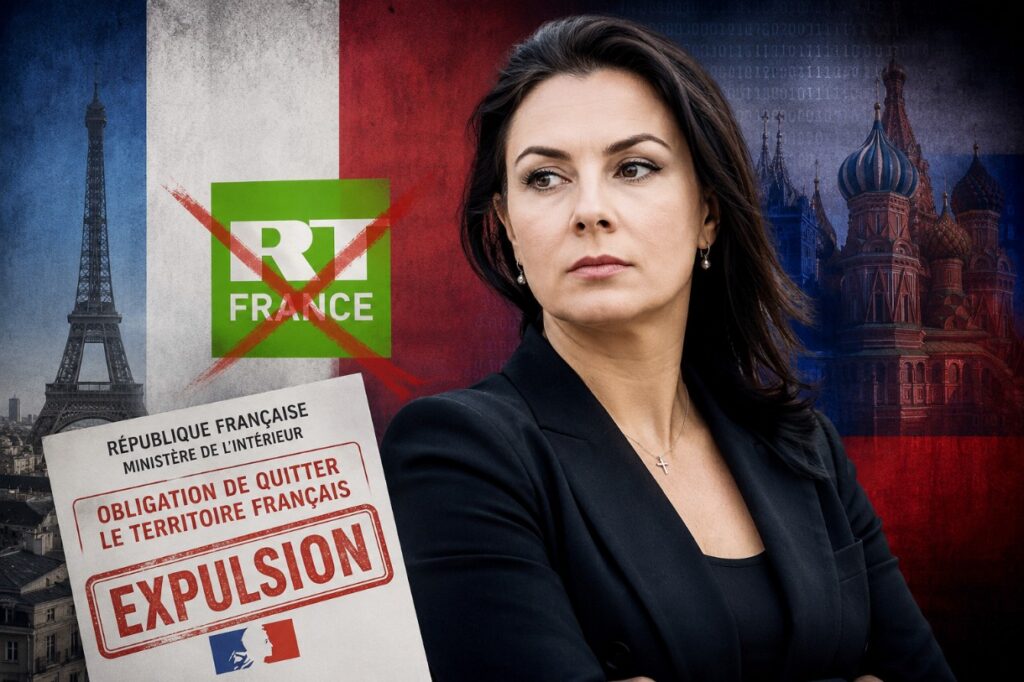
France is toughening its stance against suspected Russian influence operations. The Interior Ministry has issued a deportation order against Xenia Fedorova, the former head of the now-banned broadcaster RT France. Authorities accuse the Russian journalist of deliberately introducing Kremlin narratives into the French media landscape, thereby endangering public order and the fundamental interests of the state.
Fedorova has not yet been deported. Since being served with the order, she has been under house arrest and must report to a police station daily. Her lawyer, Emmanuel Piwnica, announced that he would immediately file an appeal against the decision. Under French administrative law, a court is now expected to examine whether the conditions for deportation have in fact been met.
Allegation of coordinated influence operations
In the Interior Ministry’s view, the case goes far beyond controversial journalistic activity. The deportation order describes Fedorova as a conduit for Russian disinformation campaigns. By disseminating such narratives, it says, she contributes to influencing public opinion and undermining the trust of French and European citizens in their institutions. Her presence therefore constitutes a “particularly serious and current threat to public order.”
The French government places the case within a broader security policy context. Since the start of Russia’s war of aggression against Ukraine, France and other European states have significantly tightened their measures against foreign influence operations. Alongside cyberattacks, espionage and sabotage, disinformation campaigns and the use of state-controlled media are increasingly becoming a focus for security authorities.
From state broadcaster RT France to CNews
Since 2017, Fedorova had been tasked with establishing and running RT France. The French branch of the Russian state-funded broadcaster lost its means of distribution within the European Union shortly after the start of Russia’s invasion of Ukraine in March 2022. Brussels justified the ban by stating that Russian state media were part of a coordinated Kremlin information strategy and were disseminating propaganda in support of the war of aggression.
After the final closure of RT France in 2023, Fedorova remained in France. She founded a consulting firm and quickly established herself as a commentator in several media outlets owned by businessman Vincent Bollore. Since then, she has appeared regularly on CNews and Europe 1, written for JDNews and hosted programs on the Orthodox Church.
Her analyses of the war in Ukraine often follow the official Russian line of argument. Critics accuse her of downplaying Moscow’s responsibility for the war of aggression, holding Western states responsible for the conflict’s duration and encouraging doubts about European institutions. Foreign Minister Jean-Noel Barrot had already publicly described her weeks before the deportation order as a “proven propagandist” who serves as a mouthpiece for Kremlin disinformation.
Legal tightrope between freedom of expression and state protection
The case is now likely to occupy the administrative courts. Fedorova’s lawyer argues that his client is a journalist and has carried out her professional activity within the framework of applicable laws. Deportation solely on the basis of political views or editorial positions would hardly be compatible with fundamental rights.
The government must therefore demonstrate that this is not merely a matter of pointed or controversial expressions of opinion, but of an active contribution to a foreign influence operation with concrete effects on national security or public order. This distinction is considered legally challenging and is likely to form the core of the forthcoming proceedings.
European legal standards also play a role. The European Convention on Human Rights protects both freedom of expression and freedom of the press. At the same time, it recognizes that these rights may be restricted under certain conditions when national security or public order is seriously endangered. The courts will therefore have to carefully weigh individual freedoms against the state’s security interests.
Controversy over the residence permit
The case gained additional political sensitivity from the fact that Fedorova had only received a French residence card valid for ten years in 2024. The permit had been issued through a regular administrative procedure and triggered considerable debate after becoming known.
Opposition politicians questioned why a former head of an already banned Russian state broadcaster could obtain a long-term residence permit. Several ministries subsequently felt compelled to explain that the decision had been made at the administrative level and that there had been no political interference. The affair led to an intense debate over reviewing residence permits for individuals accused of links to foreign influence networks.
Bollore media outlets call it an attack on press freedom
The media groups Canal+ and Lagardere demonstratively backed their employee. In a joint statement, they said they were “shocked” by the deportation order and assured Fedorova of their full support.
In the companies’ view, the attempt to exclude a journalist from public debate because of her political positions constitutes a serious infringement of freedom of expression and press freedom. In a democratic society, there must also be room for uncomfortable or controversial views.
Critics counter that the protection of press freedom may have limits where media outlets deliberately become part of state-directed influence campaigns. This very question is now likely to take on political significance beyond the specific individual case.
The deportation order thus marks a turning point in France’s approach to suspected foreign influence. For the first time, such a far-reaching measure is being directed at a commentator established in the French media, whom the government accuses of acting in the interests of a foreign state. Whether this allegation will withstand judicial scrutiny remains open. Regardless of the outcome of the proceedings, the case is likely to shape the debate over the boundaries between press freedom, national security and the protection of democratic institutions for a long time to come.
Andreas M. Brucker