
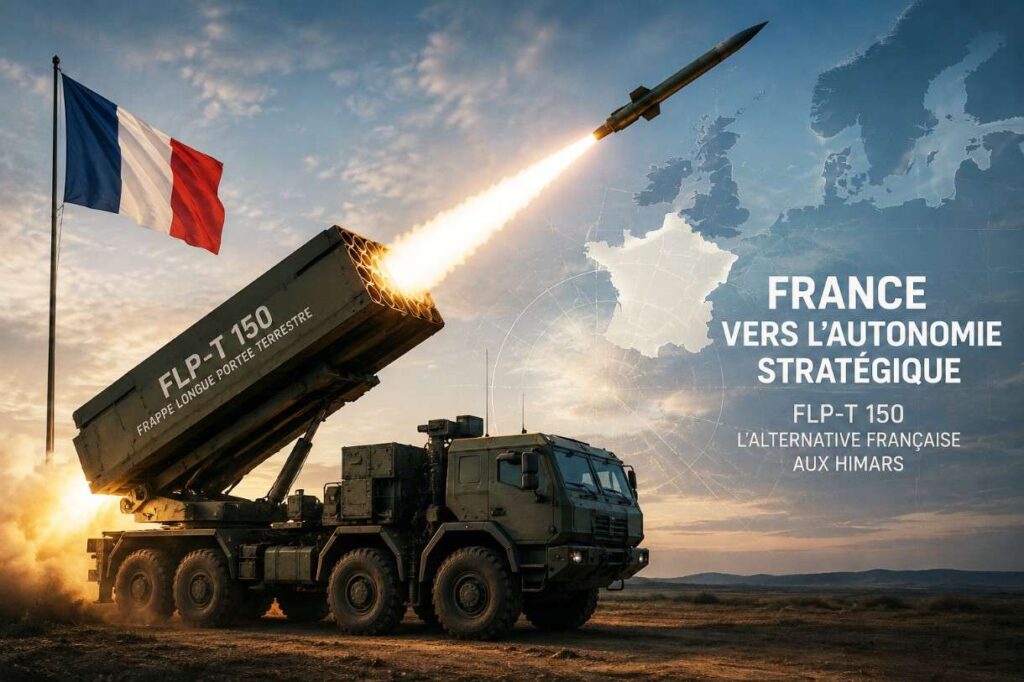
France has taken a symbolic step in its military modernization. The first successful test of the new FLP‑T 150 system is considered in Paris an important milestone on the way to an independent European capability in the field of long-range precision artillery. Behind the technical testing lies much more than an ordinary armament project: it is about strategic sovereignty, industrial independence, and the lessons learned from the war in Ukraine.
The name FLP‑T 150 stands for “Frappe Longue Portée Terrestre,” meaning ground-based long-range strike capability. The system is intended to enable the French army to accurately hit targets at distances of several hundred kilometers in the future. This places France in the area of modern warfare that has gained massive importance since the beginning of the Russian war of aggression against Ukraine. Above all, the American Himars systems have shown how strongly mobile rocket artillery can influence the course of a conflict.
The war in Ukraine changes military priorities
Hardly any weapon system has received as much international attention in recent years as the American Himars system. The highly mobile rocket artillery enabled Ukraine to attack Russian ammunition depots, command centers, and logistics hubs deep behind the front lines. What was crucial was less the pure firepower than the combination of range, precision, and mobility.
The experiences of the Ukraine war have triggered a fundamental reassessment of military capabilities in European capitals. For decades, foreign missions, counterterrorism, or asymmetric conflicts were the focus of Western armed forces. In contrast, classic large-scale conflicts between states were considered unlikely in many places. Accordingly, heavy artillery units were reduced, ammunition depots downsized, and industrial production capacities scaled back.
The war in Eastern Europe has shaken these assumptions. Military planners now observe that modern conflicts are again characterized by mass artillery, drone reconnaissance, and long-range precision strikes. In particular, the ability to eliminate enemy supply routes and command centers from a great distance is now considered a key factor on the battlefield.
Against this background, the development of the FLP‑T 150 no longer appears as an isolated French project but as part of a comprehensive strategic reorientation of Europe.
France’s Search for Strategic Independence
The program has a dual significance for Paris. On the one hand, the French army is to modernize its capabilities and close existing gaps. On the other hand, France has pursued the goal for years of reducing Europe’s dependence on American weapons systems.
President Emmanuel Macron has repeatedly emphasized the necessity of Europe’s “strategic autonomy.” This means the ability to act independently in security and defense policy, without being fully dependent on American technologies or political decisions.
The debate gained new momentum especially after the start of the war in Ukraine. Although the United States remains Europe’s most important military partner within NATO, concerns are growing that Europe could become too dependent on American supply chains, ammunition, and technologies in the long term.
This dependency became particularly apparent in the field of rocket artillery. Many European countries have only limited own capacities or purchase American systems directly. France is now trying to establish an independent alternative with a nationally developed model.
Technological Requirements of Modern Rocket Artillery
The FLP‑T 150 is intended to meet several requirements simultaneously. Mobility is crucial at first. Modern artillery systems must be able to change their position within a short time. Satellite reconnaissance, combat drones, and electronic surveillance make stationary launch positions extremely vulnerable today.
The principle is therefore “Shoot and Scoot”: fire and relocate immediately. It was precisely this capability that made the American HIMARS so effective in Ukraine. After firing, the vehicles can leave their position within minutes, thereby avoiding enemy counterattacks.
Added to this is the question of precision. Modern rocket artillery fundamentally differs from the area bombardments of earlier decades. GPS-guided ammunition now allows for the targeted striking of individual buildings or infrastructure objects. This not only increases military effectiveness but also the political acceptance of such systems, as collateral damage can be reduced.
So far, little is known about the exact technical specifications of the FLP-T 150. However, French defense circles emphasize that the system is intended to offer both long ranges and flexible deployment options. Observers assume that the development could, in the long term, also involve European partners.
The Return of the Arms Industry as a Strategic Factor
The project holds not only military but also significant industrial-political importance. The European defense industry is currently undergoing a phase of profound changes. After decades of relatively low defense spending, numerous countries are once again investing massively in new systems, production capacities, and ammunition reserves.
France has traditionally been one of the few European countries with a largely independent arms industry. Companies in the fields of aviation, rocket technology, and electronics possess extensive expertise. The FLP‑T 150 is intended to strengthen this industrial base while simultaneously securing technological sovereignty.
The French government increasingly views defense programs as an economic policy tool. New projects create highly qualified jobs, promote research and development, and strengthen export opportunities in the international arms market.
This market in particular has become significantly more competitive in recent years. American, South Korean, and Israeli manufacturers dominate many areas of modern artillery systems. Europe is now attempting to partially regain lost industrial capabilities.
Europe’s difficult path to common defense
The successful test of the FLP‑T 150 also raises a fundamental European question: How realistic is truly independent European defense capability?
So far, the European Union has only limited joint defense structures. National interests, different military requirements, and complex decision-making processes complicate many projects. Numerous European defense programs have suffered delays, cost increases, or political conflicts in the past.
France also faces these problems. Years can pass between a successful initial test and full operational readiness. Added to this are questions of financing, serial production, and integration into existing NATO structures.
Nevertheless, awareness is growing within Europe that security policy dependencies carry risks. The geopolitical situation has fundamentally changed in recent years. The war in Ukraine, tensions in the Indo-Pacific, as well as uncertainties about the long-term American role in Europe increase the pressure on European states to expand their own capabilities.
In this context, the FLP‑T 150 appears as more than just a new weapon system. The project symbolizes Europe’s attempt to regain more control over its military capabilities.
The coming years will show whether France can also practically implement this claim. The successful initial test at least marks an important psychological and political step. In a time of growing geopolitical tensions, the ability to independently produce modern long-range weapons is increasingly regarded not as a strategic luxury but as a security policy necessity.
P.T.