
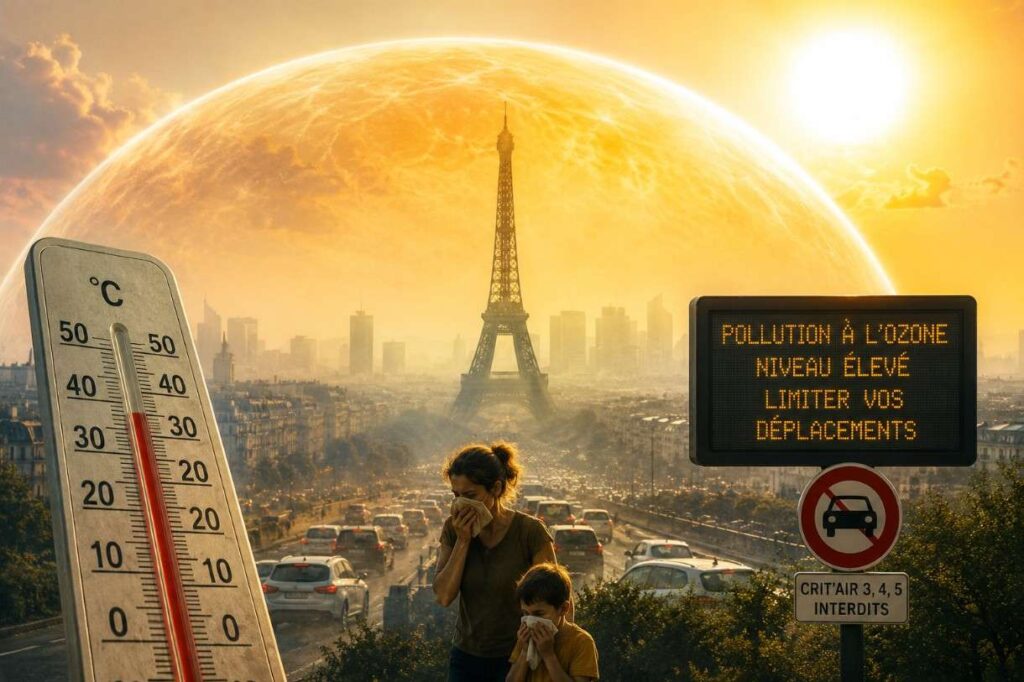
Before the meteorological summer begins, France is experiencing weather conditions that have so far been mainly associated with the height of summer in July and August. Temperatures well above 35 degrees, a very stable high-pressure zone, and a rapid deterioration in air quality combine to put the country under a double burden. While people suffer from an early heatwave, ozone levels have reached concentrations that pose health problems in several regions.
The combination of heatwave and air pollution is an increasing challenge for health authorities, municipalities, and transport policies. What is particularly notable is not its intensity but its timing. It is unusual even among atmospheric scientists for major ozone alerts to be issued as early as the end of May. This event is like a preview of the climatic conditions experts have been predicting for years.
Midsummer phenomena appearing in spring
In Île-de-France, Centre–Val de Loire and Auvergne–Rhône–Alpes, ozone concentrations exceeding official information and alert thresholds were observed. In parts of Normandy, Hauts-de-France and Grand Est, increases in pollution levels were also reported. Meteorologists do not expect the situation to improve at least until the weekend.
The cause lies in unusual weather conditions. France has been under a stable high-pressure system known as a “heat dome” for several days, with a mass of warm air from North Africa stalled over Western Europe. Several regions have seen May record high temperatures broken, and temperatures are well above seasonal averages.
It is precisely this weather pattern that promotes ozone formation near the surface. Unlike the protective ozone layer in the stratosphere, this ozone is produced in the lower atmosphere by photochemical reactions. Nitrogen oxides from vehicle exhaust, emissions from industrial facilities, and volatile organic compounds react under strong sunlight, and high temperatures further accelerate these reactions.
At the same time, under a stable high pressure system, air exchange is hindered and pollutants do not disperse but stagnate. Urban air is trapped as if sealed, allowing emitted substances to become increasingly concentrated. This weather setup has produced high pollution levels in city centers such as Paris and Lyon.
An invisible threat to health
Ozone is one of the summer air pollutants considered particularly problematic. Unlike fine particles, it is hardly noticeable to the general public, but its health impacts are serious.
Healthcare professionals point out that ozone can irritate mucous membranes, promote respiratory inflammation, and reduce lung function. Children, the elderly, people with asthma, and those with cardiovascular disease are particularly at risk. Even short-term exposure can cause coughing, difficulty breathing, eye irritation, and headaches. Prolonged exposure increases the risk of hospitalization due to respiratory and heart problems.
Heat itself also places strain on the body. When high temperatures and air pollution occur simultaneously, health risks are mutually amplified. The current weather situation creates a double burden and is a serious issue particularly for vulnerable groups.
Effects are already appearing. Multiple sporting events have been adjusted, postponed, or canceled. Organizers have had to provide additional medical arrangements or fully suspend competitions. This discussion shows how extensively extreme weather events affect everyday areas of society that have not previously been regarded as a problem.
Authorities respond with traffic restrictions
In the Paris region, authorities implemented the standard responses currently used for severe ozone events. The police prefecture temporarily enacted differentiated vehicle driving bans, prohibiting high-pollution category vehicles from entering certain sections of the capital region. At the same time, speed limits on highways and main roads were reduced. Recommendations for teleworking and restrictions on large vehicle traffic were also issued.
The logic of these measures is understandable. Reduced traffic leads to lower nitrogen oxide emissions, which has the effect of suppressing ozone precursor formation. However, the effectiveness of such measures is debatable. Air quality experts point out that ozone is often formed in locations different from emission sources. Chemical reactions can extend for tens of kilometers, so local traffic restrictions can be expected to have only limited effect.
Still, these measures carry a political signal: that authorities recognize this situation not as a mere temporary weather anomaly but as a structural environmental and health issue.
Climate change is changing the calendar
What is particularly worrisome is the timing of its occurrence. In France, ozone peaks have traditionally been phenomena during the summer holiday period, but this time it occurred early at the end of May.
According to air quality experts, this is the earliest large-scale ozone alert issued since the start of modern observations, and climatologists do not consider it an isolated event but see it as a further sign of a fundamental shift in European weather and climate patterns.
Since the beginning of the century, the frequency of heat waves in France has increased markedly. At the same time, rapid temperature fluctuations have also become more common, with abrupt changes from unusually cool conditions to very high temperatures occurring within a few days. Just before this event, such temperature changes were observed.
Climate change acts more as an amplifier of certain weather phenomena than as their direct trigger. These atmospheric patterns have existed before, but they now overlay a generally warmer climate system. As a result, heat waves arrive faster and stronger, last longer, and occur earlier.
This ozone event in France is not merely a temporary deterioration of air quality. It is a symbolic example of how environmental and health risks that were previously confined to a few weeks in summer in Europe are now occurring earlier in time and affecting a much wider area. This heat dome is not just a weather event but an indicator of rapid changes in climatic conditions, signaling that politics, cities, and healthcare systems must respond urgently.
Andreas M. Brucker