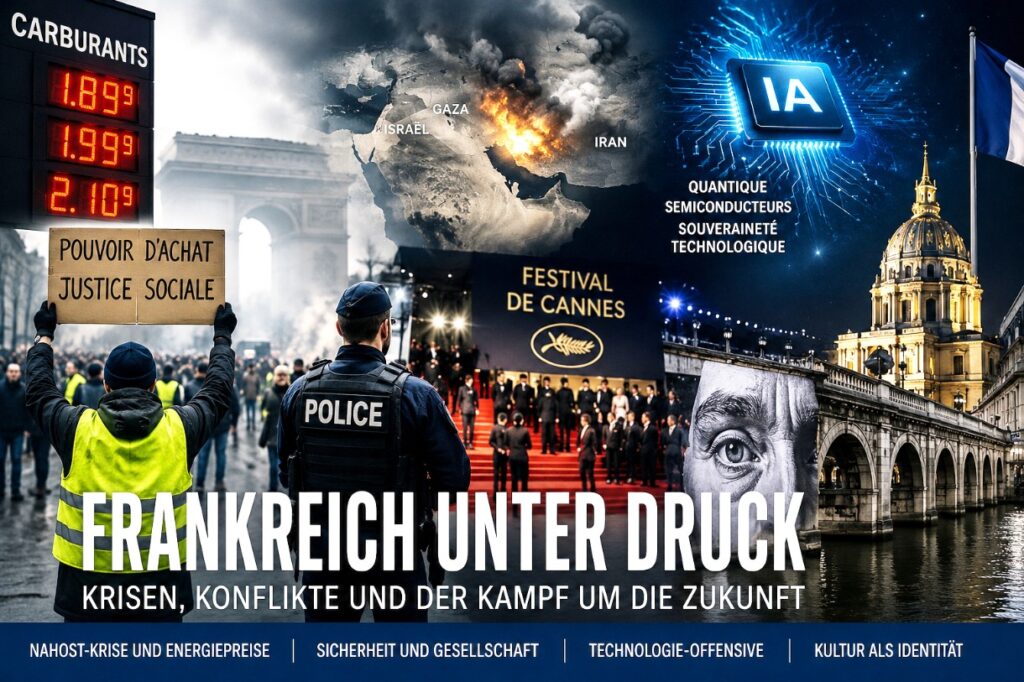
The French media landscape on this May 23, 2026, portrays a country in a permanent state of alert. Hardly any sector remains untouched by crisis topics: foreign policy, energy prices, security, technology, societal polarization, and cultural symbolic politics intertwine and create a remarkable simultaneity of tensions. France does not appear as a state in acute panic, but rather as a nation accustomed to a state of permanent uncertainty.
The Fear of a New Social Explosion
At the center of coverage remains the geopolitical escalation in the Middle East and its economic consequences for Europe. Particularly strongly, the French media are preoccupied with the renewed rising energy and fuel prices. The government under President Emmanuel Macron is visibly trying to cushion social aftermaths early on. New aid programs for the transport industry, agriculture, commuters, and small businesses are interpreted in commentary less as classic social policy and more as preventive crisis management.
The historical shadow of the “Gilets jaunes” remains omnipresent. Several commentators recall that the Yellow Vests protests in 2018 were originally also triggered by rising fuel prices. Back then, a fiscal measure developed within a few weeks into a nationwide revolt against loss of purchasing power, elites, and social alienation.
Today, the situation appears more complex. France is suffering simultaneously from weaker growth, rising national debt, geopolitical uncertainties, and a general feeling of economic fragility. Many editorials now openly speak of an “économie de guerre larvée” — a latent war economy that is not officially declared but whose logic increasingly shapes everyday politics.
Cannes as a Mirror of a Nervous Nation
In parallel, the sense of security once again dominates the headlines. The Cannes Film Festival, ending today, is not only viewed as a major cultural event but increasingly read as a socio-political symbol.
Reports about luxury watch thefts, organized crime groups, increased police presence, and comprehensive security measures around the Croisette shape the coverage almost as strongly as the films themselves. The glamorous Cannes now appears to many commentators as a condensed metaphor for modern France: internationally visible, culturally prestigious, and economically attractive — yet marked by nervousness, social withdrawal, and permanent surveillance.
The security debate points to a deeper problem. France remains one of the European countries with particularly pronounced sensitivity to public order. Terror attacks, urban violence, organized crime, and social unrest in recent years have created a climate in which security issues permeate almost every political discussion.
That even a film festival now takes place under quasi-high-security-like conditions is described by many media less as an exception and more as the new normal.
France’s Struggle for Technological Sovereignty
Another focal point of the French press is strategic technology policy. The billion-dollar investments by the Élysée in artificial intelligence, quantum research, and semiconductor production are widely analyzed. Behind this lies the concern that Europe could be technologically squeezed in the global competition between the United States and China permanently.
France is trying to position itself as the engine of European technological sovereignty. Especially business newspapers now openly speak of a global “technology war” in which control over AI infrastructure, data centers, chips, and data flows is understood as a new form of geopolitical power.
Paris follows a dual strategy: on the one hand, to attract international investors, and on the other, to deliberately protect strategic key industries. This policy connects to a long French tradition of economic dirigisme — but under significantly more difficult global conditions than in the decades following World War II.
The nervousness is palpable. Many analyses warn that Europe remains increasingly dependent on American and Asian corporations for AI applications, cloud infrastructure, and semiconductors. France sees this not only as an economic risk but as a question of national sovereignty.
Polarization and Hardening of the Public Climate
Equally present remains the topic of social tensions. After racist threatening letters and intimidation in Agen, numerous media discuss a climate of increasing coarseness in public discourse. The debate goes far beyond individual incidents.
Many commentators diagnose a structural polarization of French society. Political camps are increasingly drifting apart, while social networks reinforce emotional escalation and radicalization. Added to this is a deep institutional skepticism towards parties, media, and state authorities.
France is experiencing a development also visible in other Western democracies, but due to its conflict-ridden political culture appears particularly intense. The tradition of tough ideological confrontations — from the French Revolution through the class struggles of the 20th century to today’s identity debates — further sharpens societal tensions.
Several newspapers now openly ask whether France is entering a phase of permanent domestic political instability, where crises are no longer exceptions but the general state of affairs.
Culture as a Counterimage to the Crisis
At the same time, cultural self-presentation remains a central component of French identity. The spectacular redesign of the Pont Neuf by artist JR or the global attention surrounding Cannes show France’s continuing claim to remain culturally visible worldwide.
Especially in times of crisis, the cultural stage seems to serve a special function for France: it not only provides entertainment but also reassures national significance. Art, architecture, film, and public symbolism thus indirectly become part of a political strategy of cultural resilience.
However, it is notable that even these cultural topics are now seldom discussed separately from security, identity, or societal issues. Culture appears less as a counterworld to the crisis and increasingly as its mirror.
The tone of many French media on this Saturday remains remarkably sober. Euphoria or progress optimism has become rare. Instead, the feeling dominates of a country simultaneously preparing itself economically, geopolitically, technologically, and socially for permanent uncertainty.