
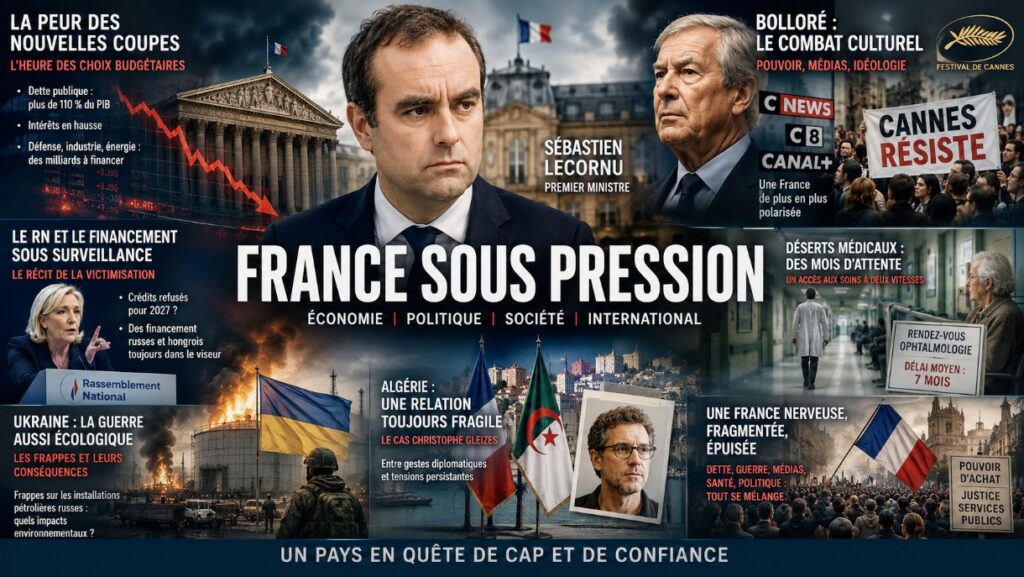
France faces on May 20, 2026, one of those political moments in which several crises become visible simultaneously and reinforce each other. The public debate no longer revolves around individual reforms or isolated conflicts, but around a fundamental question: Is the French model still financially viable, politically manageable, and socially inclusive? From state finances to media power and healthcare, the image emerges of a country under constant pressure.
The Return of Austerity Politics
Especially dominant at this moment is the debate about public finances. Prime Minister Sebastian Lecornu is increasingly openly preparing the population for cuts. The tone reminds many observers of previous phases of austerity in France, especially the European deficit crises of the early 2010s.
The situation, from the government’s perspective, is serious. France’s public debt currently exceeds 110 percent of Gross Domestic Product, while interest costs are simultaneously rising. Added to this are enormous structural burdens: expenses on defense, industrial policy, energy transition, and welfare state financing compete for limited resources.
The political importance lies less in the numbers themselves than in their social effect. France traditionally has a strong welfare state, which is deeply linked to the republican self-understanding. Cuts in pensions, health services, or municipal budgets therefore directly affect the country’s social core.
Many opinion pieces already speak of a possible “tournant de rigueur” – a return to austerity politics. The memory of previous social movements, from the Yellow Vests to pension strikes, increases the nervousness even more.
Media power and the conflict around Bolloré
At the same time, the ideological conflict around conservative entrepreneur Vincent Bolloré and his growing media empire is intensifying. The latest escalation was provoked by protests and statements during the Cannes Film Festival.
What at first seemed like a sector-specific dispute is increasingly becoming a debate of principles about cultural power and political influence. Critics accuse Bolloré of building a conservative and nationalist media network inspired by the Italian model. Supporters, on the other hand, see in the outrage of the cultural world the expression of a left-wing cultural elite that has long dominated.
The conflict touches a sensitive nerve of the French public: the connection between media, politics, and cultural identity. Television channels like CNews or Canal+ symbolically represent a deeper ideological polarization.
It is remarkable how cultural debates are now directly politicized. Issues regarding journalistic independence, cultural representation, or pluralism of opinions merge with partisan conflict between liberal, conservative, and populist right sectors.
The Rassemblement National and the victim narrative
The Rassemblement National uses this atmosphere strategically. The discussion about difficulties in funding election campaigns fits perfectly with the party’s self-image as a supposedly marginalized opposition force.
RN leaders argue that French banks systematically refuse to grant loans to the party. With this, Marine Le Pen’s sector revives a victim narrative cultivated for years: the political and economic establishment wants to prevent the rise of the party.
At the same time, the past remains problematic. Previous funding from Russia and Hungary still raises questions about geopolitical proximity and political dependence. This topic is once again discussed sensitively, especially in the context of the war in Ukraine.
Interesting is the strategic shift of the RN. Today the party presents itself less as a radical protest movement and increasingly as a supposedly normal governmental alternative that would be disadvantaged by the “system”. This normalization remains one of the central factors in French politics ahead of the 2027 presidential elections.
The war in Ukraine and the ecological dimension
The war in Ukraine remains omnipresent, but the French debate is shifting its focus. In addition to military developments, the ecological consequences of the war are gaining more prominence.
Especially discussed are the attacks on Russian oil facilities and the possible environmental damage they may cause. This shifts the perspective: whereas for a long time the Russian environmental destructions were mainly addressed, commentators now more often inquire about the ecological consequences of modern warfare in general.
This debate shows how much environmental issues are now also interpreted from a security perspective. The war is no longer seen solely as a military or humanitarian catastrophe, but increasingly as a long-term ecological burden.
French media often link this discussion to fundamental questions of European energy security. The relationship between fossil fuel dependencies, geopolitical conflicts, and climate policy is clearer than a few years ago.
The Medical Supply Crisis
However, many French people experience the crisis particularly concretely in everyday life, for example, in access to medical care. The so-called “medical deserts,” regions with a severe shortage of doctors, remain one of the most emotionally charged domestic issues.
The long waiting times for appointments with specialists, especially ophthalmologists or dermatologists, are no longer only lamented in rural areas. Even medium-sized cities are increasingly struggling with supply shortages.
The problem has several causes: the aging medical workforce, unattractive working conditions outside of metropolises, and educational planning that has been criticized for decades in the healthcare system.
The development becomes politically dangerous because it undermines the republican promise of equality. When healthcare increasingly depends on the place of residence, the impression of a territorially divided country arises, with privileged urban centers and lagging regions.
This perception, in turn, reinforces political support for populist and anti-elitist movements.
The Fragile Relationship with Algeria
In foreign policy, France remains under tension. Relations with Algeria continue to be one of the most sensitive dossiers of French diplomacy.
The case of the French journalist Christophe Gleizes once again shows how quickly internal and historical conflicts impact bilateral relations. Every diplomatic approach is immediately interpreted through internal politics both in Paris and in Algiers.
The background goes far beyond the current conflicts. The colonial past, migration issues, security cooperation, and the role of the population of Algerian origin in France make the relationship especially complex.
It is remarkable how strong symbolic gestures have become. Individual statements by ministers or diplomatic meetings often provoke greater debates than concrete political results.
France remains caught in a difficult balance between historical responsibility, geopolitical interests, and internal political pressure.
Currently, France seems like a country in a permanent state of overlapping crises. Economic insecurity, geopolitical conflicts, cultural polarization, and social tensions are intertwined and reinforce each other. What is striking is not so much the existence of individual problems, but their simultaneous concentration.
The political class tries to convey stability, while the media and the public are increasingly marked by an atmosphere of exhaustion. Trust in institutions remains fragile, social fragmentation visible.
At the same time, however, a typically French pattern also emerges: especially in phases of great tension, the political debate intensifies markedly. France remains a country that faces conflicts publicly – often loudly, polarized and contradictory, but rarely apathetic.