
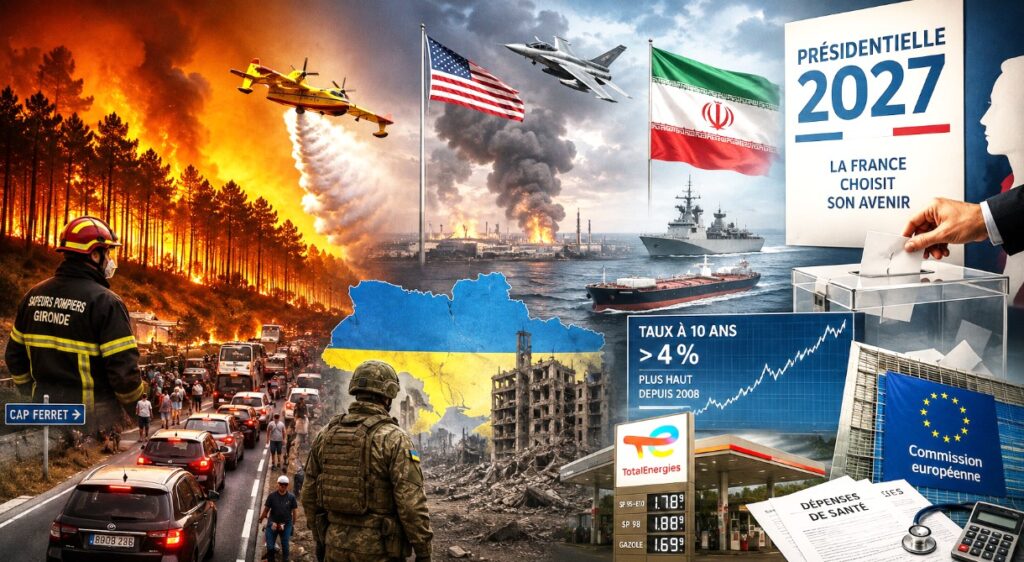
Current events in France this Friday are shaped by a multitude of crises unfolding simultaneously. At the center are the devastating forest fires in the southwest of the country, which have become a national challenge. At the same time, the escalation of international conflicts, economic uncertainties, and the first signs of the 2027 presidential campaign are occupying politics and public opinion. Added to this are healthcare reform projects that foreshadow new social tensions.
Forest fires become a national challenge
The dominant topic in the French media is the severe forest fires in Gironde. Around the northern part of the Arcachon Basin, the flames continued to spread overnight. More than 8,700 hectares of forest and vegetation have already been destroyed.
The authorities ordered the gradual evacuation of the entire Cap Ferret peninsula. More than 23,000 people had to leave their homes, holiday residences, or campsites. Numerous tourists have been particularly affected, as they had to vacate their accommodation in a very short time. Images of kilometer-long vehicle queues, dense smoke, and nighttime evacuations remind many French people of the devastating fires of summer 2022.
President Emmanuel Macron activated the European Civil Protection Mechanism to request additional firefighting aircraft and helicopters from other EU member states. The decision highlights that French emergency services are reaching the limits of their capacity in the face of several major fires occurring simultaneously.
At the same time, structural deficiencies are increasingly being debated. Firefighter associations point to staff shortages, overstretched response teams, and an insufficiently small fleet of firefighting aircraft. As numerous departments are already considered high-risk areas, the debate on long-term preparedness for more frequent large-scale fires is gaining considerable relevance.
Climate change exacerbates drought and conflicts over use
Forest fires are increasingly seen as an expression of a deeper climatic development. Persistent heat, parched soils, and declining water reserves have transformed large parts of France into a highly flammable landscape.
It is particularly striking that regions previously hardly considered prone to forest fires are now also affected. At the same time, conflicts over the use of increasingly scarce water reserves are intensifying. Agriculture, tourism, municipalities, and private households are increasingly competing for limited resources.
The situation is taking on political significance due to the call by the agricultural union Coordination rurale not to comply with certain water restrictions. In this way, the ecological crisis is increasingly becoming a matter of social distribution, in which economic interests, security of supply and climate adaptation clash directly.
The Middle East conflict affects international security
The situation also remains tense in foreign policy. The military conflict between the United States and Iran continues with new attacks on Iranian facilities. At the same time, concern is growing about a regional expansion of the war.
Particular attention is being paid to attacks by the Houthi militia on Saudi oil tankers in the Red Sea. Alongside the Strait of Hormuz, the Bab al-Mandab Strait is thus also coming into focus: one of the most important trade routes in global commerce. Disruptions on these sea routes could have considerable effects on energy prices and supply chains.
France is already directly affected. Following the detention of French diplomats in Tehran, the government is examining additional measures to protect French citizens in Iran. French media are increasingly describing the conflict as a war of attrition in which military pressure and economic consequences are used equally as strategic instruments.
The war in Ukraine remains a central security issue
The war in Ukraine also continues to occupy a great deal of space in French coverage. New Russian missile attacks on Kyiv highlight the ongoing intensity of the fighting.
At the same time, domestic political debate in Ukraine is growing. Protests against government decisions show that democratic disputes persist despite the war.
Reports of internal problems within the Russian armed forces are also receiving special attention. The analyzed complaints of Russian soldiers and their relatives paint a picture of significant supply problems, high losses, and growing dissatisfaction within the military. French observers see this as evidence of increasing pressure on Russia’s conduct of the war.
International crises affect the French economy
International tensions are increasingly being reflected in the French economy. Yields on French government bonds are now above four percent, reaching their highest level since the 2008 financial crisis. Higher financing costs, geopolitical uncertainties, and concerns about public debt are increasing economic pressure on the government.
New U.S. import tariffs, which affect numerous trading partners and pose new challenges for European companies as well, are creating additional pressure.
For private households, however, TotalEnergies’ decision to reintroduce price caps for fuel at French petrol stations provides, at least in the short term, some relief. In view of the rising cost of living, energy price developments remain one of the most sensitive issues in economic policy.
At the same time, transatlantic tensions are being exacerbated by a European Commission competition proceeding against Google. The case could further affect the already difficult trade relations between the United States and the European Union.
France is already in presidential campaign mode
Although the presidential election will not take place until 2027, political competition begins much earlier. Parties and potential candidates use the summer months to make public appearances and position their political issues.
There is particularly intense debate about the financing of future election campaigns. At the heart of the discussion are considerations about how democratically approved candidates can access bank loans without calling into question the independence of private financial institutions. The debate concerns fundamental issues of equal democratic opportunity.
Other political disputes concern the planned age restrictions for social media, as well as elements of judicial reform. In particular, the partially suspended use of genetic genealogy in criminal prosecution highlights the persistent tension between security interests and the protection of fundamental rights.
Healthcare reform sparks new social debates
Healthcare policy is also becoming a field of conflict. The government plans to introduce higher co-payments for medicines, medical consultations and medical transport in order to limit public health insurance spending.
Social organizations warn of a greater burden on chronically ill people, older people and low-income households. Following disputes over pension reforms and purchasing power, another politically sensitive area for society could thus move to the forefront.
The Tour de France provides a sporting counterpoint
Despite the predominant crisis issues, the Tour de France remains a fixed part of French public life. With today’s Alpine stage to Alpe d’Huez, the historic cycling race reaches one of its decisive phases. Following Richard Carapaz’s solo victory the previous day, attention is focused on the battle for the general classification.
The contrast between sporting enthusiasm along the Alpine roads and the dramatic events in the southwest of the country highlights France’s exceptional situation. While hundreds of thousands of spectators celebrate the Tour, thousands of firefighters are battling a natural disaster of historic proportions. At the same time, international conflicts, economic uncertainties and domestic political decisions shape everyday political life. France is thus experiencing a summer in which rest and holidays take a back seat for many people in the face of the challenges of a world increasingly marked by crises.