
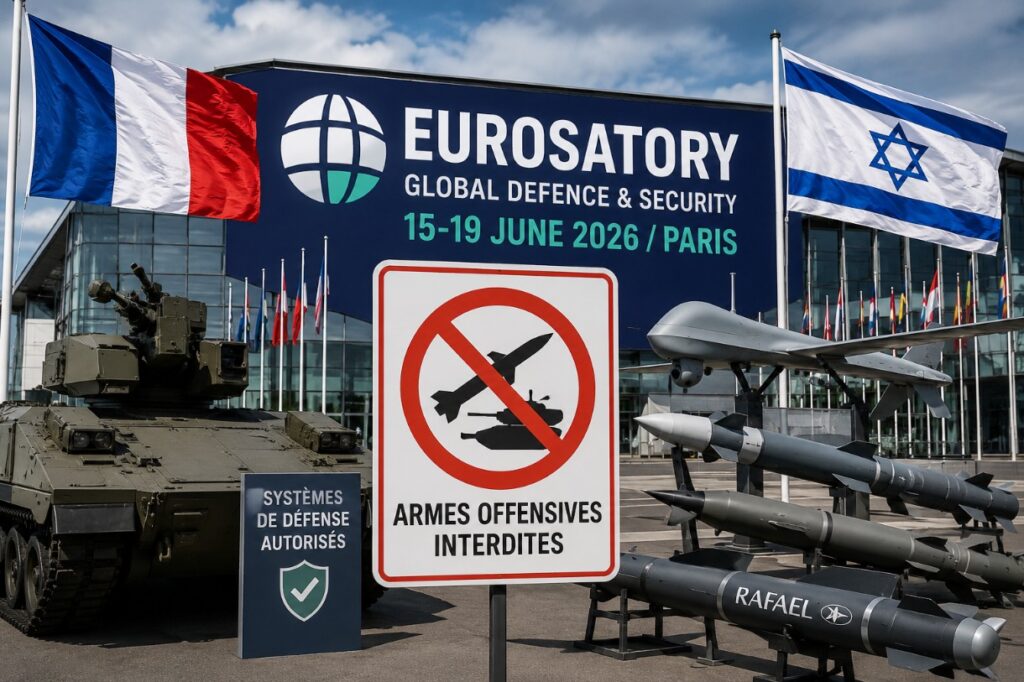
The decision by the French government to ban the presentation of Israeli offensive weapons at the Eurosatory 2026 defense fair marks a further step in the increasingly tense relations between Paris and Jerusalem. Although Israeli companies can still participate in one of the most important defense trade shows in the world, France sets clear limits: air defense and missile interception systems remain allowed, while offensive weapon systems will not be permitted.
The measure goes far beyond a simple organizational decision for a specialized trade show. It represents an example of the French foreign policy attempt to balance strategic interests, economic considerations, and political messages. This case highlights the growing tensions within Europe in managing the Middle Eastern conflict.
A decision full of symbolism
Eurosatory is recognized as one of the most important showcases of the international defense industry. Every two years, manufacturers, military representatives, and government delegations from around the world meet to present new technologies and weapon systems.
The fact that France imposes restrictions precisely at this venue therefore has significant symbolic meaning. The Israeli defense industry is among the most technologically innovative in the world. Systems like the “Iron Dome” missile defense, modern drone technologies, or precision weapons have secured the country a strong position in international markets.
With the new regulation, Paris signals the desire to distinguish between defensive and offensive military capabilities. Defense systems can continue to be exhibited, while weapons that can be used immediately in offensive operations are excluded from the exhibition.
This differentiation seems aimed at preventing France from giving the impression of legitimizing military operations that the French government increasingly criticizes.
The deterioration of Franco-Israeli relations
Since October 7, 2023, with the Hamas attack and the subsequent conflict in Gaza, the tone between France and Israel has changed noticeably.
Immediately after the attacks, President Emmanuel Macron strongly took Israel’s side, reaffirming the right to legitimate defense. However, as the conflict has prolonged, the high number of Palestinian civilian casualties and the humanitarian situation in the Gaza Strip have taken a central role in French criticism.
At the same time, tensions have escalated due to the expansion of military activities in other areas of the region. Representatives of the French government have repeatedly expressed concern about developments in Lebanon and have warned against a possible further escalation of the conflict.
The decision regarding Eurosatory should therefore not be seen as an isolated case. It is part of a series of political signals with which Paris manifests its growing distance from some Israeli military actions.
The strong reaction of Israel
The Israeli government reacted, as expected, with a blunt criticism. The Ministry of Defense called the decision discriminatory and politically motivated.
From the Israeli perspective, an imbalance is created because other exhibitors can present their military products without similar restrictions. Jerusalem argues that the distinction between offensive and defensive weapons systems is often difficult to draw in practice. Many modern military technologies perform both functions or can be used differently depending on the deployment scenario.
Moreover, concern is growing that the French decision could set a precedent. If other European states adopted similar measures, this could have long-term effects on the international marketing of Israeli defense technologies.
A controversy with a backstory
The conflict around Israeli companies at French trade fairs did not start in 2026.
Already before Eurosatory 2024, the French government tried to completely exclude Israeli companies from the event. However, French courts overturned this decision, highlighting serious legal problems and possible violations of the principles of equal treatment.
Controversies were also recorded at the Le Bourget air show in 2025. Several Israeli exhibitors had to remove or cover certain weapons systems. The discussion about the political role of international defense fairs thus gained new intensity.
The current solution therefore appears as a compromise. Israeli companies are not excluded, but their presence is strongly limited.
The dilemma of French foreign policy
For Paris, the issue is particularly delicate.
France is one of the largest arms exporters in the world. The defense industry employs tens of thousands of people and is considered a strategic pillar of national sovereignty. Events like Eurosatory are crucial platforms for international business and cooperation in security matters.
At the same time, France seeks to maintain its role as a diplomatic actor in the Middle East. The government wants to present itself as a credible interlocutor to Arab states, without jeopardizing its traditional relations with Israel.
This tense situation makes a clear position difficult. A total exclusion of Israel would have caused serious diplomatic frictions and it is likely that it would have been contested again in court. On the other hand, not adopting any measures would have weakened the credibility of French criticism of Israeli military operations.
The intermediate solution chosen highlights the attempt to reconcile both interests.
Europe and the new politicization of arms markets
The case indicates a broader trend. International arms fairs have long been mainly economic and technical events. Increasingly, however, they are becoming stages for geopolitical conflicts.
Sanctions against Russia after the attack on Ukraine, debates about arms supplies to conflict areas or export restrictions to individual states have significantly heightened the political dimension of the defense industry.
The question of which countries are allowed to participate in international fairs and what restrictions apply is increasingly becoming the subject of diplomatic controversies. Eurosatory 2026 will therefore likely be perceived not only as a trade fair for new military technologies but also as the stage for a diplomatic conflict between two long-standing partners.
France is trying with its decision to follow a fine line: it wants to make visible the criticism of Israeli military operations without fundamentally questioning relations with Israel. Whether this balance will succeed will not only depend on the reactions in Jerusalem. It will be crucial to see if Paris consistently applies its position to other conflicts and actors as well. Otherwise, the risk remains that the criticism will be of a selective policy – and thus the controversy that the French government actually intended to mitigate with its compromise solution will continue.
Author: P. Tiko