
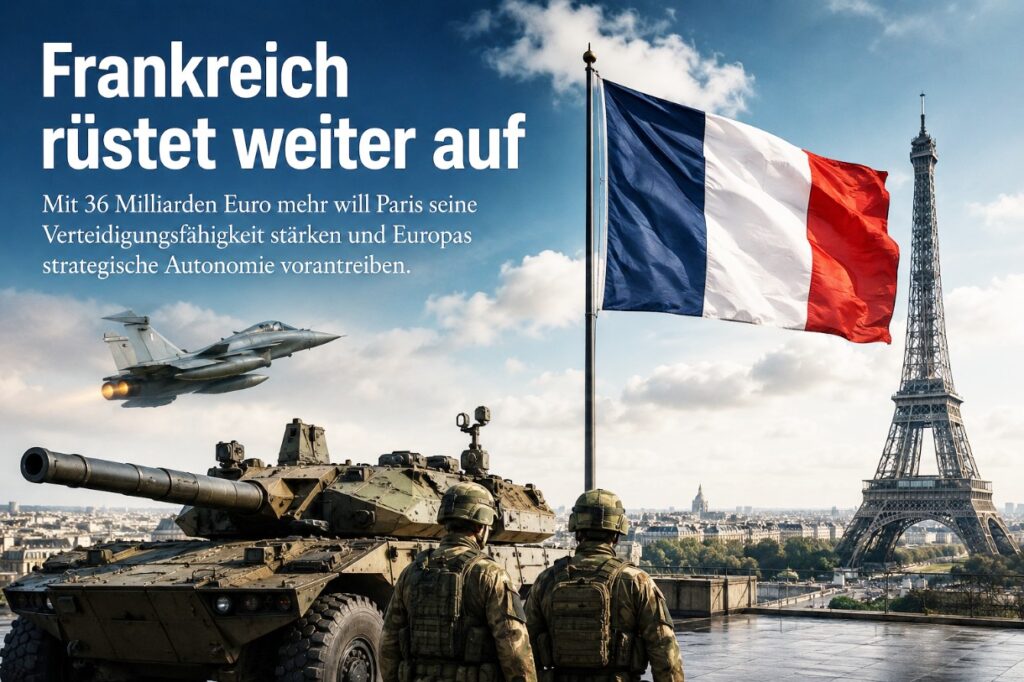
France has made its decision. With the National Assembly’s clear approval of the updated military planning 2024–2030, Paris is pursuing not only a fiscal policy adjustment but also a geopolitical recalibration of its role in Europe. 436 billion euros are to be invested in the armed forces by 2030, 36 billion more than previously planned. In times of chronic state deficits and growing social tensions, this is not an ordinary budget decision, but a strategic prioritization.
The message is aimed both outward and inward. Outwardly, France signals its claim to remain Europe’s military core state – regardless of how the United States might position itself under a possible second Trump presidency. Inwardly, the massive rearmament is intended to convey an impression of governmental capability, after France has repeatedly experienced the limits of its military and administrative capacity in recent years: in the Sahel zone, during the energy crisis, in the fight against terrorism, and in the face of social polarization.
The term “réarmement,” which government members now use offensively, is more than a military formula. It stands for a broader concept of national resilience. France wants to prepare itself against a world that, from the perspective of the political leadership, has become permanently more uncertain.
The Ukraine war is changing Europe’s security architecture
The Russian war of aggression against Ukraine has triggered a security policy watershed in Europe. What was considered a theoretical scenario for decades – a conventional war on European soil – has become a reality. France is responding differently than Germany.
While Berlin primarily wants to correct past failures with the special fund of 100 billion euros, Paris pursues a long-term strategic approach. France traditionally understands defense as an expression of state sovereignty. Nuclear deterrence, global military presence, and the permanent seat on the UN Security Council have shaped this self-image since Charles de Gaulle.
The now decided military planning builds on this. Investment is to be made not only in classic armaments but also in reconnaissance, drones, cyber defense, space capabilities, and industrial production chains. France has recognized that modern wars are decided less by technological superiority alone than by endurance, logistical depth, and industrial scalability.
The war in Ukraine has especially shown how quickly Western armies reach production limits. Ammunition, spare parts, and air defense systems become strategic resources. France therefore tries to bind its defense industry more closely to state planning goals. The state is thus returning to a role that has never completely disappeared in France: as the strategic conductor of industrial policy.
Europe’s Security Order Without American Backup
France’s rearmament simultaneously expresses growing uncertainty towards the United States. While NATO remains the foundation of European defense, concerns have been growing in Paris for years that Europe might rely too heavily on American security guarantees.
This debate did not start with Donald Trump. Even Barack Obama had called for a greater sharing of burdens. The chaotic withdrawal from Afghanistan further increased doubts in Europe about Washington’s strategic predictability. If American foreign policy were to focus more on the Indo-Pacific in the future, Europe would need to be able to act significantly more independently in security policy.
For this reason, France sees itself as the engine of a European “strategic autonomy.” President Emmanuel Macron has been advocating for years to expand Europe’s military capabilities without formally questioning the transatlantic partnership. However, the reality remains complicated. Many Eastern European countries still primarily trust the United States and view French autonomy plans with skepticism.
Nevertheless, the balance of power is shifting. France now has a strategic advantage: it is the only EU power with nuclear weapons, an operational arms industry, and military intervention capabilities. In a more uncertain world, this profile gains importance.
The Domestic Political Ordeal
As convincing as the security policy logic may seem, the domestic political dimension remains delicate. France’s public finances are in a tense state. Debt stands at over 110 percent of gross domestic product, and the budget deficit remains well above the European stability criteria.
Against this backdrop, the massive increase in defense spending appears politically risky. Every additional euro for the armed forces competes with social benefits, education, healthcare, or ecological transformation. France is a country with a high public sector share and simultaneously growing social unrest. Pension reforms, purchasing power losses, and the crisis of public services have already damaged the trust many citizens have in the state.
Therefore, the government is trying not to present rearmament as opposed to the welfare state but as a prerequisite for national stability. Defense policy is increasingly linked with economic policy arguments: jobs in industry, technological innovations, and strategic independence are meant to legitimize the financial effort.
Whether this argument will hold in the long term remains open. France has repeatedly adopted ambitious state programs in the past, the financing of which was later politically contested. It will be crucial whether growth remains high enough to support the rising defense budget without drastic cuts elsewhere.
A Remarkable Cross-Party Consensus
Also noteworthy is the political breadth of the approval. The fact that both parts of the socialists and the Rassemblement national supported the draft points to a fundamental change in the French debate. Issues of national security are increasingly escaping the classic left-right logic.
The opposition criticizes less the necessity of military strength than its concrete design. Left-wing parties warn against infringements on civil rights and criticize new security instruments such as the planned “état d’alerte de sécurité nationale” (national security alert state). Behind this is the concern that France could gradually become accustomed to a permanent state of emergency.
This debate is not new. Since the terrorist attacks of 2015, France has continuously tightened its security architecture. The state claims more powers in order to be able to respond to hybrid threats, cyberattacks or terrorist risks. The line between external defense and internal security is becoming increasingly blurred in the process.
At the same time, the broad parliamentary consensus shows how deeply the feeling of geopolitical vulnerability now runs. France no longer regards the international order as a stable framework, but as a conflict-ridden environment in which power politics returns.
Europe is thus experiencing a development that once seemed unthinkable: the return of the military to everyday politics. France is leading the way – out of strategic conviction, but also from historical experience. The question is no longer whether Europe is rearming. What will be crucial is whether this rearmament remains economically viable, politically legitimate, and strategically coherent.
Author: P. Tiko