
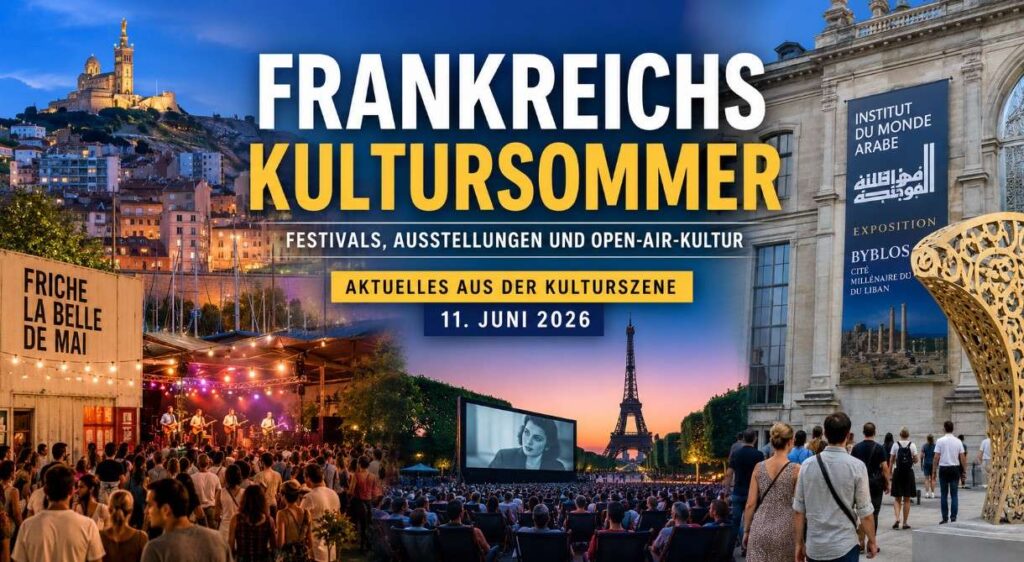
June traditionally marks the time of year in France when culture takes place not only in museums, theaters, and cinemas but also conquers the streets, squares, and parks across the country. In 2026, the French cultural scene is particularly lively. Between major exhibitions, international festivals, and free outdoor events, a cultural mosaic emerges that appeals to people of all generations.
The festival season, in particular, is currently reaching its peak.
In Marseille, the renowned Rencontres à l’Échelle are underway, bringing together artists from across the Mediterranean region. Theater, dance, music, and performance art meet there on equal footing, creating a creative dialogue between different cultures. At the same time, the port city is already looking forward to the upcoming Festival de Marseille, which in the coming weeks will bring international productions to Provence. The city is once again transforming into an open-air stage.
Culture is also highly prioritized around Paris. Families, children, and teenagers are more in focus than a few years ago. The family festival “Un neuf trois Soleil !” in Seine-Saint-Denis combines art, theater, and cultural education in a playful way. Such formats especially demonstrate how strongly many cultural institutions strive to reach new visitor groups and reduce apprehension.
In the film sector, France remains true to its role as a talent incubator.
The short film festival Côté Court in Pantin has long been regarded as an important meeting point for young directors. Many filmmakers who are now represented at international festivals gained their first experiences here before larger audiences. The event offers space not only for classical short films but also for experimental works and new narrative forms. This ensures the festival remains a seismograph for developments in French cinema.
At the same time, interest in the cultural and societal significance of film is growing. Numerous events are currently addressing the question of how cinema documents historical developments and makes social changes visible. Film no longer serves entertainment alone—it is increasingly seen as a mirror of its time.
Museums are also experiencing a successful start to the summer.
Major special exhibitions attract numerous visitors, especially in Paris. The Institut du Monde Arabe is currently gaining attention with several projects centered around the history and culture of the Mediterranean region. Historical themes are connected with modern presentation forms, appealing to a broad audience.
Also notable is a trend seen across many French museums: exhibitions are no longer just to be viewed but to be experienced. Interactive elements, audiovisual installations, and thematic stagings create new ways to access art and history. This makes the traditional museum feel much livelier than a few years ago.
However, the most visible feature of the 2026 cultural summer remains the return to public spaces.
Free concerts, open-air cinemas, and cultural events outdoors attract thousands of visitors. In Marseille, the Friche la Belle de Mai is once again developing into a lively meeting point for artists and audiences. In Paris, film nights and cultural summer events create a special atmosphere between historic buildings and modern neighborhoods.
The message behind it is clear: culture should take place where people live.
After years of great challenges, France’s cultural landscape presents itself with renewed confidence. Museums, festivals, and cultural centers focus on openness, diversity, and encounter. The summer of 2026 impressively shows that culture in France is not only preserved but actively lived—on the big stages as well as right on the streets of the country.
By C. Hatty