
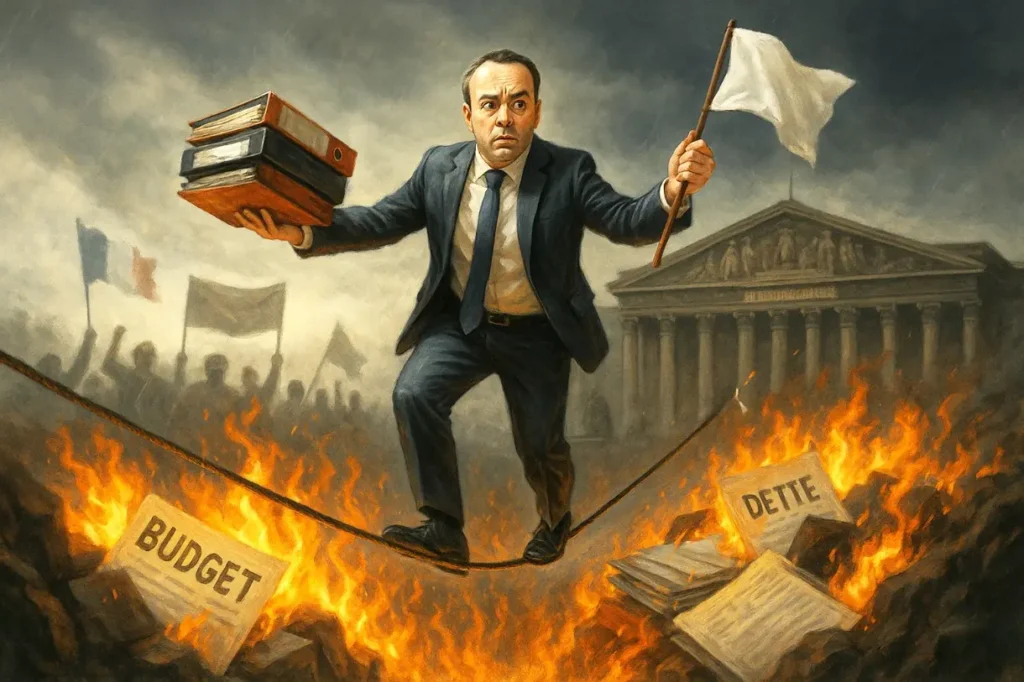
The French government is once again facing a political moment marked by overlapping economic realities, geopolitical instability, and social tensions. On Thursday, May 21, Prime Minister Sébastien Lecornu announced that new support measures targeting high fuel costs would be unveiled. However, as the announcement approaches, there is a growing impression in Paris that the government itself is still searching for a feasible policy approach.
The situation is contradictory. On one hand, in many regions, the price per liter of gasoline and diesel is exceeding the symbolic threshold of 2 euros. On the other hand, France’s financial condition leaves little room for austerity, making it difficult to implement billion-euro relief programs. Added to this is the rising geopolitical tension in the Middle East, whose economic repercussions are now directly affecting everyday life in France.
As of May 18, 2026, France’s well-known dilemma is once again revealed. How can social stability be secured without further worsening an already deteriorated national budget?
The Reemergence of the Fuel Crisis
The current energy crisis is not solely caused by market mechanisms. For weeks, military tensions between Iran, Israel, and the United States have been pushing up international oil prices. In particular, uncertainty about the safety of the Strait of Hormuz, one of the world’s major oil shipping routes, is creating tension in the market.
France has a limited share of direct crude oil imports from the Gulf region, but price formation takes place globally. Therefore, even small geopolitical shocks are reflected in petrol station prices in France within days. According to several market observers, traders now expect a prolonged phase of high oil prices.
This situation comes at the worst possible timing for the French government. Although inflation has eased compared to the crises of 2022 and 2023, the purchasing power of many households is still under pressure. Commuters in rural and suburban areas, where cars are essential, are particularly affected.
This is precisely what makes the issue politically sensitive. The memory of the Yellow Vest movement still lingers in the Élysée Palace. There are few topics in France that carry as explosive a social symbolism as rising petrol prices.
Lecornu relies on targeted aid
Therefore, the government is trying to prevent the spread of the situation at an early stage. Already in early May, Prime Minister Lecornu announced that existing support mechanisms would be expanded in “scope and scale.” However, concrete measures have been slow to materialize.
There are currently indications that a selective approach will be taken. First of all, the support targets long-distance commuters and so-called “grands rouleurs” with low incomes. Additional support for sectors highly dependent on diesel, such as construction companies, taxi drivers, farmers, and fisheries workers, is also under consideration.
Existing programs have already been partially expanded. For example, the “prêt flash carburant,” originally designed for transportation and agriculture, is now also open to the construction sector. In addition, a tax-free corporate subsidy that employers can pay to reimburse employees for additional costs is reportedly under consideration.
The underlying economic policy rationale is clear. Paris wants to support as targeted as possible while avoiding a return to the costly crisis response mode of the past.
The End of the “quoi qu’il en coûte”
The fiscal policy context explains the government’s caution. France now ranks among the major European economies with a high debt ratio. National debt exceeds 110% of gross domestic product (GDP), and rising interest rates are putting additional pressure on public finances.
At the same time, the European Union is demanding fiscal discipline again after years of emergency spending. Already in April, the government announced additional savings of 4 to 6 billion euros. This is against the background of the economic impact of the Middle East crisis and declining tax revenues.
Thus, the government finds itself facing a fundamental conflict of goals. On the one hand, the social situation demands relief, but on the other hand, new spending must be “offset exactly, down to the last euro,” as emphasized by Finance Minister David Amiel.
In Paris, the phrase “the end of quoi qu’il en coûte” is now being openly circulated. The state will help, but increasingly selectively and only temporarily intervene.
This strategy clearly differs from the energy crisis following Russia’s invasion of Ukraine in 2022. At that time, the government responded with widespread price controls, uniform gas station discounts, and massive state transfers. The costs ran into the billions. Now, neither political nor financial conditions allow such a response.
The government struggles against the impression of inaction
However, this very caution carries political risks. In recent days, the government has been more frequently criticized for delaying announced measures. The French media are already describing this as an “attente anxieuse”—a state of anxious waiting.
In fact, the administration currently seems trapped between crisis management and communication issues. Recently, a hantavirus case on a cruise ship attracted considerable political attention, while energy-related support measures were being internally adjusted.
There is another problem here. The government is simultaneously trying to lower expectations. Lecornu publicly emphasized several times that the government does not automatically benefit from high fuel prices. He said there is no “tax dividend” because consumption has dropped significantly.
According to government announcements, fuel consumption fell by about 30% in early May. This suggests that many households are already reducing consumption, a typical warning sign of worsening conditions.
Between Energy Transition and Social Reality
This debate once again reveals the structural vulnerabilities of France’s transition policy. France is investing heavily in electric vehicles, nuclear power, and decarbonization. Yet a significant part of the country still relies on traditional internal combustion engines.
Especially in areas outside large cities, there is often a lack of viable alternatives to cars. High energy costs affect not only consumption but also social participation.
The government is trying to compensate for these contradictions with temporary and selective support. However, in the long term, this does not solve the fundamental problems. France is in a growingly difficult transition phase where ecological goals, social equity, and fiscal realities are increasingly hard to reconcile.
Therefore, the next few days will be an indicator beyond a simple fuel subsidy. It will show whether the government of Lecornu still has the capacity to politically mitigate economic hardship, or whether France will once again fall into a state mixed with purchasing power anxiety and government distrust, returning to a situation that in the past has caused multiple social shocks.