
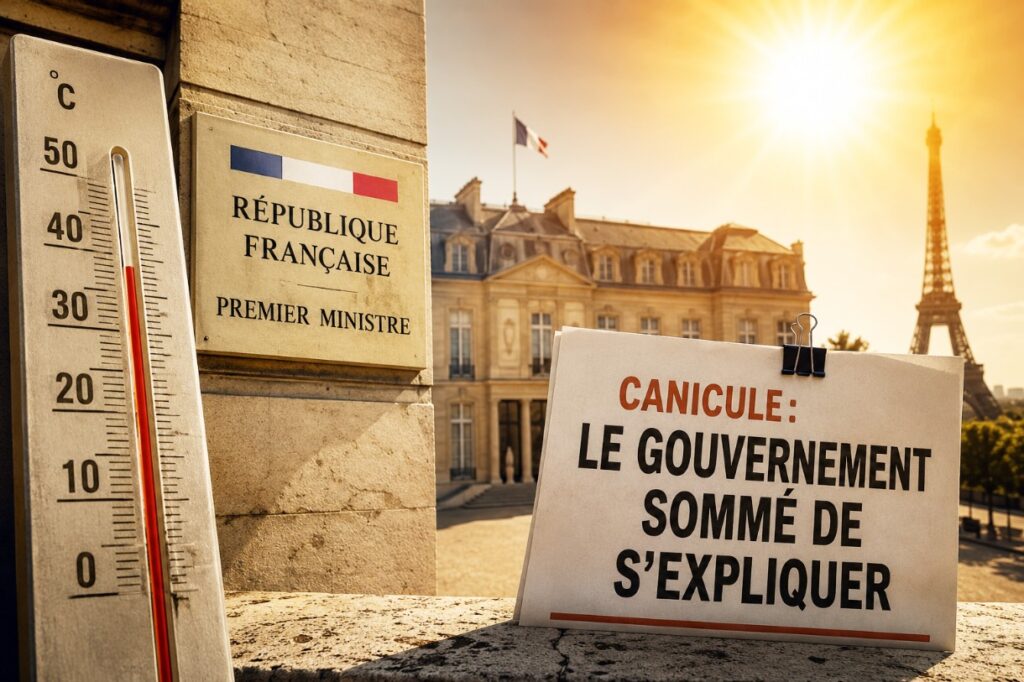
France’s government faces growing criticism from politicians, municipalities and society after the latest heatwave. While the health consequences cannot yet be fully quantified, political pressure is mounting on the government to disclose its crisis management and its long-term adaptation strategy. The debate goes far beyond the immediate handling of extreme heat. It raises fundamental questions about France’s resilience to the impacts of climate change.
Criticism of insufficient preparation
At the center of the accusations is the inadequate preparation of public facilities for increasingly frequent and intense heatwaves. Numerous schools had to suspend classes, shorten the school day or switch to remote teaching because classrooms were no longer usable due to a lack of thermal insulation or cooling. Many buildings date from a time when extreme summer heat in France was considered exceptional.
High indoor temperatures also worsened the already strained situation in hospitals. Employees reported difficult working conditions while especially vulnerable patient groups had to be cared for. Opposition parties therefore accuse the government of again relying only on short-term emergency measures instead of consistently adapting public infrastructure to the changed climatic conditions.
Government points to existing emergency plans
The government rejects the accusations and emphasizes that it activated all measures provided for in the national heat protection plan. Prefectures, regional health authorities, municipalities and emergency services were mobilized at an early stage. In addition, extensive prevention notices were published for the population.
According to the government, close coordination took place with hospitals, nursing homes and social institutions to protect the most vulnerable people. These included elderly people, those with chronic illnesses and people living alone. Authorities point out that the warning and crisis systems introduced after the devastating heat disaster of 2003 are now significantly more effective than they were two decades ago.
Opposition demands political review
However, this argument does not convince large parts of the opposition. Several deputies are calling for a comprehensive debate in parliament and demand detailed explanations about which precautionary measures could have been taken months before the start of summer.
Particularly critical are the lack of adaptation in schools, inadequate protective measures for outdoor workers and shortcomings in the heat protection of residential buildings. Many parliamentarians believe the problem is less a lack of emergency plans than a lack of long-term investments in climate-resilient infrastructure.
The political discussion gains additional urgency because early provisional health data indicate a significant excess mortality during the heatwave. Final figures are not yet available, but experts expect that the true impacts will only become fully visible after a comprehensive analysis of mortality data.
Adapting to climate change remains the central challenge
The current debate makes clear that France has made considerable progress in crisis management, but lags behind the requirements when it comes to structural adaptation. Since the 2003 heat disaster, early warning systems, medical alert plans and coordination between authorities have been significantly improved.
Much slower to develop, however, is the modernization of public buildings, urban planning, and the adaptation of transport infrastructure and working conditions to rising temperatures. Many schools still lack sufficient shading or modern ventilation systems. Many hospitals and care facilities also do not meet the requirements that recurring extreme heat will likely impose in the future.
Climate researchers have been pointing out for years that heatwaves in France are no longer extraordinary weather events. Rather, they are increasingly part of the new climatic normal. Accordingly, political pressure is growing to shift the focus from short-term crisis management to long-term adaptation measures.
Between immediate aid and long-term strategy
The government will likely have to further clarify its climate adaptation strategy in the coming days. With each new hot summer, the expectation grows that France will not only respond to acute crises but systematically prepare its infrastructure for permanently higher temperatures.
The current heatwave shows that functioning warning systems alone are no longer enough. What is required are profound investments in schools, hospitals, residential buildings, urban planning and the world of work. The political confrontation of recent days could therefore prove to be a turning point: moving away from pure crisis management towards a comprehensive adaptation of the country to a climatic reality that is no longer exceptional.
Author: P. Tiko