
France traditionally sees itself as a military great power in Europe. In 2025, Paris continues to reinforce this claim: With a globally present army, nuclear deterrence, and modern armed forces, the country is considered a strategic cornerstone of European security. However, the security policy situation is changing – and France’s defense apparatus faces structural as well as conceptual challenges.
With the current increase in the military budget, a realignment of the armed forces, and ambitious plans for the coming decade, the French government aims to secure military capability – both nationally and internationally. A look at figures, structures, and strategies shows: France remains one of the few European nations with a global agenda – but this is becoming increasingly costly and complex.
Measured rearmament – the budget as a strategic signal
In the fiscal year 2025, the French defense budget – excluding pension payments – amounts to 50.5 billion euros, which corresponds to around 2.0% of the gross domestic product. Thus, France fulfills the NATO target, which has applied as a minimum standard since the 2014 Wales summit, not only arithmetically but also politically: In the 2025 National Strategy Review, defense is explicitly designated as a central element of national and European security.
But the financial effort is only the beginning. The military program planning 2024–2030 foresees a significant increase in spending in the coming years – with the goal of making France’s army “combat-capable on all levels” by 2030. The reason lies in a geopolitical environment that, according to the Élysée, is “more unstable than ever since the Cold War”: Russia’s war of aggression against Ukraine, tensions in the Indo-Pacific, hybrid threats from cyberattacks and disinformation, as well as the erosion of multilateral orders.
An Army with Global Ambitions – Structured, Ready for Deployment, Specialized
The French armed forces count 264,000 active soldiers (as of 2025). Including reservists and the paramilitarily organized Gendarmerie, the total strength amounts to around 462,000 personnel. This places France personnel-wise clearly ahead of other Western European countries such as Germany (approx. 183,000 active) or the United Kingdom (approx. 198,000).
The structure follows a clear inter-institutional concept: about 56% of the personnel belong to the Army (Armée de Terre), 19% to the Air and Space Forces (Armée de l’Air et de l’Espace), 17% to the Navy. In addition, there are specialized units for cyber operations, intelligence, and electronic warfare. The forces are organized according to the principle of modular interoperability – that is: rapid reaction forces, flexible contingents, multinational deployability.
In practice, this means: France can deploy forces on five continents within days – for example to West Africa, the Middle East, the Indo-Pacific, or to NATO missions in Europe. In 2023 alone, French troops were active in around 30 countries, whether as part of anti-terror operations, evacuation missions, or to support local partner armies.
Multidimensional capabilities – from nuclear strike to cyberspace
What distinguishes France’s armed forces from those of other European countries is their complete military structure. In addition to the Army, Air Force, and Navy, the country has an independent nuclear force as well as operational capabilities in the cyber and space sectors.
- Nuclear Weapons: France possesses around 290 strategic warheads (estimate SIPRI, 2025). The nuclear force relies on four Triomphant-class submarines (equipped with M51 intercontinental missiles) as well as air-launched capabilities with nuclear-capable Rafale jets. The doctrine of “strict sufficiency” aims for a minimal but credible deterrent – independent from NATO, yet as an integral part of it.
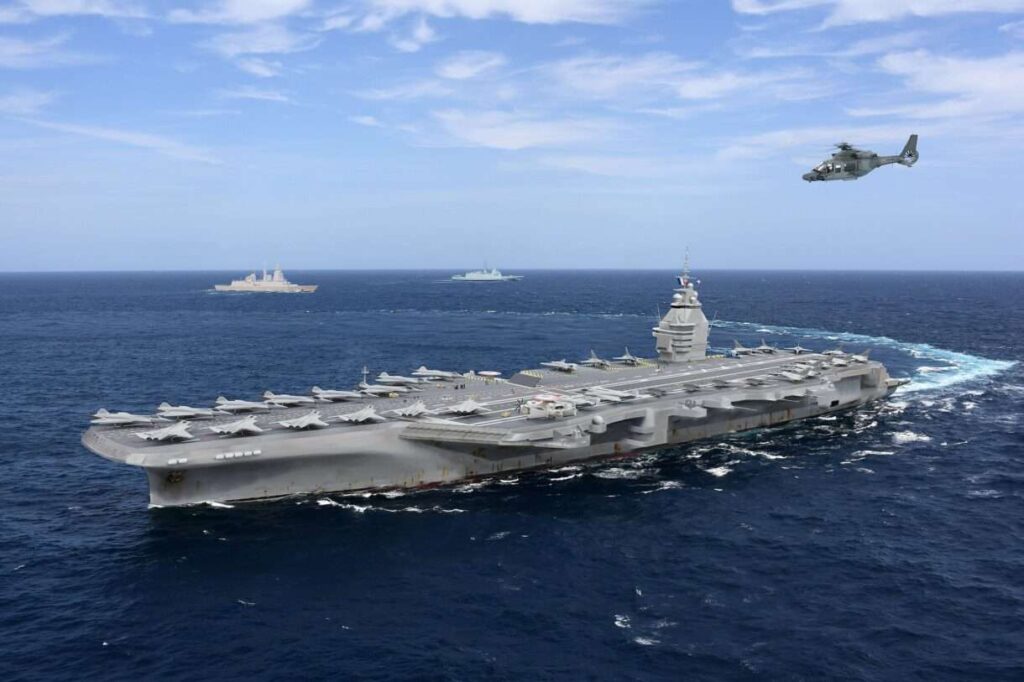
- Navy: The aircraft carrier Charles de Gaulle forms the centerpiece of the French blue-water fleet. Supplemented by frigates, hunter submarines, and amphibious units, France remains one of only three nations worldwide with its own carrier strike group (alongside the USA and China).
- Air Forces: The Armée de l’Air has modern multirole jets (Rafale), tanker aircraft, strategic transport capacities, and early warning systems. In 2025, the development of a European air defense system (jointly with Germany and Italy) also began.
- Cyber & Space: Since 2019, there has been a dedicated Space Command. France is increasing investments in satellite-based reconnaissance, communication security, and electronic warfare. The Cyber Defense Staff in Rennes has coordinated all digital operations since 2023.
These multidomain capabilities give France a special strategic depth – especially since they not only enable national operations but also provide a relevant contribution within NATO and EU frameworks.
Strategy of Autonomy – Between European Responsibility and National Lone Action
French military strategy rests on three pillars:
- Strategic Autonomy: France wants – and is able – to act militarily without foreign assistance in case of emergency. This is demonstrated in independent operations such as “Barkhane” (Mali) or in the capability for nuclear deterrence. This autonomy goes hand in hand with a robust defense industry (including Dassault, Naval Group, Thales) that enables both self-supply and exports.
- Global Projection Capability: The armed forces are designed to intervene quickly and worldwide – for example in humanitarian crises, asymmetrical conflicts, or to support unstable regimes. Unlike Germany or Italy, France explicitly sees itself as a “security power with a global radius.”
- Adaptation to New Threats: The wars of tomorrow will not be fought with tanks alone. France therefore invests specifically in drone technologies, cyber defense, space surveillance, and artificial intelligence. The recent defense report calls this preparation for a “multidimensional conflict dynamic.”
At the same time, the Macron government emphasizes the necessity of a European defense architecture – albeit always while maintaining a French leadership role. Projects like the Future Combat Air System (FCAS) with Germany and Spain or the joint missile development with Italy testify to this balance between integration and sovereignty.
Between Ambition and Reality – Structural Challenges Remain
Despite all its strengths, French defense policy faces fundamental challenges:
- Budgetary conflicts of objectives: Although the defense budget is at 2% of GDP, experts and the French Court of Audit point out that a credible “high-intensity army” actually requires 2.5 to 3% of GDP – especially with regard to Russia or possible crises in the Indo-Pacific.
- Armament projects and equipment modernization: Numerous major projects – such as the new nuclear submarine “SNLE 3G” or the future air combat system FCAS – require high investments, long lead times, and close coordination with partners. Delays and cost explosions threaten to jeopardize the strategic timeline.
- Political legitimacy of the nuclear doctrine: In a multipolar world, the question increasingly arises of when and for what purpose nuclear deterrence is still useful – and how its credibility in crisis scenarios can be maintained without creating escalation risks.
France will not be able to provide the answer alone. Rather, it also depends on the behavior of other major powers, developments in NATO, and the security policy priorities of the European Union.
France remains a military leadership power in Europe in 2025 – with a structurally complete army, global presence, and strategic autonomy. But this model is under pressure: New threats, technological upheavals, and geopolitical uncertainties require more than just money. It is about adaptation, innovative capacity – and political coherence.
Author: Andreas M. Brucker