
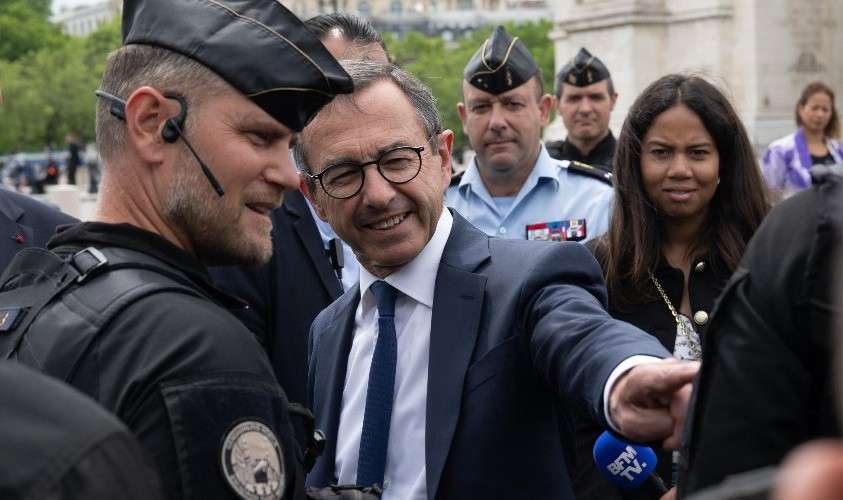
The French center-right force made its decision quite early – yet the real struggle is only now beginning. With the official nomination of Bruno Retailleau as the presidential candidate from the Les Républicains party for 2027, the formal hurdle has been overcome. Politically, however, the conservative camp faces a much more difficult task: its own reorganization in a fragmented party system.
Clear decision with limited scope
At first glance, the result looks unequivocal. About 73 percent of party members supported Retailleau’s appointment as candidate without prior primaries. The party consciously declines the tool it considered a democratic progress just a few years ago.
The experience of the 2016 and 2021 primaries left deep marks. Internal power struggles, weakened candidates, and lack of unity significantly contributed to the marginalization of the bourgeois right. Therefore, the decision against new “primaries” is not a show of strength, but rather a strategy of caution.
However, legitimacy remains limited. Voting took place exclusively among members – a small, politically very active segment of voters. It does not replace broad societal support. Thus, Retayo is primarily a candidate of his party, not of the political camp.
Open Vulnerable Spot: Fragmentation of the Right
The central problem remains unresolved: the structural fragmentation of the French right. Besides Retayo, several well-known figures also have ambitions, including Laurent Waucier, Xavier Bertrand, and David Lisnard.
This multiple competition is not only a personal but also a systemic problem. Since the rise of Emmanuel Macron and the simultaneous strengthening of the National Rally, the political landscape in France has changed radically. The classic bipolar structure between socialists and Gaullists has transformed into a three-part structure — with a liberal center, a strong radical right, and a weakened traditional right in the middle.
In such a constellation, internal party unity is no longer sufficient. What will be decisive is whether the entire conservative spectrum can be united — including those voters who in recent years have shifted to the National Rally.
Ideological profile: clarity with risks
Rethelo’s political profile is clearly defined. As a representative of the conservative wing within the Republicans, he focuses on classic topics: internal security, migration control, and strengthening state authority.
This course is strategically understandable. It aims to win back voters who have turned away from the more moderate right. At the same time, Rethelo tries to distance himself from right-wing populist discourse without completely abandoning its themes.
However, this is precisely where the difficulty lies. Too close an alignment with the rhetoric of Rassemblement national carries the risk of legitimizing their program. On the other hand, too obvious a distance may alienate potential supporters who could return.
This complex balance is not a new phenomenon, but is gaining importance against the backdrop of the strength of the radical right. France differs significantly in this from other European countries, where conservative parties have partially successfully established cooperation or clear strategies of separation.
The problem of insufficient recognition
Another structural drawback is Retea’s limited national recognition. While figures such as Macron or leading representatives of the Rassemblement national have built media presence over the years, Retea remains relatively inconspicuous outside politically interested circles.
In a highly personalized presidential campaign, this is a serious factor. The Fifth Republic rewards candidates who have charisma, media appeal, and a clear narrative. Party apparatuses alone are not enough.
Additionally, there is widespread skepticism about his ability to mobilize a broad electoral audience. Polls have shown for years that traditional right-wing candidates have difficulty gaining support beyond their core clientele.
2027: Open but Asymmetric Race
The initial situation for the 2027 elections is formally open. Since Macron is not allowed to run again after two terms, there is no dominant incumbent president. Historically, this often leads to more fragmented races.
However, this openness is distributed asymmetrically. The radical right side in particular benefits from a stable electoral base and high mobilization. At the same time, the political center is trying to undergo reform in order to continue the “Macronist” project in a changed form.
For Republicans, this means that they will have to face two strong poles. Their traditional role as a force supporting the state is weakened, their ideological position has become unclear.
Strategy between duty and calculation
Retalio’s actual presentation of his candidacy stands out. He repeatedly emphasizes that this is less a personal project and more a responsibility towards his political family.
This narrative corresponds to classic French political rhetoric, which is oriented towards a sense of duty and understanding of the state. At the same time, it points to a structural reality: the candidacy is not the result of enormous popularity, but a necessity within the party.
This can be both an advantage and a disadvantage. On the one hand, it signals seriousness and distance from opportunistic motives. On the other hand, there is a lack of dynamics, which is often decisive for a successful presidential campaign.
Decisive question: unity or dissolution
The real test for the right is still ahead. What will be decisive is not who was nominated first, but who can embody a credible unity candidacy.
French history provides numerous examples of this. Candidates who were determined early often failed due to lack of support within their own camp. Conversely, predictable outsiders could win if they created broader momentum.
For Retayo, this means: his nomination is a necessary but not sufficient step. Without a strategic opening beyond the party and without a convincing response to structural shifts in the political system, the path to the second round will likely remain closed.
The right is faced with a fundamental choice – not only regarding one individual but also concerning its future role in France’s political system.
Author: P. Tiko