
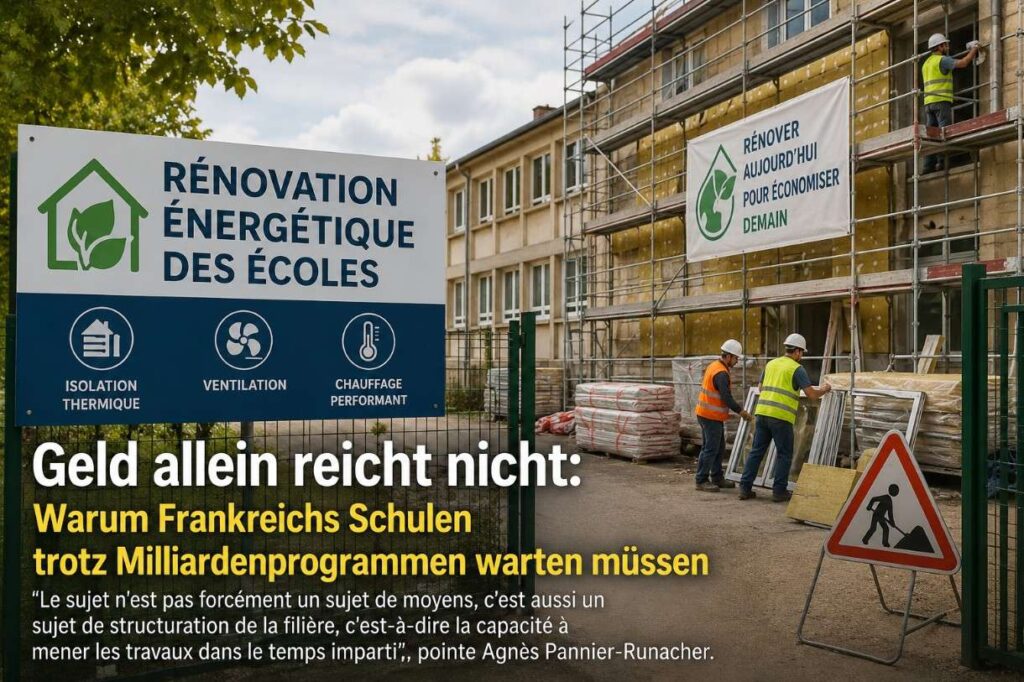
With a remarkably frank statement, the French Minister of Energy Agnès Pannier-Runacher pointed out a central problem of the ecological transformation. Regarding the energy renovation of schools, she stated: “The problem is not necessarily a financial issue, but also a problem of sector structuring – that is, the capacity to carry out the work within the given deadlines.” This statement refers to a development that goes far beyond the scope of individual school buildings. France is increasingly reaching the limits of its practical implementation capacities in the energy transition.
The bottleneck is on the construction sites
In the political debate, the question of investment amounts dominated for a long time. Multi-billion programs for the ecological transformation were considered a decisive lever to achieve the European climate goals. But today, it is clear that public funds alone do not guarantee rapid implementation.
Particularly in the energy renovation of public buildings, a structural problem is emerging. France does indeed have subsidy programs, government aid, and European financing. But there is often a lack of companies capable of actually carrying out the work.
The energy modernization of schools is among the most technically demanding areas of construction. Insulation, window replacement, conversion of heating systems, ventilation systems, or roof renovations must be coordinated. Added to this are new requirements for heat protection and energy efficiency. However, many municipalities report long waiting times, a lack of specialized craftsmen, and tenders with few company responses.
The situation is particularly difficult in rural areas. There, specialized craftsmen or design offices with sufficient capacity are often lacking. At the same time, pressure is increasing on municipalities to modernize their buildings more quickly.
A shortage of skilled workers
The problem mainly stems from a shortage of skilled personnel. France has faced recruitment difficulties in the construction and craft sectors for years. Many professions are seen as physically demanding and socially unattractive. Many companies no longer find sufficiently qualified labor.
However, energy renovation requires increasingly specialized skills. Modern buildings must not only be insulated but also designed intelligently from a technical standpoint. Mistakes can have serious consequences. Poor ventilation can lead to moisture problems, insufficient protection against summer heat results in overheated classrooms. Furthermore, actual energy savings are often lower than theoretical calculations when the work is poorly coordinated.
Thus, the debate shifts from just financing to the industrial capacity of the country. France needs not only investments but also a functional value chain: training centers, craftsmen, engineers, material suppliers, and local construction companies.
The Problem of Narrow Time Windows
Added to this is an organizational factor that Pannier-Runacher explicitly highlights: the timing of the work. Schools can only be renovated to a certain extent during class hours. Many important tasks must therefore take place during summer holidays.
This drastically reduces the available windows. Municipalities therefore often try to carry out as many works as possible simultaneously within a few weeks. For the construction sector, this means huge peak loads. Even with sufficient funds, it is impossible to manage several thousand sites in parallel in a very short time.
This problem is expected to worsen in the coming years. France has set ambitious climate targets and is under European pressure to significantly reduce the energy consumption of buildings. Public buildings play a central role because they represent a large share of energy consumption.
Schools, a symbol of the French infrastructure crisis
The debate is also politically sensitive because many French schools are in poor condition. A large part of the building stock dates from the 1960s and 1970s. At that time, many school complexes were built quickly and cheaply, often with low energy quality.
Today, many establishments suffer from outdated heating systems, insufficient insulation, and inadequate ventilation. The European energy crisis since 2022 has worsened these problems. Many municipalities have had to face a sharp increase in heating costs, while the pressure for decarbonization intensified.
Added to this is the growing importance of protection against heat. France has been experiencing increasingly intense heatwaves for years. Many schools are not prepared for this. Classrooms sometimes become unbearably hot in summer, which is becoming more and more an issue of education and public health.
A shift in political thinking
The statement by Pannier-Runacher thus also marks a rhetorical turning point within the French government. For a long time, politics mainly framed the ecological transition as a matter of financing. Now, practical implementation moves to the forefront.
This does not only concern the renovation of buildings. Similar bottlenecks are appearing in the development of renewable energies, the electrical grid, or transport infrastructures. The same question arises everywhere: does France have sufficient industrial and human capacities to ensure the transition at the planned pace?
The minister thus indirectly suggests that the ecological transition might be limited less by political goals than by the capacity of the real economy. Climate policy is therefore entering a new phase: away from symbolic announcements, towards questions of production capacity, training, and organizational efficiency.
This is probably where the biggest challenge of the coming years lies. The energy transition is not decided solely in ministries or at international climate conferences. It is just as much about the construction sites, vocational schools, and the local craft organizations.
Author: P. Tiko