
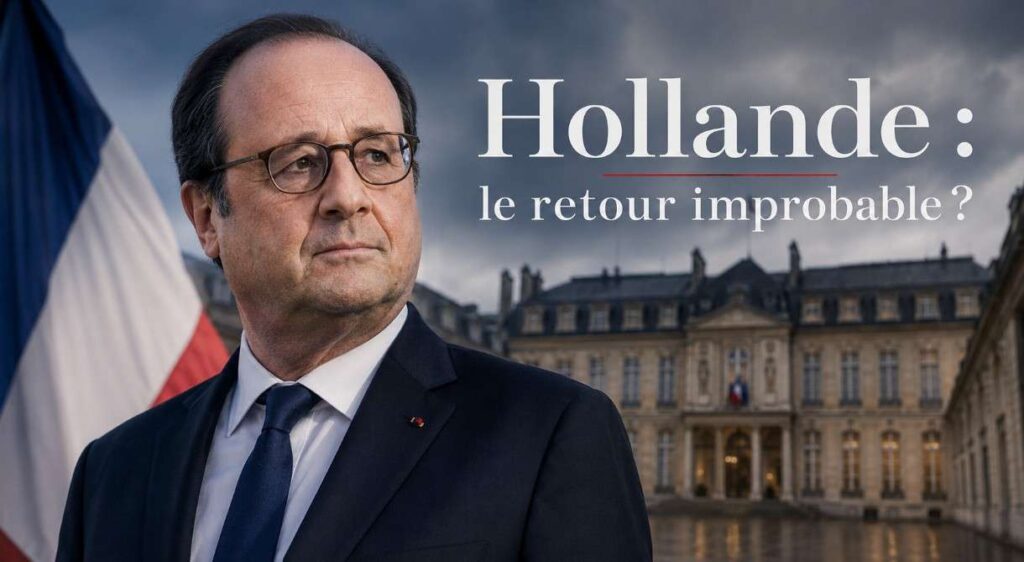
Fourteen years after his move into the Élysée Palace, François Hollande does not seem ready to come to terms with the role of a former political president. While the French party system continues to fragment and the centrist camp around Emmanuel Macron visibly loses cohesion, the former socialist head of state is intensifying his public appearances, interviews, and programmatic statements. Hollande is sending a message that is being closely noted in Paris: he obviously does not consider his political career to be over.
Just a few years ago, the idea of a political comeback by the former president would have seemed far-fetched. Today, it no longer seems entirely unrealistic. Although a return to the forefront of power remains unlikely, French politics has a long tradition of surprising resurrections. The Fifth Republic loves political returnees – from Jacques Chirac to Nicolas Sarkozy, from Dominique de Villepin to countless failed candidates who later regained influence.
The Hollande Paradox
The central paradox of François Hollande has been known for years: he counts among the most unpopular presidents in recent French history, yet he is experiencing a remarkable partial rehabilitation.
When Hollande left the Élysée in 2017, his political capital was largely exhausted. The high unemployment, the controversial labor market reform “Loi Travail,” the deep conflicts within the Socialist Party, as well as the impression of constant indecisiveness had severely damaged his reputation. His decision to be the first president of the Fifth Republic to forgo a re-election bid marked a historic political collapse at the time.
But political memory rarely works linearly. The multiple crises of recent years – pandemic, inflation, geopolitical uncertainty, the Russian war of aggression against Ukraine, and the increasing polarization of Western democracies – have changed the perspective on previous terms of office. Compared to Macron’s highly presidential and often confrontational governance, Hollande in retrospect appears to some French people as a more moderate, consensus-oriented, and parliamentary head of state.
This relative nostalgia is used by Hollande with remarkable skill. His calm tone, his foreign policy experience, and his demeanor as a professional party politician contrast with the nervous constant agitation of today’s political debate. The former president presents himself less as a charismatic tribune than as a sober steward of republican stability.
The Crisis of the French Left
The main reason for Hollande’s renewed visibility lies less in his own person than in the state of the French left.
For years, the left-wing camp has failed to produce a lasting consensual leadership figure. Jean-Luc Mélenchon still has a loyal following but polarizes massively beyond his own camp. The Greens struggle with internal tensions and strategic uncertainty. Meanwhile, the Socialist Party is caught between institutional survival and political marginalization.
In this fragmented environment, Hollande is trying once again to position himself as a figure of stability and governance capability. His message is aimed at a precisely defined political space: a social-democratic, pro-European, and republican left that remains willing to compromise and claims responsibility for the state. At its core, Hollande is working to revive the classic governing left that shaped France for decades.
His return to the National Assembly in 2024 was therefore much more than a local candidacy. In Paris, it was widely interpreted as a strategic move to regain institutional legitimacy and media presence. Hollande knows the mechanisms of French power politics better than many of his younger rivals. A former president without a mandate remains a commentator; a former president in parliament becomes an actor again.
The Return of Experience
Hollande also benefits from a development observed in numerous Western democracies: the renaissance of political experience in times of general uncertainty.
The past years have created a paradoxical dynamic in many European societies. On one hand, the desire for political renewal remains strong. On the other hand, in the face of economic and geopolitical crises, the longing for predictable and institutionally experienced personalities grows.
It is exactly at this point that Hollande comes in. Unlike in 2012, he can now refer to the authority of a former head of state who has managed severe national crises – especially the Islamist terrorist attacks of 2015. His public statements regularly emphasize institutional stability, European cooperation, fiscal discipline, and republican order.
With this, Hollande pursues no strategy of political breakthrough, but one of republican normalization. He presents himself as a counter-model to ideological sharpening and populist polarization. In a way, this resembles the development of other former European heads of government whose record was judged more leniently only in contrast to later years of crisis.
Political memory is often relative. The past often seems more stable once the present appears more turbulent.
The Limits of Rehabilitation
Despite his cautious return, the structural obstacles remain enormous.
Initially, Hollande remains closely connected to a weakened Socialist Party, whose organizational and social roots have massively eroded. French presidential politics today demand highly personalized dynamics and strong mobilization power – qualities that Hollande traditionally embodied only to a limited extent.
Added to this is the ongoing skepticism of a significant part of the left towards his social-liberal economic policy during the presidency. For many former supporters, Hollande continues to symbolize the ideological shift of the Parti Socialiste towards a technocratic centrist course.
Above all, however, his possible return suffers from a symbolic problem. In a society that increasingly distrusts traditional elites, the comeback of a former president can quickly be interpreted as an expression of political exhaustion – as a sign of a system that no longer produces new leaders.
Hollande also has a peculiar political weakness: he commands respect, but rarely enthusiasm. Many French people now acknowledge his statesmanlike qualities. Yet this does not yet lead to an active longing for his return to the head of state.
In the end, this may precisely be the ambivalence of his strategy. Hollande deliberately keeps all options open without committing himself. In French politics, visibility often already means a resource of power. Whether this will ever again lead to a real presidential candidacy remains open.
But the political history of France teaches that seemingly written-off figures sometimes return surprisingly. The Fifth Republic is not only a system of strong presidents. It is also a system of long political memories.
And François Hollande seems determined to rely exactly on that.
Author: P. Tiko