
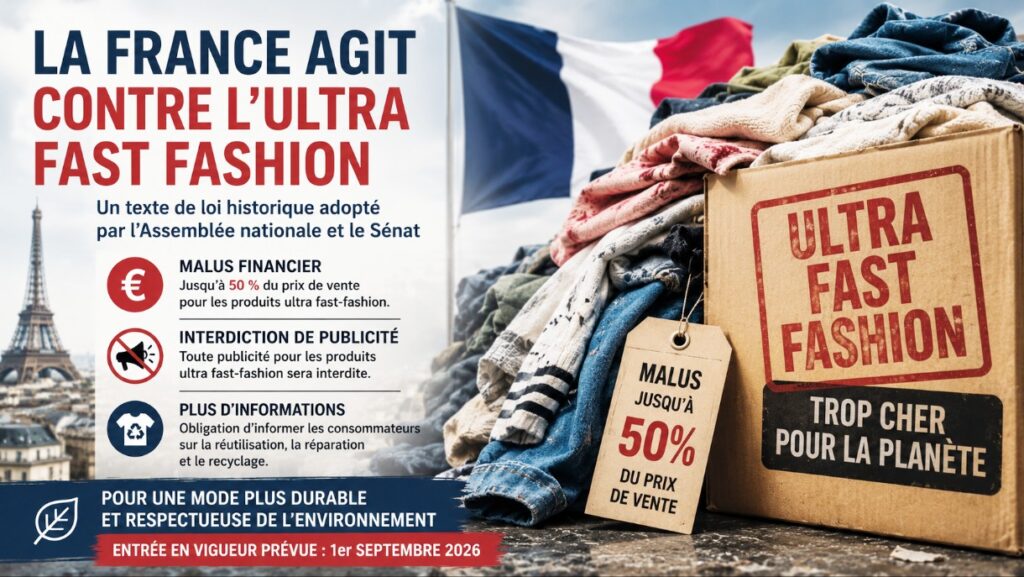
France is stepping up the fight against environmentally harmful cheap fashion. The National Assembly and the Senate have passed a law that specifically targets so-called Ultra Fast Fashion. The country is taking a pioneering role in Europe and is the first EU state to introduce financial sanctions against particularly environmentally harmful online retailers such as Shein and Temu. The aim of the new regulation is to curb the consumption of extremely cheap disposable fashion and to encourage more sustainable purchasing behavior.
At the heart of the law is a financial environmental surcharge for companies that fall into the Ultra Fast Fashion category. This surcharge is to be introduced gradually and could ultimately reach up to 50 percent of the sale price of an item of clothing. The exact level and the method of calculation will be determined by the government in the coming months by regulation. According to the current schedule, the main provisions are to come into force on 1 September 2026.
In addition to the financial surcharge, the law provides for a far-reaching advertising ban for Ultra Fast Fashion. Advertising for the affected products is to be generally prohibited. However, legal uncertainties remain. The European Commission has expressed concerns about the compatibility of this provision with European law. Whether the advertising ban will stand in its current form will be decided after further reviews.
Additionally, the law requires the affected platforms to be more transparent. Consumers will in future receive information on reuse, repair and recycling of the products offered. The government aims to place greater emphasis on the lifespan of clothing and to promote the idea of a circular economy.
During the parliamentary deliberations, however, the original draft bill changed significantly. Initially all Fast Fashion providers were in focus. After intensive debates and considerable pressure from the industry, lawmakers ultimately limited the scope to so-called Ultra Fast Fashion.
Companies are considered Ultra Fast Fashion if they both offer an exceptionally large product range and sell their clothing at extremely low prices. The products often cost so little that repairs are hardly worthwhile and new items are bought instead. It is precisely this business model that the French government views as particularly harmful to the environment and resources.
Numerous well-known fashion chains in Europe benefit from the restriction. Companies like Zara, H&M or Kiabi do not initially fall under the new financial sanctions according to the current version of the law. Critics therefore complain that the original plans have been significantly watered down and that the law now primarily targets non-European platforms such as Shein and Temu.
Despite this criticism, the law marks a milestone in French environmental policy. For the first time a European state is using financial incentives to make the Ultra Fast Fashion business model deliberately less attractive. Supporters hope for fewer impulse purchases, longer use of clothing and lower consumption of valuable raw materials. Whether the environmental surcharge will actually change purchasing behavior and whether other European countries will follow the French example will become clear in the coming years.
An article by M. Legrand