
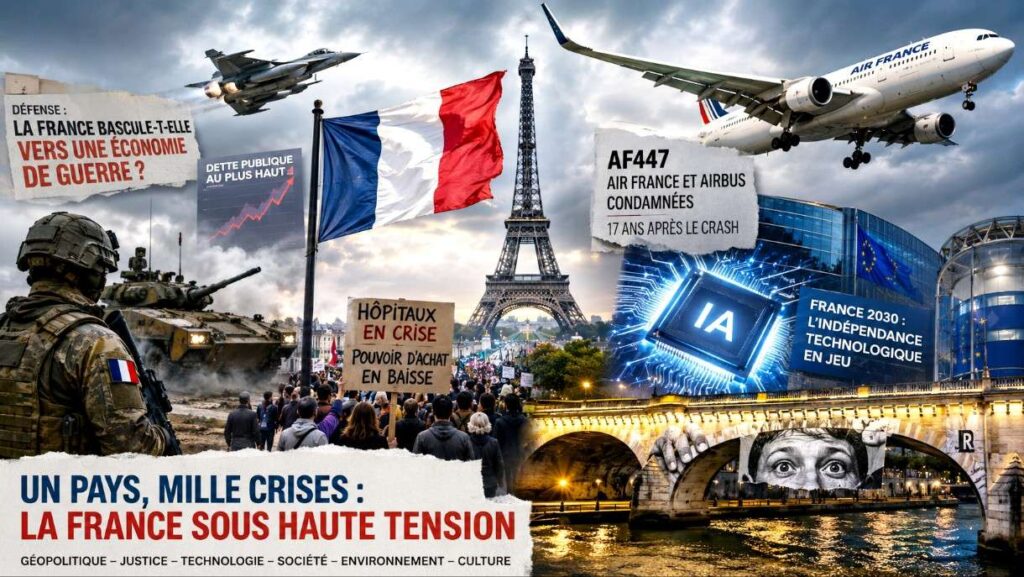
The French press on May 22, 2026, portrays a country that simultaneously feels pressured militarily, economically, technologically, and socially. What stands out is less a single dominating crisis than the simultaneity of permanent states of alarm. France appears in editorials, newscasts, and regional media as a republic that has grown accustomed to uncertainty as a normal state.
At the center is the geopolitical reordering of Europe. The debate over additional billions for defense and rearmament has shifted at a remarkable pace. Only a few years ago, the idea of an “économie de guerre” in France was regarded as a theoretical formula from strategic think tanks. Today, commentators openly discuss whether the country is already in a creeping war economy. The war in Ukraine, the escalations in the Middle East, and the growing tensions between the USA and China form the foreign policy backdrop.
The Security Policy Paradigm Shift
President Emmanuel Macron’s government argues that France must massively strengthen its military capabilities to remain strategically sovereign within Europe. For years, Paris has pursued the goal of a European “autonomie stratégique,” that is, security policy independence from Washington. Yet geopolitical pressure is growing faster than the economic leeway.
Consequently, French media increasingly ask whether the republic risks overextending itself financially. France’s national debt now stands well above 110 percent of GDP, while enormous investments in armaments, energy, digitalization, and industrial policy appear necessary.
Especially remarkable is the tone of many commentaries. Even traditionally economically liberal voices now speak about defense spending no longer primarily as a budget problem but as a matter of survival for Europe. At the same time, however, concerns grow that military priorities could accelerate the slow decline of public services.
The AF447 Verdict and the Question of Responsibility
Parallel to the geopolitical debate, a historic verdict dominates French public attention. Almost 17 years after the crash of Air France flight AF447 from Rio de Janeiro to Paris, Air France and Airbus were convicted of negligent homicide.
The 2009 crash is one of the traumatic events in recent French aviation history. At that time, 228 people died over the Atlantic. The lengthy legal processing evolved over years into a symbolic confrontation about responsibility in highly complex technical systems.
The French press interprets the verdict not only legally but also socially. It concerns the question of whether global corporations in an increasingly automated world can truly be held liable—and whether modern technology ultimately obscures or actually intensifies human responsibility.
Many commentaries also see this as a signal for the digital future: In an era of artificial intelligence and algorithmic control, societal expectations grow that technological systems—despite their complexity—must remain politically and legally controllable.
France’s Struggle for Technological Sovereignty
This discussion connects directly with another central theme of the day: France’s technological future. President Macron has tried for years to position France as a leading European technology and innovation power. The government is investing billions in quantum computers, semiconductor production, cloud infrastructures, and artificial intelligence.
French leading media now speak openly of a global technology war. The USA still dominate key AI platforms and digital infrastructures. China controls strategic supply chains and is systematically expanding its technological power. Europe, by contrast, struggles with regulatory strength but industrial weakness.
Therefore, France tries to take a leadership role within Europe. Paris increasingly regards technological independence not only as an economic issue but as part of national security.
However, an obvious contradiction emerges: While the government promotes future industries, regional media simultaneously report on overloaded hospitals, physician shortages, and growing social exhaustion. The state’s technological ambition contrasts with the everyday life of many citizens, which is marked by declining purchasing power and growing distrust in the state’s ability to deliver services.
The Fear of Social Wear and Tear
Especially in regional newspapers, it becomes clear how strongly the perception of France differs from that of the Parisian elite. Reports about long waiting times in the healthcare system, rising energy prices, and fears of new austerity measures dominate there.
France suffers from a structural dilemma: The state remains a central guarantor of social stability, yet simultaneously financial pressure on that state grows. Many observers recall the early 1980s, when France once again balanced between geopolitical ambition and economic reality.
Today, it is added that after years of multiple crises, the population appears noticeably more nervous. Pandemic, inflation, energy crisis, pension protests, and international conflicts have created a climate of permanent insecurity. The French press increasingly describes a country whose psychological resilience is visibly weary.
Culture as a Counterworld to Crisis Mood
All the more striking is the enormous attention given to spectacular cultural and societal topics. The art installation by artist JR on the Pont Neuf, the series of luxury watch thefts at the Cannes Film Festival, or the urban climber on the Tour Montparnasse almost act as counterimages to political nervousness.
France here shows an old national constant: the ability to stage culture and spectacle as part of collective self-assertion even in times of crisis. Especially Paris continues to thrive from its symbolic power as a stage of modernity.
These topics often receive surprisingly ample space in the media—not despite the crisis situation, but precisely because of it. Culture appears as a temporary interruption of permanent threat perception.
Invisible Dangers and New Environmental Anxieties
Added to this is a growing ecological nervousness. Reports on dangerous Atlantic currents on the southwest coast or PFAS contamination of drinking water in Alsace intensify a feeling of invisible risks.
This development is politically significant. Whereas earlier environmental debates often seemed abstract, today’s issues directly affect health and everyday life. PFAS chemicals, for example, exemplify a modern fear of invisible, long-term contamination.
The French public reacts increasingly sensitively. Environmental issues are no longer viewed in isolation but are linked to distrust of industry, administration, and political elites.
Perhaps the deeper mood of this day appears precisely here: France no longer discusses isolated crises, but the possibility of permanent instability. The media describe a country that has learned to cope simultaneously with geopolitical tensions, economic insecurity, technological upheavals, and social nervousness.
The actual change lies less in the individual events than in collective perception. Crisis no longer appears as an exceptional state, but as a permanent structure of the present. On May 22, 2026, France seems like a society in a mode of permanent vigilance—strategically ambitious, culturally vibrant, yet visibly exhausted.