
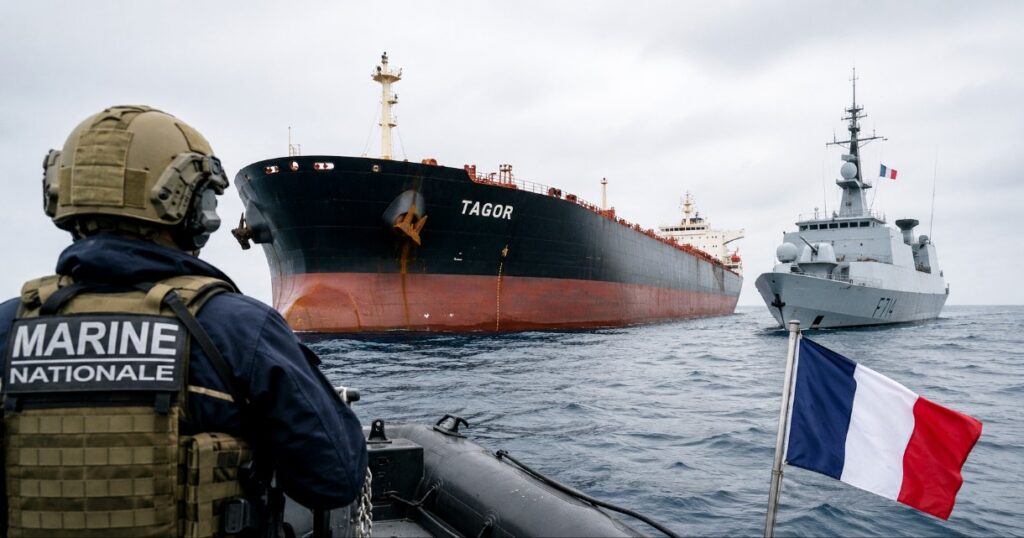
The detention of a tanker allegedly belonging to Russia’s “shadow fleet” is becoming a case of significant political and legal consequence for the French authorities. After the French Navy stopped the ship in late May on the high seas west of Brittany, the Russian captain of the tanker is now in police custody.
The Brest prosecution office accuses him of sailing without a valid flag and ignoring instructions from the French authorities. According to investigators, the captain repeatedly ignored demands to allow inspection of the vessel. If convicted, he faces imprisonment, a substantial fine, and confiscation of the ship.
The tanker had departed from Murmansk in northwestern Russia and was en route to Cameroon. French authorities had noticed irregularities in the vessel’s registration. After the check on the high seas, naval units took control of the tanker. Since Tuesday, the ship has been anchored in the Bay of Douarnenez, where it is being held indefinitely.
For the French government, the case goes far beyond a single ship. President Emmanuel Macron publicly confirmed the operation and emphasized that it was carried out in accordance with international maritime law. Paris views the action as part of its efforts to rigorously enforce sanctions imposed on Russia.
Moscow, however, assesses the events completely differently. Russian officials speak of an unlawful intervention and sharply criticize France’s actions. The Russian embassy in Paris demands consular access to the captain and his immediate release.
At the heart of the dispute is the so-called shadow fleet. This term refers to tankers whose ownership structures are often opaque. Many of these vessels regularly change their flags, operate with difficult-to-trace insurances, or use complex corporate setups. From a Western perspective, they serve to circumvent international sanctions against Russian oil and fuel exports.
French authorities have already inspected several suspicious tankers in recent months. However, the current case is considered particularly symbolic because, for the first time, a captain is being criminally prosecuted.
This illustrates how much the conflict surrounding the war in Ukraine has shifted to new arenas. The struggle for influence is not only fought on frontlines and negotiation tables. Increasingly, it is also decided on the world’s oceans, in ship registries, and behind the scenes of the international oil trade how effective sanctions truly are. The detained tanker off the Breton coast thus stands as an example of a geopolitical power struggle that extends far beyond France.
Andreas M. Brucker