
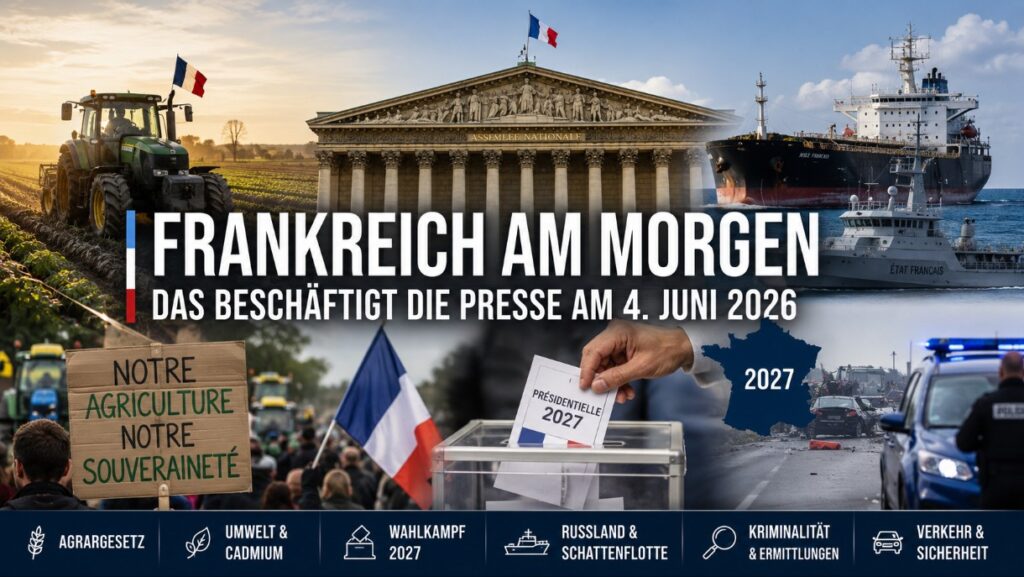
France is experiencing a political concentration of several fundamental conflicts in early June 2026. While the government defends its agricultural policy as a contribution to national sovereignty, environmental organizations warn of a rollback of ecological standards. At the same time, the pre-election campaign for the 2027 presidential election is visibly gaining momentum. Added to this are foreign policy tensions with Russia as well as several high-profile criminal and accident cases that dominate public interest.
The Agricultural Law Becomes a Fundamental Issue
At the center of the domestic political debate is the so-called Agricultural Emergency Act, which has been passed in the first reading by the National Assembly. The government justifies the reform with the aim of strengthening the competitiveness of French agriculture and reducing bureaucratic obstacles.
Among the most controversial points are simplified approval procedures for agricultural projects, changes in the management of wolf populations, and relief for certain production methods. Supporters see this as a necessary response to the economic difficulties faced by many farms. Critics, however, speak of a significant setback in nature and species protection.
The debate thus touches on a core conflict in French politics: how to ensure the country’s food security without endangering long-term environmental goals? The dispute now goes far beyond agriculture and is increasingly seen as a symbol of the conflict between ecological transformation and economic reality.
The 2027 Presidential Election Casts Its Shadow
Although the next presidential election is still almost a year away, potential candidates are already positioning themselves clearly.
Particular attention is currently focused on the Rassemblement National. The party is developing its own system based on artificial intelligence to support officials and candidates in argumentation, program analysis, and campaign strategies. Observers see this as another step toward the professionalization of political communication.
Other political heavyweights are also positioning themselves. Former Prime Minister Édouard Philippe is calling for a revision of the environmental charter to grant greater room for maneuver to agriculture. This addresses a topic that is increasingly resonating in rural regions.
The political newsrooms are already outlining a possible range of topics for 2027: purchasing power, migration, security, agriculture, energy supply, and dealing with artificial intelligence are expected to be crucial campaign fields.
Paris Tightens Stance toward Moscow
In foreign policy, the French intervention against a Russian oil tanker has sparked discussions. The ship, which according to French authorities is part of the so-called Russian shadow fleet, was controlled in the Atlantic. The authorities accuse the captain of violating international regulations.
The incident is interpreted by many observers as a sign of a tougher French stance against circumvention strategies of Western sanctions. Since the beginning of the Russian war of aggression against Ukraine, European countries have been increasingly trying to uncover covert trade structures in the energy business.
While Paris presents its actions as a lawful enforcement of international rules, Moscow sharply criticizes the measure. The case highlights that the conflict between Russia and Europe is now also being fought on economic and maritime levels.
Cadmium Becomes a Political Controversy
Alongside the agricultural law, another environmental topic is occupying the French public: the contamination of fertilizers with cadmium.
The heavy metal has long been suspected of increasing health risks and causing long-term soil pollution. Now, stricter limits are being discussed in the National Assembly.
The confrontation follows a familiar pattern. Environmental organizations and numerous scientists call for stricter regulations, while representatives of agricultural interests warn against additional burdens for farms. The conflict again shows how closely environmental and agricultural policies are intertwined.
Remarkably, the cadmium debate is no longer limited to expert circles. Several national media now treat the topic as a symbolic issue for the future direction of French environmental policy.
New Developments in Old Criminal Cases
The media are also devoting great attention to several investigations.
Particularly closely followed is the reopening of the case of biologist Didier Seignole, who disappeared without a trace in 1994. After decades without decisive progress, investigators have now taken several people into custody.
Such so-called “cold cases” traditionally enjoy high media attention in France. They combine criminal investigation with the hope of late justice for relatives and those affected.
Additionally, other missing person and abuse cases engage the regional and tabloid press. The intensive coverage shows the continued importance of security and justice topics in public discourse.
Traffic Safety Back in the Spotlight
Another headline involves a serious multi-vehicle pileup near Antibes on the Côte d’Azur. A truck collided with numerous vehicles, injuring several dozen people.
The accident has reignited the debate about traffic safety on the heavily used routes in southern France. Especially during the summer months, traffic volume and accident numbers regularly increase significantly. Local politicians and traffic experts have been calling for years for additional measures to relieve and secure particularly heavily used sections.
France is currently experiencing a political constellation in which numerous debates culminate in the same fundamental conflict. Whether agriculture, environmental policy, energy supply, or industrial competitiveness—more and more often the question arises how economic interests can be reconciled with ecological requirements.
The discussions about the agricultural law and cadmium limits exemplify that this tension now forms the center of political confrontation. At the same time, the early campaign for 2027 indicates that these very topics will shape French politics for months to come.