
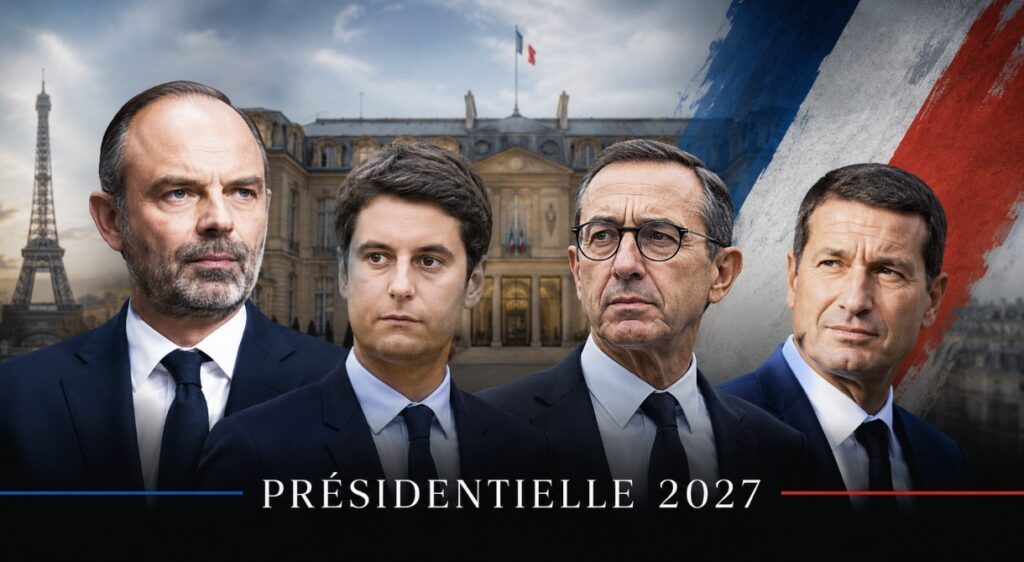
There are still several months until the French presidential election in 2027, but the contours of the center-right camp are already becoming clear. Four personalities dominate the debate to the right of the political center: Édouard Philippe, Gabriel Attal, Bruno Retailleau and David Lisnard. They all share the ambition to formulate an alternative to the Rassemblement National. Yet their starting positions differ significantly — as do their political prospects.
The campaign is still in its early phase. Nevertheless, structural power relations are already visible that go far beyond short-term mood swings. The decisive question is not only who can lead the center-right camp, but who is able to significantly expand its voter base and reach the runoff.
Édouard Philippe: The pragmatic favorite
Among the potential candidates of the political center, Édouard Philippe currently occupies a special position. The former prime minister combines government experience with an image of economic competence and statesmanlike composure. Unlike many representatives of the Macron camp, he has managed to preserve an independent political identity.
With the official launch of his presidential campaign in early July and the presentation of a program for the “renewal of France,” Philippe deliberately emphasizes continuity and a willingness to reform at the same time. His message targets both moderately conservative and liberal voters. European integration, economic competitiveness and institutional stability form the cornerstones of his offering.
It is precisely this positioning that currently gives him the greatest strategic advantage. Philippe appeals not only to the traditional center but can also win conservative voters who find the Rassemblement National’s course too radical. In the scenarios currently being discussed, he therefore appears as the candidate with the best chances of reaching the runoff.
His biggest liability, however, remains his proximity to Emmanuel Macron. Although Philippe has increasingly emancipated himself, many voters still associate him with the government’s record of recent years. This ambivalence could gain importance as the campaign progresses.
Gabriel Attal: The face of a waning era
Gabriel Attal remains one of France’s best-known politicians. His rhetorical strength and high media presence still earn him considerable attention. But popularity alone does not replace a convincing political narrative.
Attal’s central problem is that he is perceived as the immediate heir to Macronism. While Philippe has been able to develop distance from the previous government, Attal embodies, for many voters, the continuation of the existing political system. In a campaign likely to be strongly shaped by a desire for political change, this proximity could prove to be a burden.
There is also a strategic dilemma: Attal competes for almost the same voter group as Philippe. As long as both candidates remain present, the centrist camp risks a splitting of its votes — a danger that carries particular weight against a united Rassemblement National.
Bruno Retailleau: The return of the classic right
With Bruno Retailleau, Les Républicains once again have a candidate with a clearly recognizable conservative profile. His political priorities are internal security, state authority and a noticeably more restrictive migration policy. In doing so, he appeals to the traditional core of the republican right.
However, this is also his greatest challenge. France has changed profoundly politically. The classic bourgeois-conservative voter reservoir alone is hardly enough to win a presidential election anymore. Whoever wants to reach the Élysée Palace must mobilize well beyond their own camp.
Retailleau therefore faces a difficult balancing act. On the one hand, he must not disappoint his conservative base. On the other, he has to convince more moderate voters without losing political credibility. Whether he can pull off this balancing act remains uncertain.
Additional uncertainty is created by internal tensions within Les Républicains. Some leading party figures are already considering alternative alliances or strategic cooperation with Édouard Philippe. Such debates weaken the cohesion of a party that has been searching for its political role for years.
David Lisnard: Liberal ideas against structural limits
David Lisnard pursues a different approach. The mayor of Cannes consistently bets on economic liberalism, extensive decentralization and a significant reduction of state intervention. In doing so, he represents positions that are comparatively rarely articulated so clearly in the French party system.
His problem, however, lies less in the program than in his political reach. Outside politically interested circles, Lisnard so far has only limited name recognition. His candidacy currently serves primarily to bring liberal ideas more strongly into public discourse and to build a national political platform in the long term.
Whether this can quickly develop into a realistic presidential prospect seems doubtful. It is more likely that Lisnard will influence the campaign on substance without himself being one of the decisive contenders to make the runoff.
The current balance of forces overall points to a relatively clear ranking. Édouard Philippe currently has the most convincing prerequisites to challenge the Rassemblement National as the candidate of the political center and the moderate right. Gabriel Attal remains a serious competitor but must distance himself from Emmanuel Macron’s political record. Bruno Retailleau has a loyal conservative base but struggles with the structural limits of his party. David Lisnard, in turn, relies on long-term influence and programmatic profile-building.
Nevertheless, it would be premature to draw final conclusions from the current polls. French presidential elections have repeatedly shown how quickly political dynamics can shift. The Rassemblement National’s final candidacy, possible alliances within the center-right camp, economic developments or foreign-policy crises can change the balance of power at any time. Still, much currently suggests that Édouard Philippe will enter the campaign as the most promising challenger to right-wing populism — provided he s쳮ds in uniting the center-right behind him without losing its liberal center.
P.T.