
Back

Nachrichten.fr · 06/05/2026

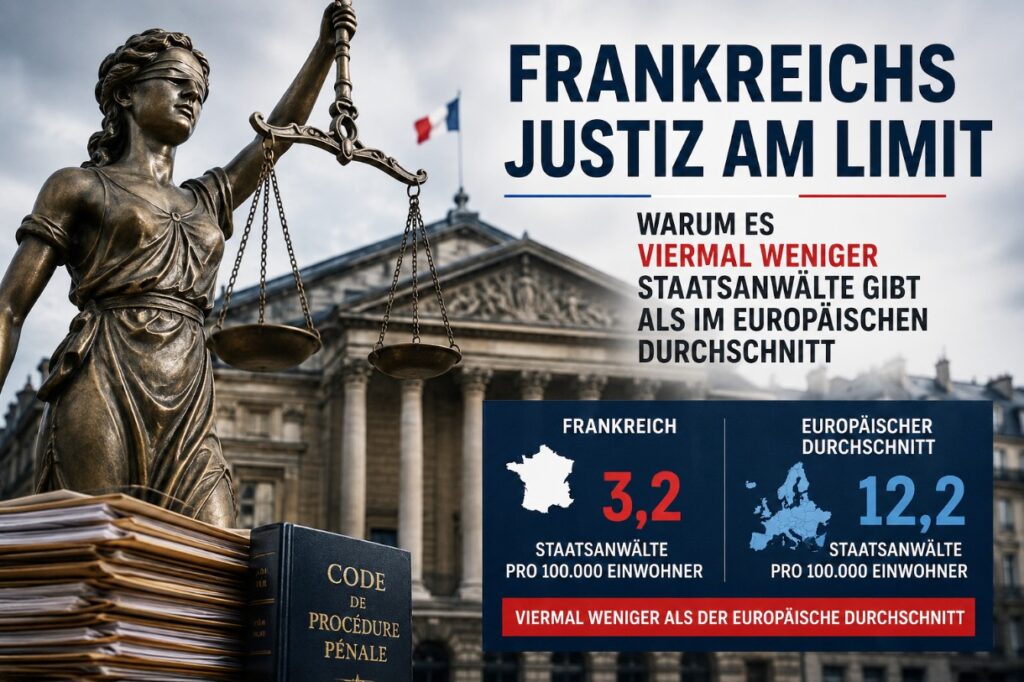
France's Judiciary at the Limit: Four Times Fewer Prosecutors Than the European Average

The effectiveness of a rule-of-law state is measured not only by its laws but also by the resources available to enforce them. In France, concerns have been growing for years that the judiciary can no longer keep pace with societal and crime policy challenges. A key indicator illustrates the problem especially clearly: France has significantly fewer prosecutors than most other European countries. The consequence is overloaded authorities, lengthy procedures, and increasing doubts about the efficiency of the justice system.

A European Special Case

The latest comparative data from the European Commission for the Efficiency of Justice (CEPEJ), based on figures from 2022 and published in 2024, paint a remarkable picture. France has only about 3.2 prosecutors per 100,000 inhabitants. The European average, by contrast, is 12.2, with a median of 11.2 prosecutors.

Measured by its population, France thus employs about four times fewer prosecutors than the European average. In the pan-European comparison, the country ranks almost at the bottom of the table, just ahead of Ireland. Several Central and Eastern European countries, on the other hand, have figures between 20 and 24 prosecutors per 100,000 inhabitants.

These numbers are all the more remarkable since France is one of the largest economies in Europe and has a highly developed administrative structure. The staffing levels of law enforcement agencies therefore stand in clear contrast to the country’s economic and political importance.

The Consequences of Staff Shortages

Statistical comparisons gain significance only through their practical impacts. In the case of the French judiciary, these are immediately visible.

According to the CEPEJ, a French prosecutor handles on average more than 2,000 cases per year. The European median, by contrast, is around 204 cases. The workload of French prosecutors is thus exceptionally high and among the highest in Europe.

Such work intensification does not come without consequences. Investigations take more time, priorities have to be set more strictly, and complex cases demand substantial resources. Particularly demanding fields such as organized crime, cybercrime, financial offenses, or domestic violence require specialized knowledge and long-term investigative work. It is especially in these areas that staff shortages are strongly felt.

Additionally, French prosecutors often have less administrative and legal support staff than their European colleagues. While in other countries a large apparatus of legal officers, assistants, and administrative employees supports the legal work, French prosecutors must manage many tasks with comparatively limited resources.

Not Only the Prosecution Service Is Affected

The structural problems are not limited to the prosecution offices. France also falls significantly below the European average in terms of the number of judges.

While the European average is 21.9 judges per 100,000 inhabitants, France has only about 11.3 judges per 100,000 inhabitants. France also lags behind significantly in the median values of European countries.

This dual understaffing—both in judges and prosecutors—exacerbates the burdens within the entire justice system. Cases backlog not only in investigative authorities but often also before the courts. As a result, processing times extend along the entire procedural chain.

The French judiciary thus faces a classic bottleneck problem: even if individual sections are strengthened in staff, delays will remain unless other stages of case processing are also expanded.

Causes of a Longstanding Deficit

The current situation is not the result of short-term developments. Rather, it is a structural problem that has developed over decades.

Although justice budgets have been increased several times in recent years and the number of magistrates has grown, the complexity of cases has increased simultaneously. Digitalization, international financial flows, cross-border crime, and new forms of internet-based offenses generate considerably more processing effort than twenty years ago.

Moreover, societal awareness of certain types of offenses has changed. Cases of domestic violence, sexual assaults, or discrimination are reported and prosecuted more frequently and intensively today than before. This progress in victim protection simultaneously increases the workload for police, prosecutors, and courts.

Many experts therefore point out that simply looking at absolute personnel numbers may even underestimate the actual workload. Not only the number of cases is rising, but also their legal complexity.

A Risk to Trust in the Rule of Law

The effectiveness of the judiciary is of central importance for the stability of democratic institutions. Citizens expect that crimes will be prosecuted, conflicts resolved promptly, and judgments delivered within reasonable timeframes.

If proceedings are delayed for years or dismissed due to lack of capacity, the impression easily arises of an overwhelmed state. This can damage trust in the functioning of public institutions.

Several high-ranking representatives of the French judiciary have repeatedly pointed out this problem in recent years. They warn that public expectations increasingly collide with the actual capabilities of courts and prosecutors. The shortage of personnel is no longer merely an internal administrative issue but a challenge to the overall quality of state justice delivery.

Against this background, the debate about judicial resources is gaining political significance. While issues of internal security regularly occupy the center of public discussions, the question increasingly comes into focus whether police, prosecution, and courts even have sufficient resources to effectively implement political objectives. The European comparative figures suggest that France still has considerable catching-up to do in this area.

Author: P. Tiko