
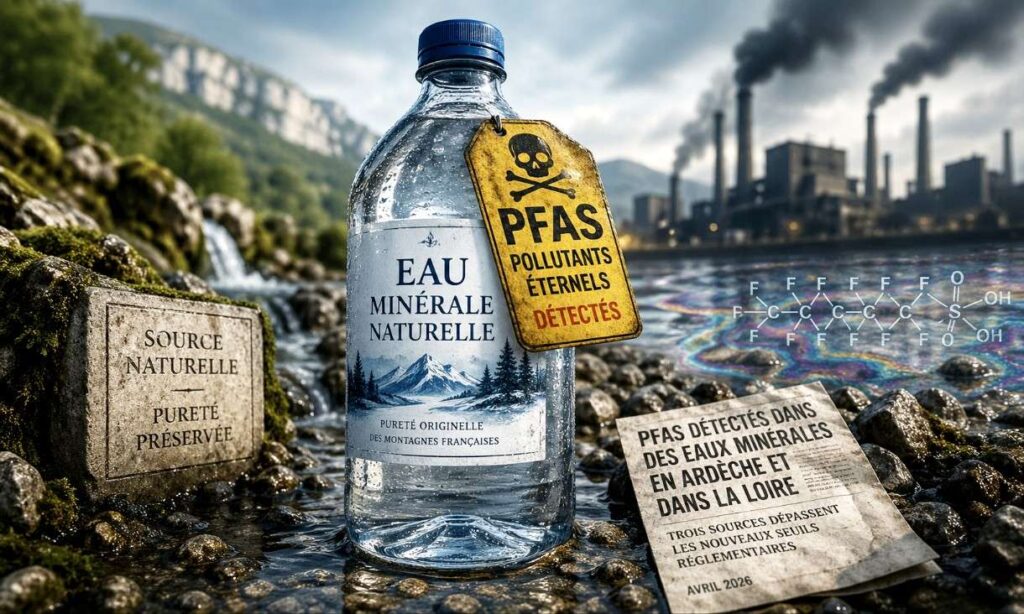
There are environmental disasters that create images. Tanker accidents. Burning refineries. Black smoke clouds over industrial cities. And then there are environmental crises like those of PFAS — silent, odorless, invisible. Because of this, they may be even more dangerous. For they undermine not only the environment but also trust in modern industrial society itself.
In Alsace, that traditional region between the Rhine, chemical industry, and European cross-border economy, this new form of environmental anxiety is now becoming tangible. Municipalities are investing millions in filtration systems, analyzing drinking water almost weekly, and trying frantically to contain contamination that may have existed for decades. France is discovering an uncomfortable truth: the technological progress of the post-war era has left side effects whose true scale may only now be beginning to emerge.
PFAS — per- and polyfluoroalkyl substances — are among the longest-lasting industrial chemicals. They resist heat, water, and grease. Precisely for this reason, they became the perfect material of a consumer-oriented modernity: in frying pan coatings, packaging, outdoor textiles, fire-fighting foams, and industrial facilities. The chemistry of convenience became the chemistry of durability. The problem is: these substances practically never disappear.
The Crisis of Invisible Risks
France is experiencing a new type of environmental debate with PFAS. Earlier ecological conflicts were mostly visible: polluted rivers, dead forests, smog over large cities. PFAS, however, produce no dramatic images. They slowly seep into soils, groundwater, and food chains. Their effects manifest statistically, medically, and over the long term — involving possible links to cancer, hormonal disorders, fertility problems, or immune deficiencies.
This very invisibility changes the political dynamics. Citizens suddenly learn that their drinking water may have been contaminated for years without anyone raising an alarm. Municipalities respond frantically with new tests. Authorities publish maps, measurements, and warnings. But the central message remains unspoken: the state itself does not really know how large the problem truly is.
This is politically sensitive. France traditionally sees itself as a highly controlling republic. The state regulates energy consumption, speed limits, heating systems, and waste separation in detail. Yet, in the case of a potentially widespread chemical contamination, the same state appears surprisingly disoriented.
The republic now measures every single CO₂ emission — and is only now discovering the chemicals in the tap water.
The Late Reckoning of Industrial Progress
Alsace is especially symbolic here. Hardly any region embodies France’s industrial history as strongly as the Rhine Valley with its chemical parks, pharmaceutical sites, and cross-border industrial clusters. For decades, this industrial concentration was seen as an expression of European prosperity. Today, these same structures suddenly also appear as sources of long-term environmental legacies.
Thus, the PFAS debate touches on a deeper French fundamental conflict: the relationship between industry, state, and society. For decades, France has defended a model of state-supported industrial sovereignty. Whether nuclear energy, aerospace, or chemistry — technological strength was always seen as a prerequisite for national independence. The ecological dimension of this modernization was often treated as secondary as long as growth, employment, and strategic autonomy seemed assured.
PFAS now reveal the dark side of this thinking. Many of the substances causing problems today were not produced through criminal negligence but within the framework of fully legal industrial production. Modernity itself thus becomes an object of mistrust.
This also explains the emotional impact of the issue. It is no longer just about individual factories or contaminated wells. PFAS symbolically represent a society coming to terms with the fact that technological progress produces not only prosperity but also risks whose consequences only become apparent generations later.
The State Between Precaution and Loss of Control
A dilemma arises for French politics. On the one hand, public pressure grows for stricter limits, comprehensive controls, and billion-euro remediation programs. On the other hand, a full reckoning would raise enormous economic and political questions.
How extensive is the contamination, really? Which industries bear responsibility? Who pays for cleaning soils and water? And how do you explain to citizens that substances long legally approved are suddenly considered health risks?
The experience of other environmental crises shows a familiar pattern: as soon as widespread measurement begins, the numbers of problematic findings grow. What might have been a local contamination can quickly become a national trust crisis.
This is exactly what makes PFAS politically more dangerous than classic industrial accidents. Oil disasters can be spatially limited. “Forever chemicals,” on the other hand, create an impression of permanent uncertainty. One never knows exactly where they are, how high the contamination is, or what long-term consequences might yet be discovered.
The French state therefore increasingly responds with the combination of transparency campaigns and technocratic reassurance typical of the republic: more measurements, new maps, additional limit values, national strategies. But the real difficulty runs deeper. Trust cannot be restored by tables and expert committees alone.
The Ecological Anxiety of Prosperity Societies
PFAS may mark the transition to a new phase of Western environmental policy. For decades, ecological debates focused on visible emissions: CO₂, fine dust, plastic waste. Now, those invisible contaminations closely connected to the everyday life of modern consumer societies are moving into the foreground.
This is where the philosophical dimension of the debate lies. PFAS are not an accident outside modernity — they are a product of its logic. They arose from the desire for efficiency, comfort, durability, and cheap mass production. Modern society wanted waterproof clothing, non-stick pans, and industrial high-performance materials. Now it discovers the long-term costs of this convenience.
This also explains the peculiar unease the topic triggers. When even drinking water no longer appears self-evidently clean, a society loses part of its sense of security. The crisis then concerns not only environmental policy but also the citizen’s relationship to their material surroundings.
France may thus be only at the beginning of a much larger debate. For PFAS ultimately raise a question reaching far beyond Alsace: how many invisible consequences of industrial modernity will Western societies discover in the coming decades?
P.T.