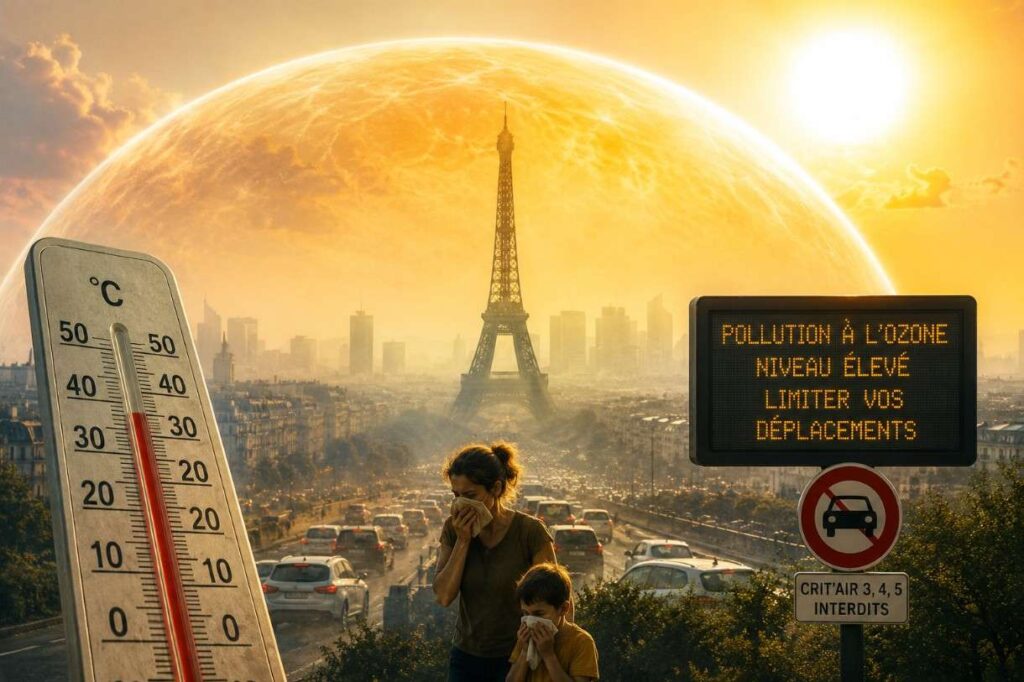
Even before the meteorological summer has officially begun, France is experiencing a weather situation that until now was mainly associated with the high summer months of July or August. Temperatures well above 35 degrees, an exceptionally stable high-pressure system, and now a rapid deterioration in air quality put the country in a dual stress situation. While the population suffers from the early heatwave, ozone levels in several regions are simultaneously rising to health-problematic levels.
The combination of heat and air pollution is increasingly becoming a challenge for health authorities, municipalities, and traffic policies. What is particularly striking here is not so much the intensity, but the timing of the phenomenon. The fact that large-scale ozone warnings have to be issued already at the end of May is considered exceptional even among atmospheric researchers. In this way, France is getting a preview of the climatic conditions that experts have been predicting for years.
A high summer phenomenon reaches spring
In the regions of Île-de-France, Centre-Val de Loire, and Auvergne-Rhône-Alpes, ozone concentrations have been measured that exceed the official information standards and warning thresholds. Normandy, Hauts-de-France, and parts of Grand Est are also reporting elevated levels. Meteorologists expect a sustainable decrease earliest by the weekend.
The cause lies in an unusual weather situation. France has been under a so-called heatwave for days – a stable high-pressure system that traps warm air masses from North Africa over Western Europe. Record temperatures for May have been broken in several regions, with values clearly above the seasonal average.
This very weather situation promotes the formation of ground-level ozone. Unlike the protective ozone layer in the stratosphere, this ozone forms in the lower layers of the atmosphere through photochemical processes. Nitrogen oxides from road traffic, emissions from industries, and volatile organic compounds react with each other under intense sunlight. High temperatures further accelerate these reactions.
At the same time, the stable high-pressure system prevents air exchange. Harmful substances cannot be dispersed. The atmosphere acts like a lid over urban areas. What is emitted in the cities remains there and concentrates increasingly. This exact constellation is currently causing the high pollution levels in Paris, Lyon, and other urban centers.
The Invisible Health Risk
Ozone is one of the most problematic air pollutants in summer. Unlike fine dust, the gas is barely perceptible to the population. However, the health effects are significant.
Doctors point out that ozone irritates the mucous membranes, promotes inflammatory reactions in the airways, and can reduce lung function. Especially children, the elderly, asthma patients, and people with cardiovascular diseases are at increased risk. Even short-term exposure can cause coughing, shortness of breath, eye irritation, and headaches. During prolonged episodes, the risk of hospital admissions due to respiratory and heart problems also increases.
There is an additional factor: the heat itself weakens the body. When high temperatures and air pollution occur simultaneously, the health risks reinforce each other. The current weather situation therefore leads to a double burden that is especially problematic for vulnerable population groups.
The consequences are already visible. Several sporting events had to be adapted, postponed, or canceled. Organizers are forced to provide additional medical care or to cancel matches entirely. This discussion illustrates how strongly extreme climatic events now also affect areas of everyday social life that were previously considered fairly unproblematic.
Authorities respond with traffic restrictions
In the Paris region, authorities resorted to measures that have now become standard during severe ozone periods. The police prefecture temporarily activated differentiated driving bans. Vehicles with higher emission classes were no longer allowed to enter certain parts of the metropolitan area. At the same time, speed limits on highways and expressways were lowered. Advice to work from home and restrictions on heavy transport were also issued.
The reasoning behind this is understandable. Less traffic means lower emissions of nitrogen oxides – the precursor compounds that significantly contribute to ozone formation. However, the effectiveness of such measures remains controversial. Air quality experts point out that ozone often does not form at the location where emissions are released. Chemical reactions can take place over tens of kilometers, meaning local traffic restrictions have only limited effects.
Still, these measures carry a political signaling function. They demonstrate that authorities no longer consider the situation as a temporary weather anomaly but as a structural environmental and health problem.
Climate change changes the calendar
The timing context is particularly alarming. Ozone peaks were traditionally a phenomenon during the summer holiday period in France. Now they occur already at the end of May.
According to air quality experts, this is the earliest large-scale ozone alert since the start of modern measurement series. Climate scientists do not see this as an isolated phenomenon but as further evidence of the profound change in European weather and climate patterns.
France has experienced a clear increase in heatwaves since the beginning of this century. At the same time, abrupt temperature fluctuations are increasing – rapid transitions from unusually cool to exceptionally warm weather within a few days. It was precisely such a temperature shift that preceded the current episode.
Climate change acts less as a direct cause of individual weather phenomena, but as an amplifier. The atmospheric patterns existed earlier. However, nowadays they affect an overall warmer climate system. As a result, heatwaves reach critical intensities faster, last longer, and occur earlier in the year.
The current ozone episode over France is therefore more than a passing phase of poor air quality. It exemplifies a development that increasingly characterizes Europe: environmental and health risks that were once limited to a few summer weeks are shifting forward in time and cover increasingly larger areas. The heatwave over France is thus not merely a meteorological phenomenon. It is an indication of how quickly the climatic boundary conditions are changing – and how urgently politics, cities, and health systems must respond.
Andreas M. Brucker