
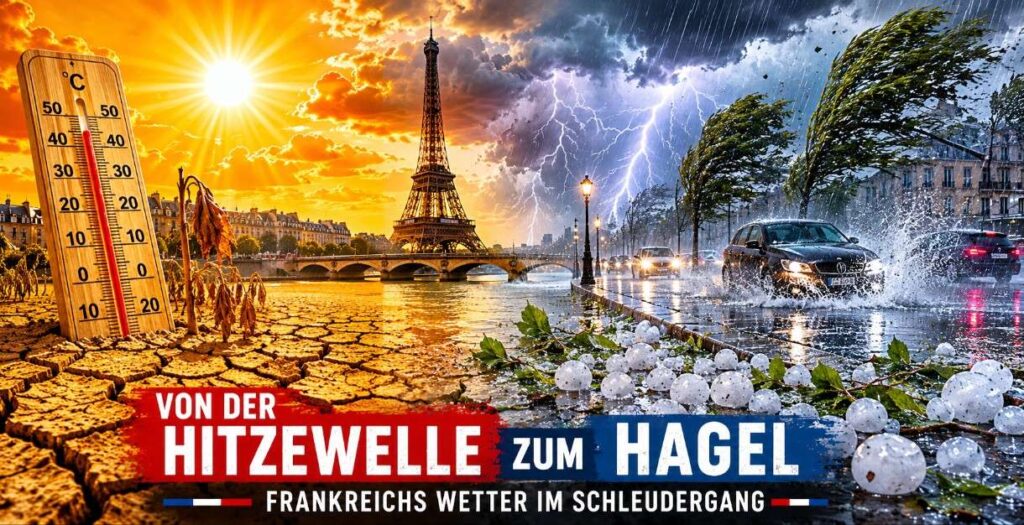
The meteorological summer in France began with a lesson that many experts had predicted for years: extreme weather events are occurring more and more frequently, one after another. Just at the end of May, the country experienced an unusually early heat wave, and at the beginning of June, thunderstorm fronts, heavy downpours, and localized powerful hailstorms swept across numerous regions.
What was previously considered a rare weather whim is increasingly becoming the new reality. Within a few days, weather conditions changed from almost hot summer heat to a scenario more reminiscent of the variable weeks of April. Temperatures dropped sharply, moist air masses collided with the heated surface, and the atmosphere reacted with the explosive dynamics that meteorologists have been observing for many years.
The sharp change is no coincidence. Warmer air can hold much more moisture. When this moist air meets cooler currents, the accumulated energy is often discharged in the form of powerful thunderstorms. Significant hailstones, strong wind gusts, and local floods are now increasingly becoming part of the French summer repertoire.
Agriculture was particularly affected. For winemakers, fruit growers, and vegetable farmers, a hailstorm is like Russian roulette. Months of work can be destroyed in a few minutes. Especially in traditional wine-growing regions of France, concern is growing over developments that could make crop losses the norm rather than the exception.
But cities are also facing new challenges. Sewer systems, designed for different volumes of precipitation, are quickly overwhelmed during heavy rains. Flooded streets, filled underground passages, and damaged infrastructure cause significant costs. Adding to this is the often underestimated burden on health. Many people first suffer from extreme heat and soon after from the consequences of severe storms.
The true essence of the problem lies deeper. France is experiencing not just more warm days. The climate is changing the way weather forms and interacts. Transition periods are becoming sharper, fluctuations more extreme, and forecasting more complex. What was considered extraordinary yesterday is gradually becoming the norm.
The prospects for the coming months also do not promise improvement. Meteorologists predict continued elevated temperatures, especially in the Mediterranean region and the Alps. The likelihood of another very warm summer is considered high.
The transition from a heat wave to hail may seem contradictory at first glance. In reality, both phenomena are manifestations of the same trend. A warmer climate means not only more heat. It means more energy in the atmosphere, more moisture in the air, and, accordingly, a greater potential for extreme weather events.
France faces a challenge that goes far beyond daily weather forecasts. Weather is increasingly becoming a matter of infrastructure, agriculture, urban planning, and ultimately, society’s ability to adapt. The sky over France is already giving the clearest signals of this today.
Andreas M. Brücker