
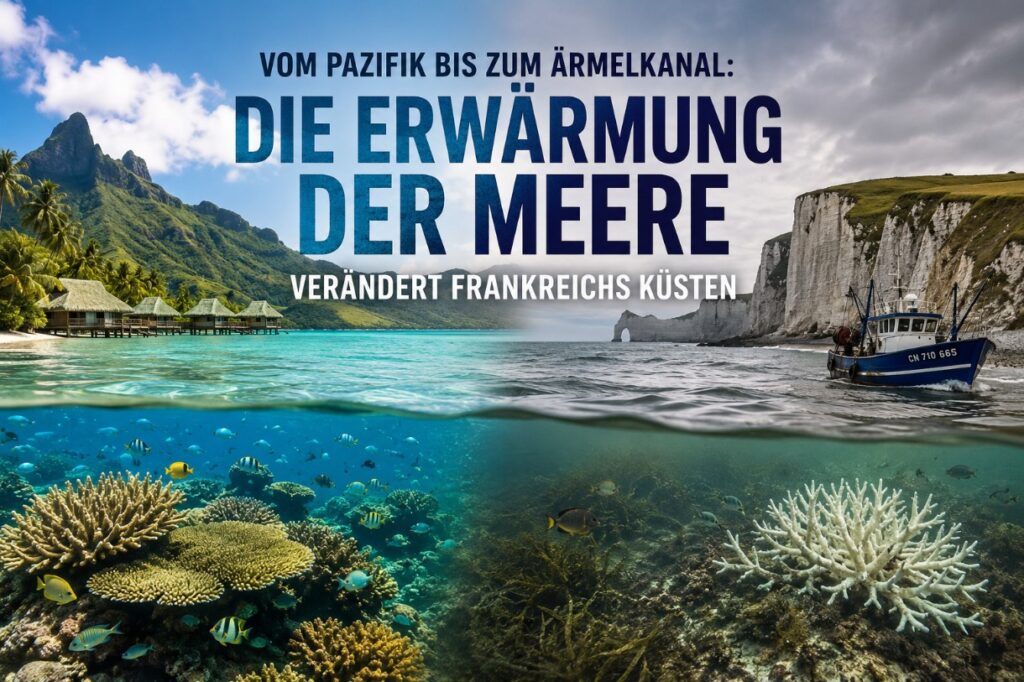
The impacts of climate change long ago went far beyond heatwaves and wildfires. A profound transformation is also taking place beneath the water’s surface. From the tropical lagoons of French Polynesia to the cool waters of the English Channel, researchers have been measuring rising sea temperatures for years. What used to be considered exceptional now occurs increasingly often and is altering entire ecosystems.
France occupies a special position in this regard. Thanks to its overseas territories, the French maritime domain spans several oceans and is among the largest in the world. As a result, the effects of warming appear across very different climate zones – yet the developments follow the same pattern everywhere.
Marine heatwaves now occur far more frequently than a few decades ago. During these events, the water warms for days or even weeks well above the long-term average. Unlike on land, this heat often persists, because water changes temperature much more slowly than air. The result: habitats fall out of balance, currents shift, and oxygen levels drop. Who would have thought that a few extra degrees could change an entire sea?
The coral reefs of French Polynesia are particularly sensitive. They are among the most species-rich habitats on our planet and provide shelter and food for thousands of species. However, if water temperatures remain elevated by just one to two degrees, coral bleaching often begins. The corals lose their vital algae, fade, and die if the heat persists.
With them not only does a unique habitat vanish. The natural protection of coastlines against waves and erosion also declines. This is of considerable importance for many Pacific islands, since healthy coral reefs form an important basis for fisheries and tourism there.
But the changes are by no means limited to the tropics. Marine biologists are also observing noticeable shifts in the English Channel. Warm-loving fish species are increasingly spreading northwards, while typical cold-water species come under pressure. This alters food chains and traditional fishing grounds. For fisheries, it means a constant adaptation to new conditions. Some fishers today catch species that were hardly found in these waters a few decades ago. Crazy, right?
In addition, many coastal habitats suffer from persistent warming. Seagrass meadows, mussel beds, and algal communities are sensitive to high temperatures. Because warm water holds less oxygen than cold, numerous fish and invertebrates become stressed. At the same time, pathogens and invasive species spread more easily. Jellyfish are also appearing more frequently on some French coasts than before.
The economic consequences are also unavoidable. Mussel and oyster farmers increasingly struggle with heat damage and disease. Tourism feels the effects through algal blooms or larger jellyfish occurrences. Especially in the overseas territories, many jobs depend directly on healthy marine ecosystems.
Part of this development can no longer be reversed. Therefore, alongside reducing greenhouse gas emissions, adaptation to the new conditions is gaining importance. Experts focus on protecting sensitive coastal areas, restoring seagrass meadows, sustainable fisheries concepts, and modern monitoring systems. Satellites and automated stations today provide near-real-time data on temperature and changes in the oceans.
Whether in the turquoise lagoons of the Pacific or on the rocky coasts of Normandy – the warming of the seas links regions thousands of kilometers apart. The state of the oceans is increasingly becoming a mirror of global climate change. How well this sensitive habitat is protected will determine not only the future of many species but also the livelihoods of future generations.
An article by M. Legrand