
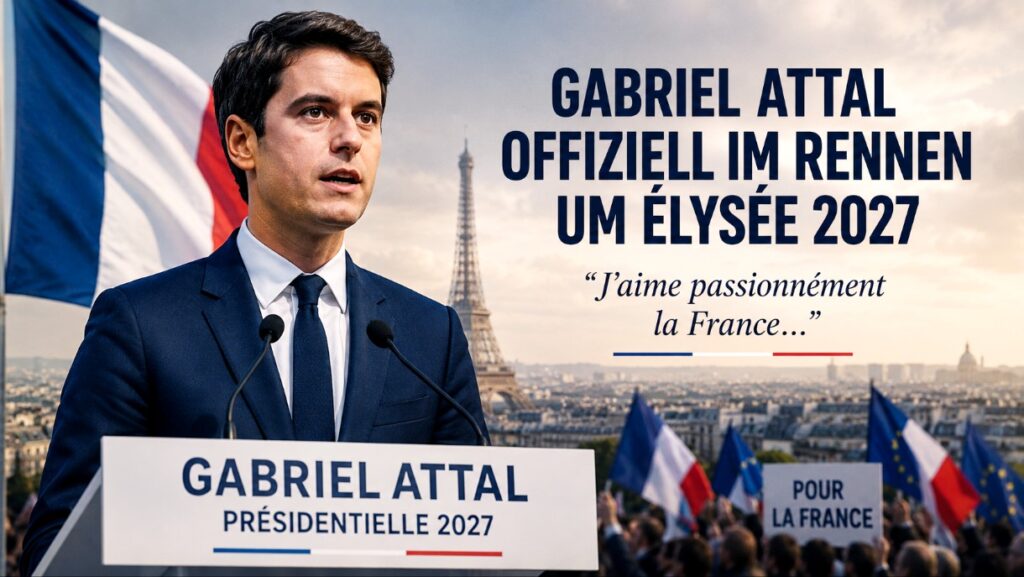
Gabriel Attal did what had been expected in Paris for months: the former prime minister is officially running for the 2027 presidency. His statement in Mur-de-Barrez, in the south of France, was more than a simple announcement of candidacy. With phrases like “J’aime passionnément la France” he presented himself as a patriotic optimist, as a dynamic representative of a new generation – and at the same time as the political heir of the Macron years.
But this is precisely where his biggest problem lies.
In fact, Attal must strike an almost contradictory balance: he needs Emmanuel Macron’s political capital, without being crushed by its signs of wear. After nearly a decade of Macronism, the French center is still electorally viable, but clearly tired. The grand reform promises of 2017 – economic modernization, political renewal, overcoming the traditional left-right scheme – have lost their shine. The pension reform, social tensions and the sense of constant crisis management have visibly weakened the centrist political camp.
Attal now seeks to present himself as a “new face,” even though he himself is one of the most important figures of the Macron system. At 37 he embodies youth, media skill and rhetorical precision. As minister of education and later as prime minister he demonstrated political discipline and communicative talent. But precisely this closeness to power makes his candidacy complicated. Many voters associate him less with change than with continuity.
Added to this is the competition within the same camp. In particular Édouard Philippe remains for many moderate voters the most credible alternative. The former prime minister has a more statesmanlike profile, a higher approval rating and a reputation for greater political independence from Macron. While Attal focuses more on dynamism and generational change, Philippe embodies stability and experience. The battle for the political center could therefore soon become a power duel between two different interpretations of Macron’s legacy.
At the same time pressure from the right is growing. The Rassemblement National continues to benefit from the fragmentation of the center and the weakness of traditional parties. Whether Marine Le Pen or Jordan Bardella runs, the national right remains in many scenarios the strongest force in the first round. For Attal this means that mere popularity will not be enough. A political narrative that goes beyond style and personality will be needed.
So far symbolism predominates. Patriotic rhetoric, closeness to citizens and youthful energy can attract attention, but they do not replace a strategic plan for France’s economic and social problems. The decisive question is therefore whether Attal will be able to formulate a credible “after”: a France after Macron that nevertheless does not break with Macronism.
His candidacy will depend on this. If he succeeds in this difficult balance, he could become the candidate of a liberal renewal. If he fails, he risks remaining the talented but ultimately too tied to an exhausted political model, an administrator.