
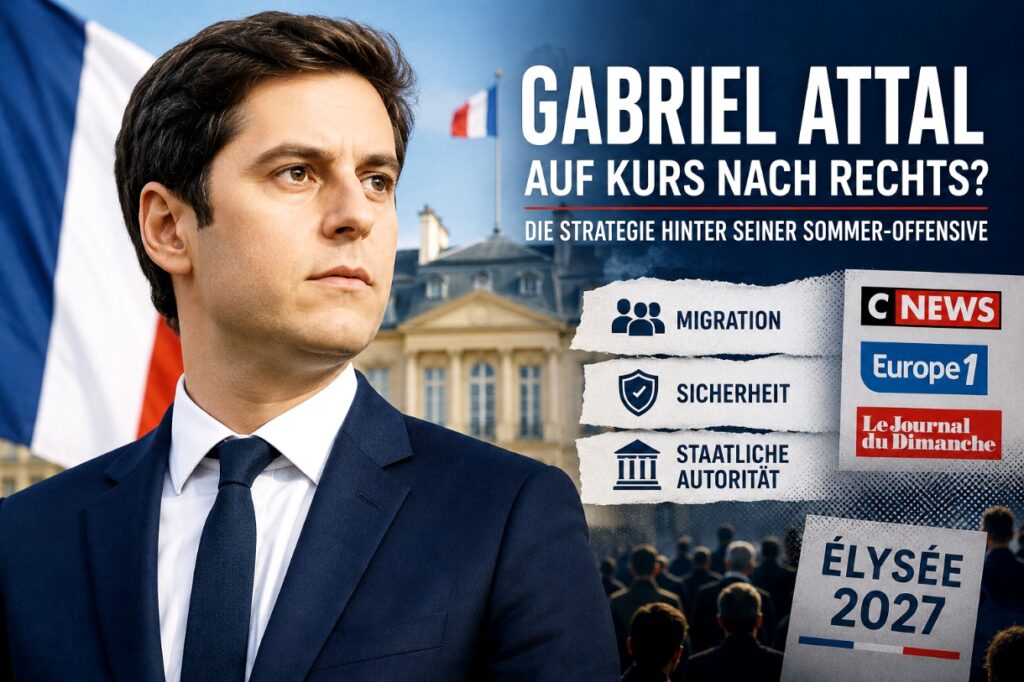
The political summer in France traditionally serves not only for rest and recovery, but often also for strategic preparations for upcoming election campaigns. In 2026, signs are mounting that former Prime Minister Gabriel Attal is using the summer months to establish himself as a serious contender for the 2027 presidential election. His recent public appearances and political demands point to a deliberate repositioning: on migration, domestic security and state authority, Attal is moving noticeably to the right, without abandoning his claim to represent the political center.
This is less a fundamental ideological change of course than a strategic adaptation to a political environment in which issues of security and migration have dominated public debate for years.
Focus on Migration and Domestic Security
In recent weeks, Gabriel Attal has presented a series of proposals that until now have primarily been associated with the conservative camp. These include the introduction of binding immigration quotas and the abolition of automatic sentence reductions for certain offenses. Such demands differ significantly from the initially more economically liberal and socially progressive orientation of Macronism.
This emphasis is hardly coincidental. For several years, opinion polls have shown that migration, crime, public safety and purchasing power are among the French public’s main concerns. For a potential presidential candidate, credibility in these policy areas has now become almost indispensable.
Attal is clearly seeking to present himself as a politician who stands not only for reforms in education or the economy, but can also demonstrate an ability to act in the traditional responsibilities of the state.
Targeted Presence in Conservative Media
Also striking is Attal’s increased presence in media outlets considered to be within the sphere of influence of businessman Vincent Bolloré. These include in particular CNews, Europe 1 and the Journal du Dimanche. Only a few years ago, regular appearances by a leading Macron politician in this media environment would have been surprising.
Politically, however, this move is understandable. The media outlets mentioned have significantly expanded their influence on public debate and regularly place issues such as migration, national identity, security and social cohesion on the political agenda. At the same time, they reach an audience that is of central importance to the centrist-conservative segment of the political spectrum.
Attal’s presence in these media outlets does not necessarily mean that he identifies with their editorial line. Rather, it follows a classic campaign strategy: anyone seeking to win over new voter groups must be present where they obtain their political information.
The Competition to S쳮d Emmanuel Macron
The real explanation for Attal’s course, however, lies in the political starting position ahead of the 2027 presidential election. Since Emmanuel Macron is constitutionally barred from running again after two consecutive terms in office, the contest to s쳮d him has long since begun.
Several prominent representatives of the former governing camp are already positioning themselves as possible successors. Édouard Philippe in particular is regarded in numerous polls as a promising candidate of the center-right camp. There are also figures such as Gérald Darmanin and Bruno Retailleau, each of whom appeals to different conservative voter groups.
This creates a strategic dilemma for Gabriel Attal. If he were to rely solely on a traditional centrist position, he would risk Édouard Philippe permanently winning over the moderate segment of the electorate. At the same time, the conservative camp could continue to be lost to Les Républicains or the Rassemblement National.
The stronger emphasis on state authority and security policy can therefore be understood as an attempt to develop an independent political profile within the former Macron camp.
Opportunities and Risks of an Opening to the Right
The strategy certainly offers opportunities. Attal can present himself as a politician who responds to the population’s changing priorities and does not leave security issues to the political fringes. In doing so, he is seeking to combine his experience in government and administration with a profile that also appeals to conservative voters.
At the same time, this course entails considerable risks.
Part of the traditional Macron electorate still sees itself as liberal, pro-European and socially open. These voters could perceive an overly strong focus on conservative issues as a departure from Emmanuel Macron’s original political project.
There is also a fundamental problem with every shift to the right in politics. Those who adopt issues that have been occupied by conservative or right-wing populist parties for years risk merely validating their agenda. In such a case, many voters often prefer the political originals to a candidate from the political center.
The Importance of the Bolloré Media Network
Attal’s increased presence in the media outlets of the Bolloré group is also interpreted by political observers as a deliberate signal. In recent years, this media network has developed into an important factor in shaping French public opinion and has a major influence on debates about immigration, security and national identity.
For a serious presidential contender, it is now likely hardly possible to ignore this media space completely. Regardless of one’s political assessment of these media outlets, they provide access to an electorate that could be decisive for the outcome of the presidential election.
Attal’s strategy therefore follows less an ideological rapprochement than a communications logic: he deliberately appears on the platforms where conservative and centrist voters get their information.
Overall, Gabriel Attal’s political summer offensive appears to be the opening of a long-term presidential strategy. His aim seems to be to break away from his role as Emmanuel Macron’s former prime minister and to be perceived as an independent candidate with a clear profile. The stronger emphasis on authority, migration and domestic security is intended to broaden his political reach without abandoning his claim to represent the political center.
Whether this balancing act will s쳮d remains an open question. The decisive issue will be whether Attal can develop a credible and lasting profile between the liberal center and the conservative right, or whether voters will see his positioning merely as a tactical adaptation to the political zeitgeist. The coming months will show whether the summer realignment will actually develop into a viable presidential campaign.
Andreas M. Brucker