
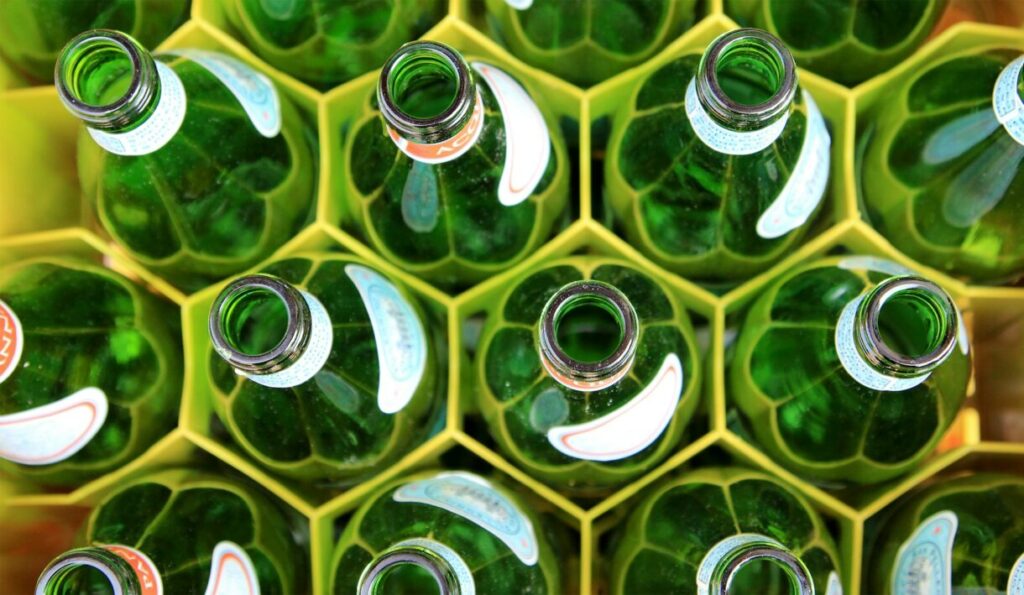
One year after the launch of a large-scale trial to reintroduce the glass deposit in several French regions, the results are sobering. The environmental organization Zero Waste France accuses those responsible of significantly missing their self-imposed targets. In particular, the program “ReUse” coordinated by Citeo, which aims to promote the reuse of glass packaging and eventually lead to a nationwide reusable system, is under scrutiny.
When the project was presented last year, the plans sounded ambitious. Hundreds of supermarkets were to be gradually involved. The goal: consumers should be able to return glass bottles and jars so they can be cleaned and refilled. An expansion to the whole of France was even discussed for 2027.
However, according to Zero Waste France, the reality looks much more modest.
Although around 350 stores are now participating in the program, environmentalists say this falls far short of the original expectations. Even more problematic for the organization is the limited variety of products actually offered in the reusable cycle.
For their investigation, members of the association visited numerous participating markets. The results were disappointing. On average, only a few reusable products were found on the shelves. Mainly beverages like beer, fruit juices, water, soft drinks, or wine were represented. The much larger product range theoretically planned was hardly visible in many places. In some stores, reusable packaging was missing entirely.
This highlights a problem many consumers already know from other environmental projects: a system can only function if it is actually present in everyday life. Those who have to search extensively quickly lose interest.
Here lies another point of criticism from Zero Waste France. In the organization’s view, there is often a lack of clear labeling. Information about how the deposit system works is frequently hard to find. Return machines are sometimes off to the side or insufficiently signposted. Those who do not specifically look for it may not even notice the offer.
Added to this is the issue of price.
Although the deposit is refunded when returned, according to the organization’s observations, some reusable products cost noticeably more than comparable goods in single-use packaging. For many households on a budget, this could be a decisive obstacle. From the perspective of many experts, environmentally friendly behavior must not remain a luxury for a few.
The criticism is therefore not only directed at the operators of the project. Zero Waste France also calls on the French government to take action. Voluntary initiatives are not enough to achieve the country’s ambitious environmental goals. Instead, more binding requirements are needed for manufacturers and retail chains to promote the wider spread of reusable packaging.
The debate comes at a time when France wants to further tighten its waste policy. The reuse of packaging is considered an important component of the circular economy to conserve resources and reduce the amount of single-use waste. Every bottle that is used multiple times saves raw materials, energy, and transport effort.
Whether the glass deposit in France actually becomes a success story remains uncertain. The current interim status shows that there is still a significant gap between political goals and reality on supermarket shelves. The coming years will likely decide whether a promising pilot project becomes a fixed part of everyday French life – or whether the idea stalls once again.
Author: C.H.