
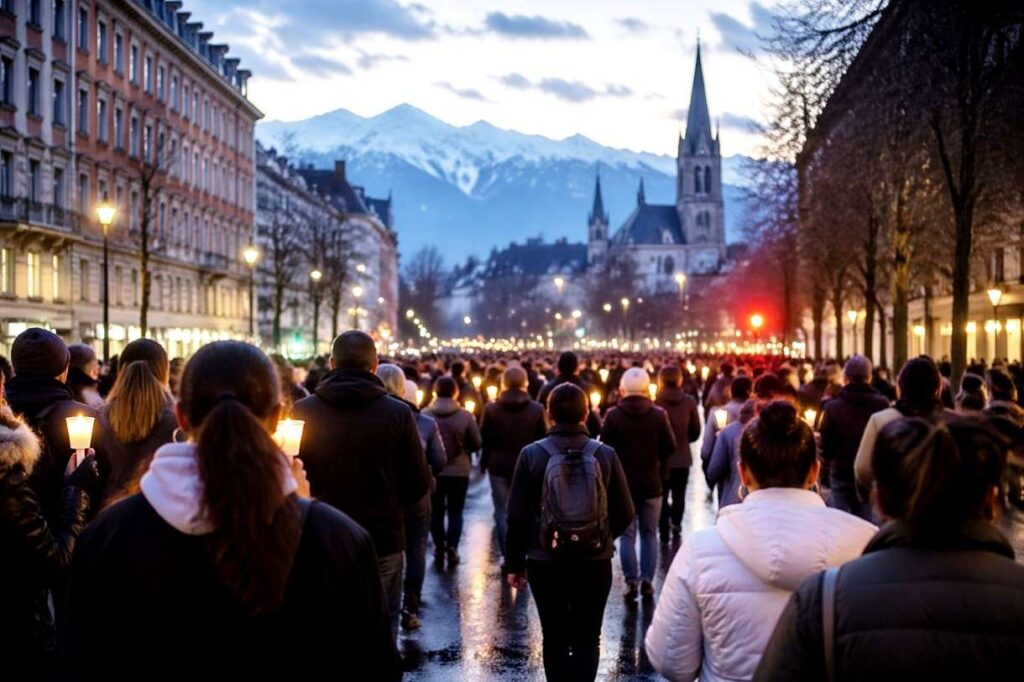
These are the moments when a city comes to a standstill.
Not noisily, not jarringly, but with a silence that weighs heavily on the streets.
In Grenoble, at the foot of the Alps, this silence has intensified in recent weeks. Too many shots, too many deaths, too many names suddenly missing. Now a response is taking shape, quiet yet unmistakable: on 3 May, people want to take to the streets together. A “white march,” a silent demonstration – a symbol of mourning, but also of resistance.
The starting point was chosen deliberately. Avenue Alsace-Lorraine, one of the city’s main arteries, leads into the heart of Grenoble, past cafés, shops and everyday life. From there, the procession is expected to move toward Notre-Dame – a route of symbolic significance. From the noise of everyday life toward a place of reflection.
The initiative does not come from politicians, but arises from the heart of society. Azzeddine Mhiyaoui, once a boxer and locally well known, launched the appeal. No complicated programme, no ideological confrontation. Just one sentence that hits the mark: “Not one more bullet. Not one more life.”
It could hardly be clearer.
What is happening in Grenoble can no longer be dismissed as a mere succession of isolated cases. Within just a few days, several men were shot dead, in the heart of the city, sometimes in places previously considered safe. A twenty-seven-year-old, gunned down at night. A security guard, killed in front of a venue. Stories similar in their brutality – and in their impact.
Because with every new crime, something shifts.
The limit of what can be endured moves, almost imperceptibly, a little further away. What was still considered an exception yesterday risks becoming a habit today. This is precisely what the planned demonstration is aimed against. It wants to stop this process, or at least make it visible.
One could say: it is an attempt to break the normalization of violence.
It is not only about mourning. It is about control over interpretation. Who decides how a city sees itself? Are they the headlines about drug trafficking and shootings? Or are they the people who live there, work there, and raise their children?
The truth probably lies somewhere in the middle. But the organizers of the “marche blanche” are deliberately sending a signal. They want to show that Grenoble is more than a stage for criminal clashes.
Of course – and honesty requires saying so – such a march will not dismantle the networks. It will not make the weapons disappear, nor resolve conflicts deeply rooted in social and economic structures.
But it changes something else.
Gives the victims a face. It takes the debate out of the cold columns of numbers and roots it in public space. For a few hours, the street belongs not to fear, but to the people.
And perhaps this is precisely where its greatest strength lies.
Because cities live not only on infrastructure and politics, but also on the feeling of enduring something together – and standing up against it. Grenoble is at a point where this feeling is being renegotiated.
Will May 3 be a turning point? Hard to say.
But it marks a threshold. One at which a city says: this far – and no further.
By C. Hatty