
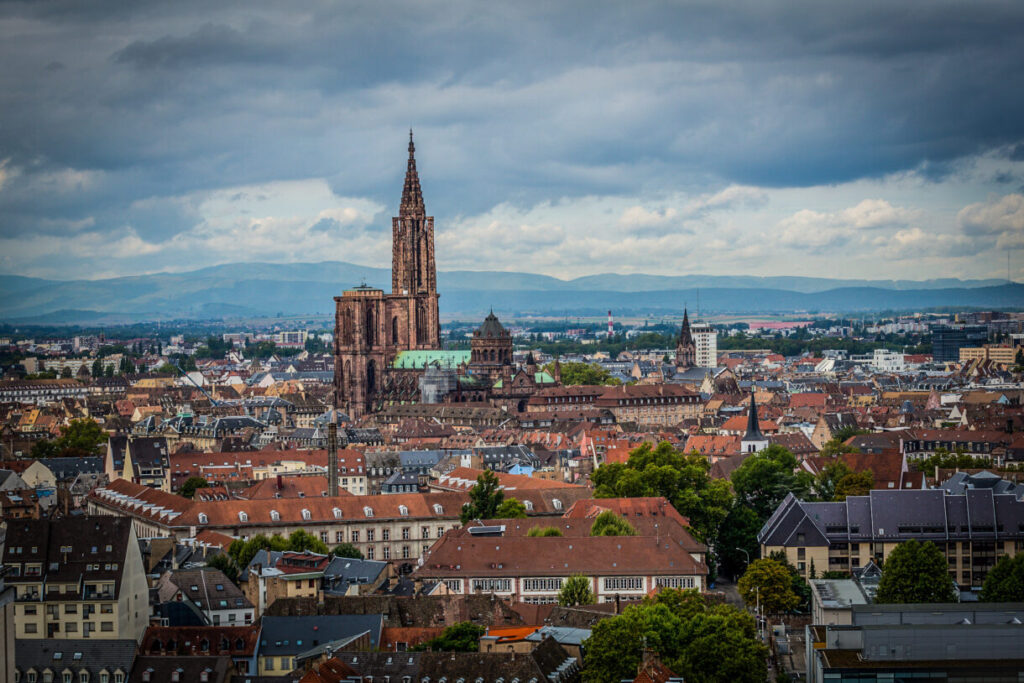
Strasbourg feels like a conversation between two countries. French joie de vivre meets German order, medieval alleys meet monumental boulevards, church bells ring alongside the clinking of wine glasses in cozy Winstubs. Walking here, you are not just strolling through a city – but through centuries of European history.
And that’s exactly what makes it so appealing.
The tour begins in the heart of the old town on the Grande Île. Early in the morning, the air is filled with the scents of buttery croissants, freshly ground coffee, and a hint of river air from the Ill. Street musicians tune their instruments, shopkeepers open their small stores, somewhere dishes clatter. Strasbourg slowly awakens – quite charmingly, by the way.
The Notre-Dame Cathedral – A Stone Giant
Amid narrow alleys, the famous Strasbourg Notre-Dame Cathedral rises like a massive sandstone mountain. First-time visitors almost automatically stop in front of it. The delicate facade looks like lace made of stone. Every figure, every decoration tells a story from the Middle Ages.
Construction began in the 12th century, and the distinctive spire followed in 1439. For a long time, the cathedral was even considered the tallest building in the world. Crazy, right?
Particularly fascinating is the astronomical clock inside. At half past twelve, the apostles’ parade begins – figures move, gears engage, visitors pull out their smartphones. Nevertheless, the scene retains all its magic.
Those with enough breath can climb the 330 steps to the platform. Upstairs awaits no ordinary view. The rooftops of Strasbourg stretch to the horizon, beyond which the Vosges and even the Black Forest shimmer in clear sight.
Right in front of the cathedral, there is constant movement. Street artists draw chalk pictures, tourist groups push across the pavement, waiters balance trays through the crowd. Right here, you feel this European flair particularly intensely.
Through the Alleys to Petite France
From Münsterplatz, the path leads southward through small streets toward the water. The houses close in, shutters glow in bright colors, flowers hang over the canals. After a few minutes, you reach La Petite France – probably the city’s best-known quarter.
And yes, it really looks almost unreal beautiful.
The Ill branches here into several arms. Between them stand half-timbered houses from the 16th and 17th centuries, whose crooked roofs and creaking beams recall old trade times. Fishermen, millers, and tanners used to live here. Especially the tanners needed wide attics so that animal hides could dry – which is why many roofs look unusually high.
When strolling, you hear the rushing of water, bicycle bells, and somewhere the clatter of dishes from a Winstub. Strasbourg has this rare ability to appear lively and relaxed at the same time.
A few minutes further on, the Ponts Couverts appear. The covered bridges once belonged to the medieval city defense. Today, their towers reflect picturesquely on the water. Right next to them rises the Barrage Vauban, a weir built in the 17th century.
A little tip: Be sure to go up to the Barrage Vauban’s viewing terrace. From there, the entire Petite France looks like it’s painted on a canvas.
Sometimes, someone simply sits there with a baguette on the wall, watching the water for minutes. Honestly, understandable.
Palais Rohan and Medieval Civic Pride
From Petite France, the path leads back north toward the center. Along the way, perspectives constantly shift: narrow alleys, small squares, suddenly again wide sightlines. Strasbourg cleverly plays with spatial perception.
At Place du Château finally waits the elegant Palais Rohan. The baroque palace was built in the 18th century as a residence for prince-bishops. Its symmetrical facades and ornate halls demonstrated power, wealth, and political influence.
Even personalities like Napoleon or Marie Antoinette stayed here.
Today the building houses several museums. Particularly fascinating are the historic chambers with their heavy curtains, gilded furniture, and huge chandeliers. You almost get the feeling a court official might march by at any moment.
Right next door stands the famous Maison Kammerzell. This richly decorated bourgeois house is one of the most beautiful half-timbered buildings in Europe. The carved figures on the facade symbolize religious motifs, zodiac signs, and human virtues.
Back then, wealthy merchants probably wanted to show what they had achieved. After all, Instagram did not exist yet.
From the Middle Ages to the German Imperial Era
Now Strasbourg changes noticeably.
From the historic center, a wide axis leads toward the Neustadt. The medieval alleys slowly disappear, instead generous boulevards with monumental buildings and plenty of greenery open up. This district was developed between 1871 and World War I during German rule over Alsace-Lorraine.
The so-called Neustadt is nowadays part of the UNESCO World Heritage – completely justified.
In the center rises the imposing Palais du Rhin. The former imperial palace was built between 1884 and 1889 for Kaiser Wilhelm I. Massive staircases, mighty columns, and richly decorated facades were meant to demonstrate strength.
The building almost looks like a mix of Berlin representational architecture and French elegance.
Around Place de la République, other monumental buildings in the style of historicism and neo-baroque stand. Libraries, administrative buildings, and theaters form a quarter designed to deliberately radiate power and modernity.
During the stroll, you notice how much Strasbourg changes here. The old town tells stories from the Middle Ages, the Neustadt from the industrial age, nation-states, and political symbolism.
Two worlds within a few minutes’ walk.
Saint Paul and the University
If you follow the broad streets further northeast, two particularly striking buildings by the water suddenly appear. The pointed spires of Église Saint-Paul reflect in the Ill and almost look like a Rhine metropolis from a historical novel.
The neo-Gothic church was built in the 1890s and strongly draws on late German Gothic. Inside, tall vaults, colorful windows, and impressive acoustics dominate. When organ music plays, the space takes on an almost mystical atmosphere.
Directly opposite lies the Palais Universitaire. The monumental university building was constructed between 1879 and 1884. Especially symbolic are the two figures Argentina and Germania on the building – emblems of France and Germany.
Strasbourg already saw itself then as a bridge between cultures.
And honestly: which other city illustrates European history so tangibly within just a few kilometers?
Cultural Highlights Between Reformation and Modernity
Strasbourg offers much more than pretty facades. The city developed over centuries into a cultural melting pot.
Romans already founded Argentoratum here, a military camp on the Rhine. In the Middle Ages, Strasbourg rose to a free imperial city and developed enormous economic strength. Later, Reformation, French royal rule, and German annexation shaped the cityscape.
These different layers can be discovered everywhere.
The Musée Alsacien shows traditional living spaces, costumes, and crafts of Alsace. In the Musée Archéologique de Strasbourg, you find Roman artifacts from the city’s early history.
Music and theater also play a major role. The Opéra national du Rhin is one of the important opera stages in France. The neoclassical building forms an elegant transition between old town and Neustadt.
In addition, churches like Saint-Thomas or Saint-Pierre-le-Jeune reflect religious conflicts and social changes over centuries.
Alsatian Cuisine – Hearty, Warm, Damn Delicious
At some point, hunger sets in. And Strasbourg takes food quite seriously.
Especially cozy are the traditional Winstubs in Petite France or the Krutenau district. Dark wood, checkered tablecloths, close seating – somewhere, someone is always laughing loudly. That’s just how it should be.
On the table come classics like Flammkuchen with bacon and onions, hearty Choucroute garnie, or Baeckeoffe, a slow-cooked stew with meat, potatoes, and wine.
A Riesling from Alsace fits perfectly with these dishes.
For dessert, Kugelhopf often tempts – light, mildly sweet, and ideal with coffee. If you stroll the markets around Place Kléber in the morning, you’ll also discover fresh bread, honey, cheese, and regional specialties.
Strasbourg tastes like a border region. Of rural tradition, French sophistication, and German groundedness.
A pretty brilliant combination.
Recommendations for Your City Walk
If you only have half a day, focus on Grande Île, the cathedral, and Petite France. This route already gives a strong impression of Strasbourg’s character.
With a full day, a detour into the Neustadt is definitely worthwhile. Only there can you truly understand the city’s political and cultural depth.
Comfortable shoes help a lot – the cobblestones take their toll eventually. Also plan enough breaks. Strasbourg does not work as a rapid tour. The city unfolds its charm slowly, almost casually.
Maybe suddenly you find yourself sitting by the canal, hearing church bells, and noticing that here, France and Germany don’t stand against each other but blend together.
That, exactly, is the magic of this city.
A travel report by V.O.Yager