
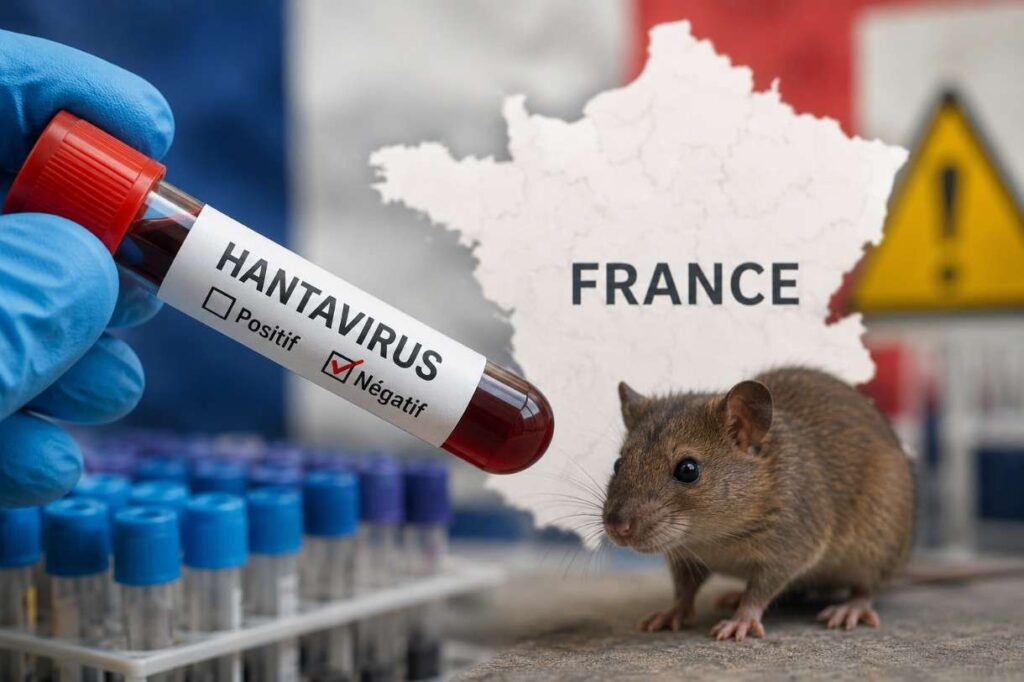
After days of growing nervousness, France’s health authorities are now striking a noticeably calmer tone. All contact persons of a recently reported hantavirus case in France have tested negative. There are currently no indications of further infection. For the authorities this is a decisive signal – and for many citizens probably an audible sigh of relief.
Because as soon as the word “virus” is mentioned anywhere, public attention now switches on like a smoke detector in constant operation. The experiences of recent years run deep. What used to remain a minor item now gains international reach within hours. That happened this time as well.
Experts make a clear distinction between hantaviruses and classic respiratory viruses such as coronavirus or influenza. Rapid human-to-human spread is considered extremely unusual for the variants known in Europe. Transmission mainly occurs via certain rodents. People usually become infected when they inhale virus-containing particles from dried urine, saliva, or feces. Poorly ventilated spaces—old barns, cellars, garden sheds, or abandoned storage areas—are considered particularly at risk. It is often there that the risk lurks unnoticed.
In Europe, hantaviruses primarily cause kidney diseases, the course of which can vary greatly. Some affected people notice little more than flu-like symptoms, others end up in hospital. In North and South America, by contrast, more aggressive virus variants exist that can cause severe lung disease. These images often shape public perception—even though they are only partly comparable with the European situation.
That all contact persons in France tested negative therefore significantly dampens fears of a larger development. Nevertheless, health surveillance remains active. Authorities now react faster, more structurally and much more transparently than a few years ago. Contact tracing, laboratory analyses and public communication now mesh almost automatically. One could say: the pandemic era has left authorities with a permanently sharpened radar.
At the same time, the current case draws attention to a reality that is often underestimated. Numerous so-called zoonoses—diseases transmitted between animals and humans—have existed in Europe for decades. Most run below the level of public awareness. Only when an unusual case appears do they suddenly move into the spotlight. Just like that, headlines and social networks start to heat up.
France’s authorities therefore rely primarily on simple precautionary measures. Anyone cleaning long-closed rooms should first ventilate thoroughly and avoid dry dusting. Damp cleaning significantly reduces the risk. Sounds banal—but often has more effect than any hectic panic reaction.
So far there is no evidence of a broader health threat in France. The situation remains under observation, but without alarm. That may be the most important message of this case: vigilance yes – collective hysteria no.