
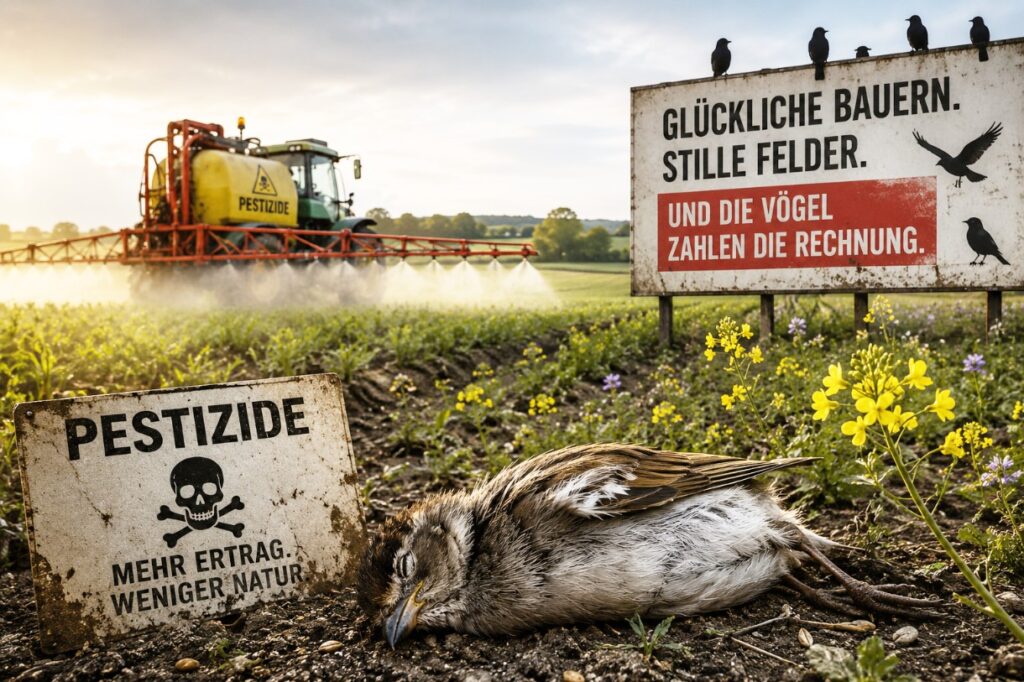
Twenty million birds. Every year. Just like that, they disappear.
We need to ponder this number for a moment. Twenty million feathered voices fall silent. Twenty million small signs of life no longer run across the fields, no longer chirp in the hedgerows, and no longer announce the spring. And while nature becomes increasingly quiet, in some political and agricultural circles, only one sound can be heard: the satisfied buzzing of pesticide sprayers.
Perhaps the simple formula still seems to apply: spraying more chemicals on the fields brings bigger harvests and more efficiency, thereby creating happy farmers. However, the fact that the entire ecosystem is destroyed in the process seems to be just an unfortunate side effect for many people. It’s as if the lark in the field has simply forgotten how to adapt to economic needs.
Statistics from bird protection organizations are a warning signal. Especially small songbirds are disappearing. Swallows, sparrows, tits – these are species that for generations have been a natural part of children’s childhoods. Today, when walking through the countryside, the change is immediately noticeable. Where once bird songs were the background music of midsummer days, now in many places it is almost eerily quiet.
Of course, the cause is already well known. No one guesses anymore. Intensive agriculture using chemicals is driving the insects that birds depend on to extinction. Hedge rows are disappearing, field edges are being removed, and small refuges are being leveled. The landscape is optimized for industrial production – polished, refined, and refined again. But nature is different from a factory. It needs diversity, chaos, and life.
However, instead of accepting the consequences, discussions about loosening environmental regulations are more lively. After all, tractors must not be slowed down by unnecessary considerations. The skylark in the fields must be economically profitable. And the swallow? Perhaps in the future, it will simply have to submit a business plan.
But the real scandal is not simply species extinction itself. It lies in our astonishing ability to ignore warning signs. For decades, birds have been regarded as indicators of natural conditions. A sharp decline in their populations indicates a bigger problem. They are like canaries in our environmental mine.
Yet we act as if the warnings are just annoying background noise.
What makes this situation feel particularly bitter is that successful nature conservation projects show that change is possible. For example, the white-fronted goose has impressively recovered in many areas. Where protective measures were rigorously enforced, life has returned. Nature responds astonishingly quickly when we allow it.
But this is exactly where our era becomes ironic. We know what is effective. We know the causes. We know the solutions.
Nevertheless, we continue.
Perhaps because pesticides guarantee short-term profits. Perhaps because election cycles are shorter than ecological processes. Perhaps because the disappeared sparrows have no lobby.
Sooner or later, the bill will be presented. Not to the birds. They will have already disappeared.
To us.
And we will realize that biodiversity cannot simply be reordered like a combine harvester attachment.
Commentary: C. Hatty