
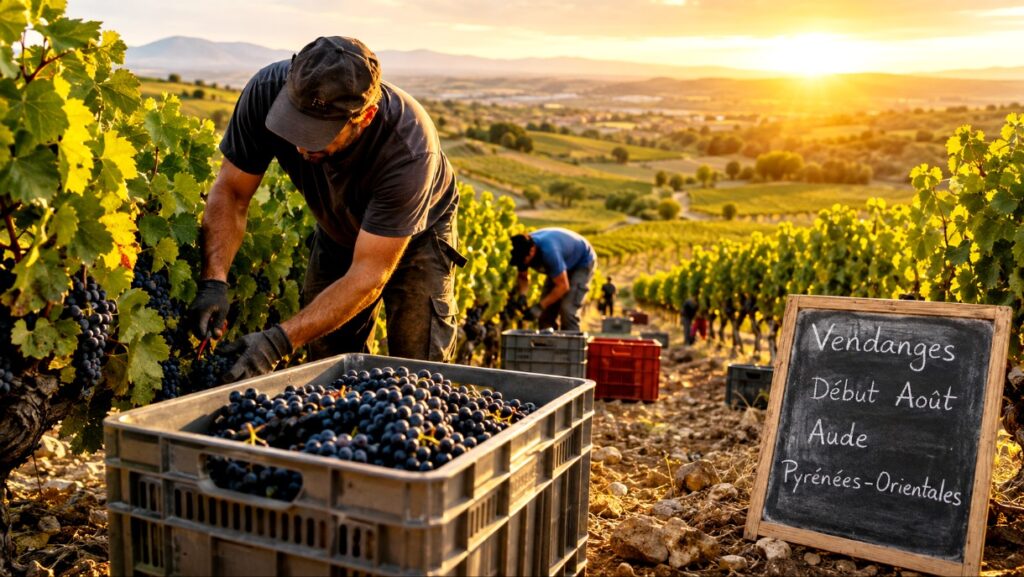
The pruning shears are being used unusually early this year. As early as the beginning of August, numerous winegrowers in the departments of Aude and Pyrénées-Orientales are starting the grape harvest – a time that would have been considered exceptional just a few decades ago. Today, the early start of the harvest is increasingly becoming the new normal. Persistent high temperatures and a lack of rainfall are responsible, significantly accelerating the ripening process of the grapes.
“It becomes more complicated year after year,” is the assessment of many winegrowers. In fact, there is hardly any time left for decisions. Within a few days, the grapes reach their optimal degree of ripeness. Those who wait too long risk excessive sugar levels, declining acidity and thus a significant change in the wine’s eventual style. There is often only a narrow window between perfect ripeness and loss of quality.
Viticulture has followed the seasons for centuries. But the familiar rhythm is increasingly falling out of sync. While the grape harvest in France’s Mediterranean regions often used to begin at the end of August or even in September, the calendar has been moving forward step by step for years. Particularly early grape varieties are now arriving at the winery as early as the beginning of August.
For businesses, this development means far more than an earlier harvest. Harvest workers must be organized at short notice, machinery prepared and winery capacity made available significantly earlier. At the same time, all the work is concentrated into a much shorter period. This requires precise planning and great flexibility. Since daytime temperatures often rise well above 30 degrees Celsius, harvesting in many places begins in the early morning hours or even in the middle of the night. This makes the physically demanding work at least somewhat more bearable.
Climate change is noticeably transforming viticulture. Higher average temperatures do promote rapid ripening, but at the same time place the vines under considerable drought stress. In addition, heatwaves and prolonged periods of drought are occurring ever more frequently. Particularly in southern France, concern is growing that extreme weather conditions will become a permanent part of everyday life for winegrowers.
The industry has long been responding to these changes. Many businesses are testing more drought-resistant grape varieties or adapting how they manage their vineyards. Vegetated vine rows help retain moisture in the soil for longer. Other winegrowers are changing their pruning methods or ensuring a denser leaf canopy so that the grapes remain better protected from intense sunlight. In some cases, higher-altitude or cooler sites are even coming into focus as a way of avoiding rising temperatures.
Despite all the challenges, cautious optimism prevails in many places. The persistent drought reduces infestation by fungal diseases, leaving many grapes looking healthy. However, the right time for harvesting remains crucial. Only those who hit the narrow window exactly lay the foundation for balanced wines with character.
The development in Aude and the Pyrénées-Orientales impressively shows how profoundly viticulture is changing. What was once considered extraordinary has now become almost routine. The grape harvest begins earlier and earlier – and every summer demands a little more adaptability, experience and sensitivity from winegrowers.
Author: Andreas M. B.
C’est du jamais vu de mémoire de vigneron : sous l’effet des chaleurs record, le raisin a mûri à toute vitesse. Dans les vignobles, il faut sortir les sécateurs en urgence. Reportage dans l’Aude et les Pyrénées-Orientales.C’est du jamais vu de mémoire de vigneron : sous l’effet des chaleurs record, le raisin a mûri à toute vitesse. Dans les vignobles, il faut sortir les sécateurs en urgence. Reportage dans l’Aude et les Pyrénées-Orientales.:quality(50)/2026/08/05/6a73419332d9a523240833.jpg)