
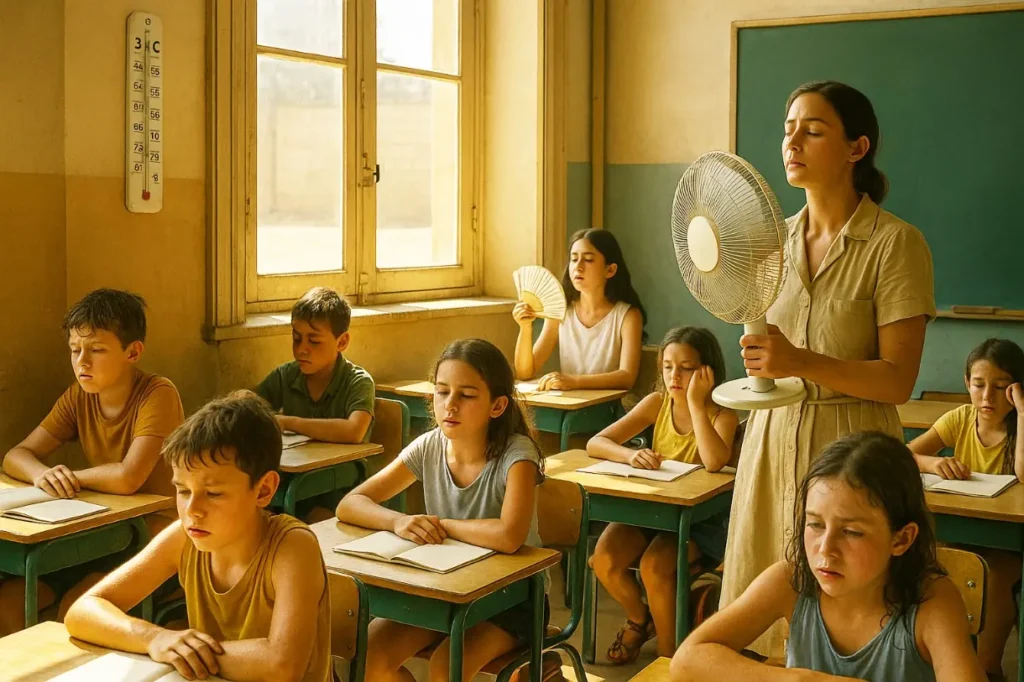
The unusually early heatwave in France is not only putting pressure on the daily lives of millions of people but is also gradually becoming a topic of political conflict. As most of the country experiences temperatures as high as 39 degrees Celsius and several provinces are under severe heat warnings, Prime Minister Sébastien Lecornu’s government is facing pressure over its crisis management.
The Green Party “Ecologists” party leader, Marine Tondelier, expressed particularly strong criticism. She claimed to be “shocked” by the government’s unpreparedness for the current weather situation. She believes that the country responded too slowly to meteorologists’ warnings issued days in advance. The government is now focusing on future heatwaves, while people are already dealing with the consequences of the current extreme heat.
Controversy over the government’s timing of response
The focus of this criticism is an interdepartmental crisis meeting, through which the government hopes to develop a comprehensive action plan covering the entire summer. The plan will address issues such as water supply, health protection, forest fire prevention, and the resilience of public infrastructure.
The opposition considers this plan too one-sided. Critics point out that although long-term planning is necessary, current protective measures have not received enough attention. Especially schools, outdoor workers, the elderly, and people with health problems are now facing serious risks.
This political debate reveals a fundamental contradiction: the government must develop long-term adjustment strategies, while citizens expect concrete and immediate measures in times of crisis.
Demand for “climate holidays”
Marine Tondelier is using the current heatwave to bring a long-discussed proposal back onto the political agenda. She suggests introducing so-called “climate holidays.” Drawing on regulations from other European countries, employees could receive up to five additional days of paid leave per year during extreme weather events.
The Green Party believes that as extreme weather becomes more frequent, traditional working models are gradually reaching their limits. Especially physical laborers or employees whose buildings lack sufficient cooling facilities are heavily affected by high temperatures.
Supporters see this as a necessary step to adapt to the consequences of climate change, while critics warn that it would increase the burden on businesses and the labor market. Therefore, this discussion may far exceed the impact of the current heatwave.
Growing Doubts About Climate Adaptability
Political accusations accompany a broader discussion about France’s ability to adapt to climate change. Scientists and environmental organizations have pointed out for years that many public facilities are still not adequately prepared for extreme heat.
Especially schools, many of which lack sufficient insulation or cooling systems. Many residences in densely built urban areas become heat accumulators during high temperatures. Additionally, insufficient urban greening and lack of shaded public spaces have also been identified as shortcomings.
Experts emphasize that climate adaptation is not just an ecological issue. It increasingly involves public health, social equity, and national economic competitiveness. The long-term costs of inadequate preparation may far exceed preventive investments.
Government Emphasizes Existing Emergency Mechanisms
The government firmly rejects the accusations. A representative from the Ministry of Health stresses that France has accumulated extensive experience in responding to heatwaves. Emergency plans have been activated, hospitals and care institutions are under special surveillance, and the public regularly receives information on protective measures.
The government believes that the existing structures show that lessons from past crises have been learned, but at the same time acknowledge that the increasing frequency of extreme weather events brings new challenges.
The current heatwave is seen as another sign indicating that unusually high temperatures in Europe may become the norm. Political pressure is increasing accordingly, requiring not only responses to sudden crises but also long-term adaptation of cities, infrastructure, and working environments to climate change.
More than twenty years have passed since the devastating heatwave in 2003 that caused thousands of deaths in France and several European countries, and the issue of governmental structural resilience has been raised again. The debate between the government and the opposition shows that climate adaptation is no longer simply an environmental issue, but is increasingly becoming a key test of national capacity to act and political credibility.
Author: P. Tiko