
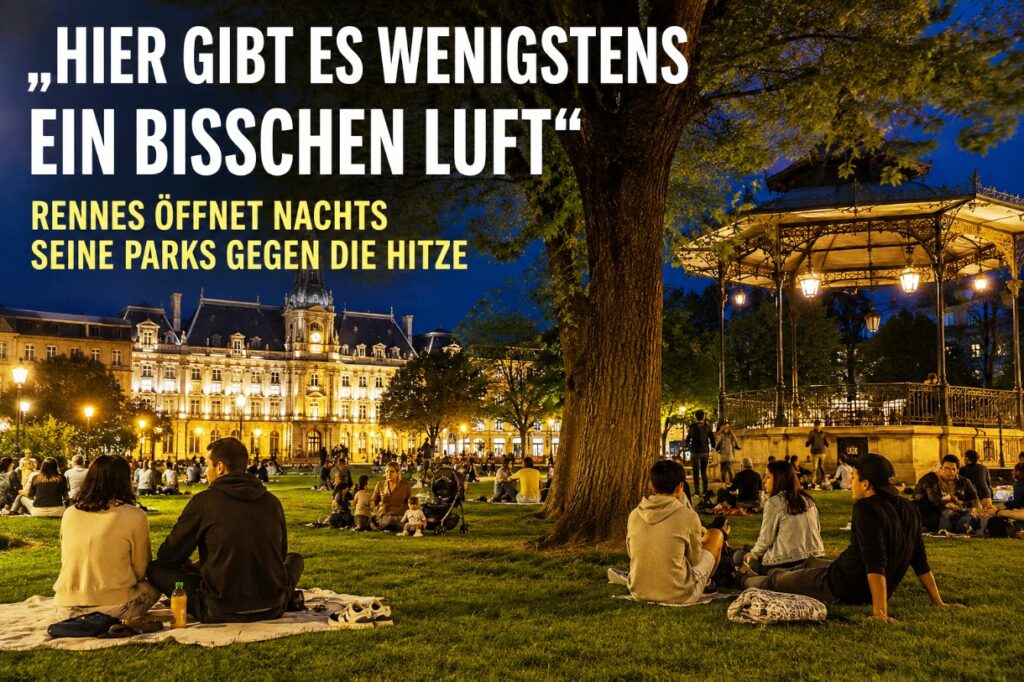
When the sun sets, a second city life currently begins in Rennes.
While the streets flicker in the heat during the day and the facades of the Breton capital absorb heat like hotplates, hundreds of people head to the parks in the evening. Families spread blankets on the lawns, young people sit laughing under old chestnut trees, elderly residents enjoy every cooler breeze. Some stay well past midnight. Not out of romance – but because it is barely bearable in the apartments.
Rennes is experiencing unusually early in the year temperatures that are normally expected only in midsummer. Up to 36 degrees during the day, tropical nights where the temperature hardly drops – even for many French people that feels unsettling. Especially in Brittany. There, heavy sweating was previously mostly seen as a holiday problem of the south.
Now the city is responding with a measure that sounds simple but tells a lot about the new reality: parks and public gardens remain open at night.
The Parc du Thabor is particularly popular, normally closed in the evening. Now, people sit on benches or directly on the grass until late at night. “That’s royal,” says a visitor about the opened green spaces. Others put it more plainly: “At least there is some air here.”
That is exactly what it’s about.
Many modern cities store heat like a sponge stores water. Asphalt, concrete, and densely built streets only release the heat hours later. Those living upstairs or under the roof know the feeling: the home feels like an oven with a half-open door at night. Sleeping? Forget about it.
Especially older people, children, pregnant women, and singles quickly reach their physical limits at such temperatures. Authorities therefore no longer see keeping the parks open at night as a fun summer idea, but as part of health protection.
Rennes is not alone with this problem. In many French cities, climate change is now altering everyday life. Public drinking water taps, longer opening hours for swimming pools, mist installations on squares, or new shading concepts are already standard equipment in many municipalities for combating heatwaves. That sounds technical – but has direct consequences for people’s daily lives.
And suddenly parks no longer seem to be just beautiful green spaces between blocks of houses, but vital shelters.
The city is therefore expanding its network of so-called “fresh islands.” These are places where trees, bodies of water, and plants noticeably lower the ambient temperature. Anyone walking through Rennes on warm evenings often notices the difference after just a few meters. Between the heated street canyons, a shady park feels almost like a different climate zone.
A few years ago, almost no one would have believed that people would seek shelter from the heat at night in Breton parks at the end of May. Today, that image has suddenly become part of daily life.
And honestly: that frightens many French people more than any weather app.
By C. Hatty