
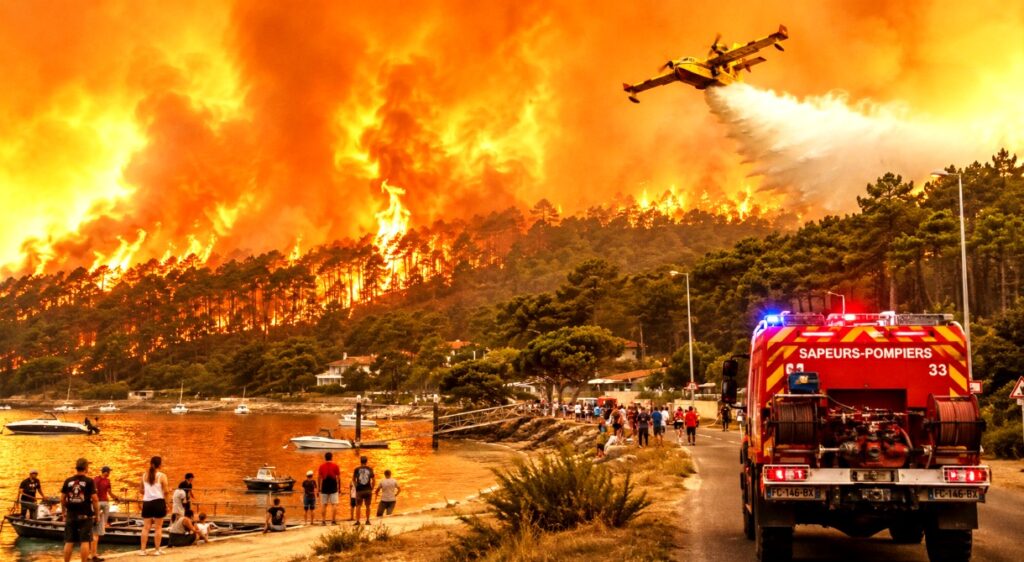
France is experiencing a 2026 wildfire season that is already exceeding all previous dimensions. Since the beginning of the year, fires have destroyed nearly 98,000 hectares of forest, scrubland and other vegetation areas. Interior Minister Laurent Nuñez spoke of a historic record – and the actual peak of the fire season is still ahead. The figures underline how dramatically the situation has developed and the challenges facing the country in the coming weeks.
The burned area corresponds to around 980 square kilometres. By comparison, it exceeds the size of Berlin’s urban area. By the end of July, the previous negative record from the extreme wildfire year of 2022 had already been surpassed. For firefighters, authorities and the public, this is an alarming signal.
The situation remains particularly tense in southwestern France. Around the Bassin d’Arcachon and in the extensive pine forests of the Gironde and Landes departments, thousands of emergency personnel are battling several major fires simultaneously. Persistent drought, exceptionally high temperatures and strong winds repeatedly fuel the flames and make firefighting efforts considerably more difficult. In some cases, the fires are spreading at a speed that pushes even experienced responders to their limits.
The impact on the population is considerable. Tens of thousands of people have had to leave their homes, holiday apartments and campsites. The situation was particularly striking on the Cap Ferret peninsula. There, road evacuations were at times no longer sufficient. Numerous people were brought to safety by boat across the Bassin d’Arcachon – scenes more reminiscent of natural disasters overseas than of a European summer.
France has now mobilised nearly all available forces. Fire services, civil protection and the military are working hand in hand to protect people, carry out evacuations and secure threatened towns. European solidarity also plays an important role. Through the European Union Civil Protection Mechanism, France is receiving additional support, including firefighting aircraft and helicopters from other member states.
The national aerial fleet is in operation almost without interruption. Canadair water bombers, Dash aircraft and helicopters are continuously dropping water and fire retardant on the fire fronts. Nevertheless, it is becoming increasingly clear that even a well-developed emergency response system reaches its limits when several major fires break out at the same time. Available reserves are barely sufficient to fight all fire sites equally effectively.
The term “wildfire” is now often too narrow. The flames are no longer destroying forests alone. Heathland, agricultural land, vineyards and wetlands are also catching fire. In addition, homes, businesses and tourist facilities have been destroyed. Roads, power lines and other parts of the infrastructure have also suffered severe damage. Entire landscapes are transformed within just a few hours.
The consequences are not limited to the immediate fire zones. Dense clouds of smoke and fine particulate matter are carried by the wind across large parts of France, sometimes reaching regions hundreds of kilometres away from the actual fires. Older people, children, pregnant women, and people with heart or respiratory illnesses are particularly affected by deteriorating air quality. For many, wildfire smoke represents an additional health burden.
The main causes are considered to be the exceptionally long dry period and several intense heatwaves. In many places, soils and vegetation have dried out so severely that even the smallest ignition sources are enough to start a fire. Human error often plays a role – such as carelessly discarded cigarettes, sparks from machinery or barbecue fires that have not been fully extinguished. In some cases, authorities also suspect deliberate arson. However, the decisive factor in the scale of the disaster remains the interaction of extreme drought, heat and wind, which can turn small fires into uncontrollable firestorms in a very short time.
The current record is therefore only an interim assessment. France still faces several weeks of traditionally high temperatures and dry vegetation. Even thunderstorms do not necessarily bring relief. If only a few drops of rain fall while lightning strikes at the same time, the risk of new fires may actually increase further.
It is becoming increasingly clear that major fires in France are no longer exceptional phenomena confined to individual extreme years. The fire season starts earlier, lasts longer and affects regions that were previously barely impacted. What once primarily characterised the Mediterranean region now also threatens the southwest, the interior of the country and increasingly northern parts of France. The figure of nearly 98,000 hectares burned therefore represents not only a historic record, but also a profound change in the country’s climatic and ecological reality.
By C. Hatty