
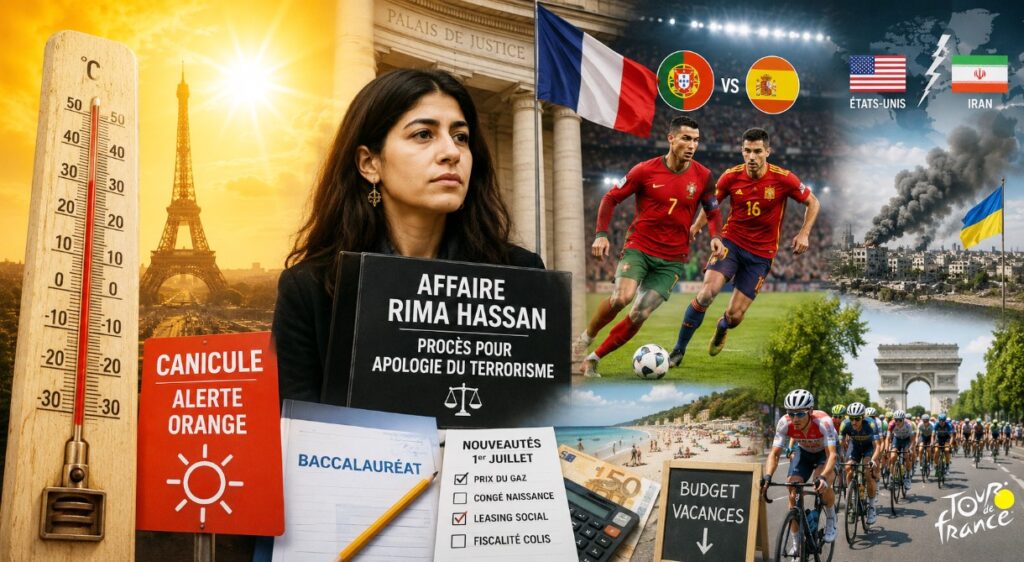
France starts the new week with a news agenda marked by an extraordinary range. Extreme weather events, a politically charged trial, international crises and major sporting events dominate the headlines. While a renewed heatwave presents the country with significant challenges, the upcoming trial of Member of the European Parliament Rima Hassan is fuelling intense discussions about freedom of expression and the criminal limits of political statements. At the same time, the Football World Cup and the Tour de France are captivating millions.
Renewed heatwave heightens climate concerns
Scarcely had France endured the exceptional heatwave at the end of June when a new phase of extreme temperatures was already announced. Meteorologists expect large parts of the country to be hit again by an intense period of heat. The south and central regions are likely to be particularly affected.
Authorities are warning of significant health risks, especially for the elderly, children and those with chronic illnesses. At the same time, pressure on water supplies is increasing. Water use restrictions are already in effect in numerous departments, while farmers fear for their harvests. The risk of wildfires also grows with each dry day.
Weather services also find themselves having to combat misinformation on social networks. Forecasts of temperatures up to 45 degrees Celsius for wide areas of France are circulating again. According to current knowledge, such values are not expected across the board. Authorities therefore urge people to rely only on official weather warnings.
The recurring extreme weather events make it clear once more that climate change is no longer an abstract future issue. France is increasingly investing in adaptation measures, but many municipalities are reaching their organizational and financial limits in the face of the growing frequency of extreme weather events.
The Rima Hassan case preoccupies politics and the judiciary
Hardly any political topic is currently debated more intensively than the upcoming trial of Member of the European Parliament Rima Hassan. Before the Paris criminal court she must answer charges of glorifying terrorist acts.
The case gained additional attention through an extensive interview in which Hassan said she felt “betrayed” by her own country. That remark provoked controversial reactions across party lines and intensified an already heated debate.
The trial touches on fundamental questions of the democratic rule of law. On the one hand, freedom of expression is an indispensable foundation of democratic societies. On the other hand, it has limits when statements may, in the view of the judiciary, meet the elements of criminal offenses.
Regardless of the outcome, the case is likely to have political ramifications far beyond the courtroom. It concerns France’s handling of the Middle East conflict as much as societal polarization and the role of social media in political debates.
Football World Cup reaches decisive phase
Sporting attention is also fixed on a high point. The 2026 Football World Cup has entered its decisive phase with the round of 16 matches.
Particular attention is paid to the clash between Portugal and Spain, considered one of the most attractive matches of the knockout round. Both teams have technically outstanding squads and are traditionally among Europe’s top sides.
In France, however, interest focuses primarily on the national team. After successfully reaching the quarter-finals, hopes are growing for another World Cup title. Ahead of the upcoming match against Morocco, experts are particularly analysing the defensive stability of the Équipe Tricolore as well as the team’s offensive punch.
The World Cup thus remains not only a major sporting event but also a significant economic and media factor with enormous international reach.
The Tour de France gains momentum
Parallel to the Football World Cup, the Tour de France is also gaining speed. After the Grand Départ, the first stages and the form of the favorites come into focus.
Young Frenchman Paul Seixas is receiving special attention. The talented young rider is regarded as one of his country’s greatest cycling prospects. Experts see in him the potential to assert himself against established professionals already in this edition.
Although the general classification naturally still has little significance at this early stage, the opening race days already provide indications of the balance of power within the peloton. At the same time, the enormous popularity of the Tour is evident once again, perceived far beyond the sport as a national summer event.
International crises remain dominant
In addition to domestic political topics, the French media are continuing to follow international hotspots closely.
Particular focus is on tensions between the United States and Iran. Any further escalation has the potential to exacerbate an already fragile security situation in the Middle East. Economists are also closely watching the impact on international energy markets. Even small uncertainties can trigger significant price movements in oil and gas.
Likewise, Russia’s war of aggression against Ukraine remains a central topic in foreign policy reporting. Military developments on the front, Western support measures and diplomatic initiatives continue to shape the international agenda.
For Europe, both conflicts have significant security and economic implications. They influence energy prices, defence spending and foreign policy decisions alike.
Economic worries shape the daily lives of many French people
Alongside major political and international issues, many day-to-day questions are occupying the French population.
For many pupils, the first exams of the Baccalauréat are beginning. As every year, families and teachers are watching the exams and their initial evaluations with great attention.
At the same time, purchasing power remains one of the dominant social issues. Summer holidays are approaching, but rising living costs are forcing many households to significantly cut their travel budgets or forgo holiday plans altogether.
There are also several legal changes that came into force on July 1. These concern, among other things, the gas price, additional entitlements to parental leave after childbirth, the relaunch of social electric car leasing and tax changes for certain goods shipments from abroad.
These measures are intended on the one hand to provide social relief and on the other to steer economic developments. Whether they will have a noticeable effect given the still strained financial situation of many households will only become apparent in the coming months.
France is thus experiencing a week that brings together many of the major contemporary challenges almost exemplarily. Climate change, political polarization, international conflicts and economic uncertainties dominate public debate as much as the unifying power of major sporting events. It is precisely this mix of crisis management and everyday social life that makes clear how closely political, economic and social developments are intertwined today and how strongly they shape the public discourse in the country.